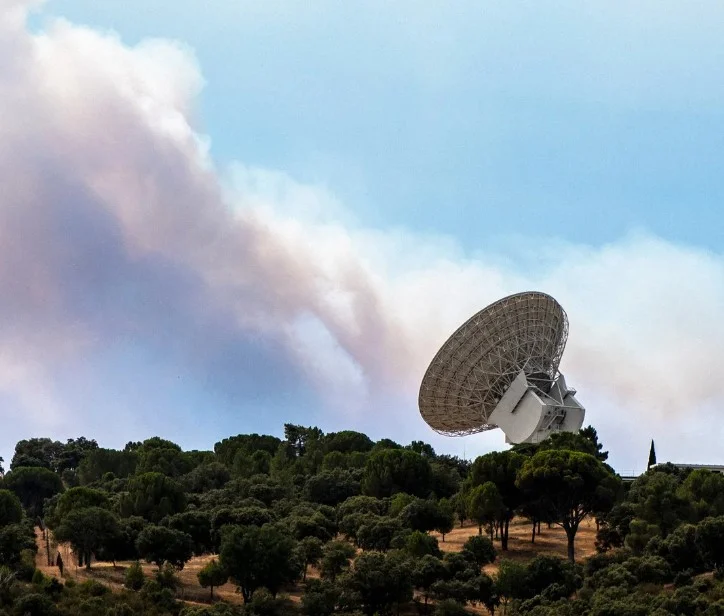
Madrid, Spain – In a stark illustration of how the accelerating climate crisis is impacting even humanity’s most ambitious scientific endeavors, a devastating wildfire tore through central Spain last Friday, encroaching upon one of the three critical ground stations comprising NASA’s Deep Space Network (DSN). The Madrid Deep Space Communications Complex (MDSCC), a pivotal node for communicating with distant spacecraft like Voyager 1, the James Webb Space Telescope, and the recently concluded Artemis lunar mission, found itself directly in the path of the inferno, forcing evacuations and raising serious concerns about the integrity of its sensitive equipment.
The incident underscores a terrifying new reality: terrestrial environmental catastrophes, intensified by global warming, now pose direct threats to our cosmic explorations. As record-breaking heatwaves grip Europe, igniting massive wildfires from Spain to France, the planet’s escalating climate challenges are literally hitting home for our ventures into the solar system and beyond.
Main Facts
On Friday, a rapidly spreading wildfire in the vicinity of Robledo de Chavela, a municipality west of Madrid, reached the perimeter of the Madrid Deep Space Communications Complex (MDSCC). This facility is one of three globally vital ground stations that form NASA’s Deep Space Network, essential for relaying commands to and receiving data from the agency’s deep space missions. Dramatic images captured by photographers depicted the colossal parabolic antennas, designed to listen to the faint whispers of distant probes, shrouded in thick smoke and surrounded by advancing flames.
Spanish authorities declared a state of emergency across affected regions, as several wildfires spun out of control near the capital, prompting the evacuation of over 60,000 residents from their homes. The proximity of the fire to the MDSCC immediately triggered emergency protocols, leading to the successful evacuation of all NASA personnel from the site. While the immediate danger to human life was averted, the long-term impact on the observatory’s highly specialized and irreplaceable equipment remains uncertain.
NASA has confirmed that mission operations support has been seamlessly transferred to the Goldstone Deep Space Communications Complex in California, leveraging the DSN’s inherent redundancy to maintain uninterrupted communication with its fleet of spacecraft. However, the incident serves as a potent reminder of the fragility of even the most robust systems in the face of extreme climate events, highlighting the intricate connections between Earth’s environmental health and our aspirations in space. The threat extends beyond Spain, with France also battling "self-sustaining" and "extremely difficult to control" wildfires, a consequence of Europe’s record-setting summer temperatures driven by persistent heat domes and the overarching effects of climate change.
Chronology of the Crisis
The unfolding crisis began to escalate rapidly on Friday afternoon as the wildfire, fueled by tinder-dry vegetation and strong winds, advanced towards the Madrid Deep Space Communications Complex. The facility, situated in the forested hills west of Madrid, suddenly found itself on the front lines of a climate-induced disaster.
Friday:
- Afternoon: Wildfires, already burning intensely in the Sierra de Guadarrama region, expand aggressively, pushing towards the Robledo de Chavela area.
- Late Afternoon/Early Evening: Flames and heavy smoke are reported at the perimeter of the MDSCC. The immediate threat prompts NASA officials, in coordination with Spanish emergency services, to initiate an urgent evacuation of all personnel from the complex.
- Evening: The fire is observed to have passed through sections of the observatory complex. While the full extent of damage is unknown, the close proximity and direct passage of the fire raise significant concerns for the sensitive radiotelescopes and control infrastructure. NASA confirms the successful evacuation of all staff and the activation of contingency plans, rerouting mission communications to the Goldstone complex in California.
Saturday:
- Morning: With fire conditions still precarious but potentially easing in some areas, NASA indicates that a preliminary assessment of the site may be possible, contingent on safety clearances from local authorities. This crucial initial evaluation aims to determine the immediate impact of the flames on the complex’s structures and equipment.
Weekend Outlook (Brief Reprieve):
- Forecasters predict a temporary drop in temperatures across the Mediterranean region during the weekend. This cooler weather offers a brief window of opportunity for firefighters in Spain and France to gain better control over the raging infernos, potentially preventing further spread and allowing for more thorough damage assessments at sites like the MDSCC.
Monday Onwards (Looming Threat):
- The relief is expected to be short-lived. Meteorological models indicate a resurgence of extreme heat starting Monday, with temperatures projected to climb as much as 10 degrees Celsius (18 degrees Fahrenheit) above seasonal norms throughout the week. This renewed heatwave carries the grave risk of reigniting suppressed fires, exacerbating existing ones, or sparking entirely new conflagrations, posing a persistent threat to communities and critical infrastructure alike.
The swift progression of events from a regional fire to a global concern underscores the immediate and far-reaching implications of climate-driven disasters. The rapid response and activation of contingency measures by NASA highlight the inherent vulnerabilities of even the most advanced technological systems when confronted with nature’s intensified fury.
Supporting Data and Context
The Madrid Deep Space Communications Complex is not merely an observatory; it is one of the three pillars of NASA’s Deep Space Network (DSN), a global constellation of ground stations strategically positioned approximately 120 degrees apart around the Earth. Alongside the Goldstone complex in California, USA, and the Canberra Deep Space Communication Complex in Australia, the MDSCC forms what NASA describes as "the largest and most sensitive scientific telecommunications system in the world." This unique geographical distribution ensures continuous, 24/7 communication with spacecraft as the Earth rotates, a critical factor for missions that traverse vast interplanetary and interstellar distances.
The DSN acts as the "ears and voice" of humanity in space. It is responsible for transmitting commands from Earth to spacecraft, receiving invaluable telemetry data on their health and status, and downloading the immense volumes of scientific data collected by instruments far from home. The precision and sensitivity required for these tasks are immense, as signals from billions of miles away arrive as incredibly faint radio waves. Each complex features multiple massive parabolic antennas, some reaching up to 70 meters (230 feet) in diameter, equipped with highly sensitive receivers and powerful transmitters.
The missions that rely on the MDSCC are at the forefront of human exploration and scientific discovery:
- Voyager 1: Launched in 1977, Voyager 1 is humanity’s farthest-flung emissary, currently traveling through interstellar space more than 24 billion kilometers (15 billion miles) from Earth. It continues to send back vital data about the heliosphere’s boundary and the interstellar medium, providing unprecedented insights into our cosmic neighborhood. Maintaining contact with Voyager 1, whose signals are incredibly weak due to the immense distance, is a testament to the DSN’s capabilities and is absolutely crucial for its ongoing mission.
- James Webb Space Telescope (JWST): Orbiting nearly 1.5 million kilometers (1 million miles) from Earth, the JWST is revolutionizing astrophysics with its unparalleled infrared vision, peering back to the earliest moments of the universe. It generates prodigious amounts of scientific data – stunning images and spectroscopic measurements of distant galaxies, exoplanets, and star formation regions – all of which must be precisely downloaded via the DSN. Any disruption to this data flow could impact the pace and efficiency of its groundbreaking scientific output.
- Artemis Missions: NASA’s ambitious program to return humans to the Moon and establish a sustainable lunar presence relies heavily on the DSN for communication with its Orion spacecraft and other lunar assets. The recently completed Artemis I mission, an uncrewed test flight around the Moon, depended on the DSN for critical command and control, trajectory tracking, and data transmission. Future crewed Artemis missions will similarly require robust and uninterrupted communication links for astronaut safety and mission success.
- Other Deep Space Probes: Beyond these flagship missions, the DSN supports a vast array of other robotic probes exploring Mars (Perseverance, Curiosity, InSight), Jupiter (Juno), Saturn (Cassini, until its end), asteroids, and comets. It also contributes significantly to radio astronomy observations, using its powerful antennas to study celestial radio sources. The network is truly the backbone of modern deep space exploration.
The wildfires in Spain are not isolated incidents but part of a broader, alarming trend across Europe and the globe. This summer, the continent has endured repeated "heat domes" – high-pressure atmospheric systems that trap hot air, leading to prolonged periods of extreme temperatures. These conditions desiccate vegetation, turning forests and grasslands into highly combustible fuel. When combined with an ignition source, whether natural (lightning) or human-caused, these dry landscapes are ripe for rapid and uncontrollable wildfires.
The current European heatwave has seen temperatures soar to unprecedented levels, breaking historical records in multiple countries. Spain and France, particularly, have been hit hard. In France, the Gironde region, known for its extensive pine forests, has seen thousands of hectares burn, forcing the evacuation of tens of thousands of residents. Similar devastating fire seasons have plagued other parts of the world recently, including the boreal forests of Ontario, Canada, and the Pacific Northwest region of the United States, all linked to warmer, drier conditions exacerbated by climate change. Scientists universally agree that climate change is increasing the frequency, intensity, and duration of such extreme weather events, making once-rare phenomena the "new normal."
The predicted return of temperatures up to 10 degrees Celsius above average next week highlights the ongoing vulnerability and the immense challenge faced by emergency services and communities in adapting to this rapidly changing climate.
Official Responses and Contingency
The response to the unfolding crisis has involved swift action from both national and international agencies, demonstrating the gravity of the situation and the critical importance of the assets threatened.
Spanish Authorities:
The Spanish government reacted decisively to the widespread wildfire threat, particularly around Madrid. A state of emergency was declared in several affected regions, mobilizing extensive firefighting resources, including ground crews, aerial firefighting planes, and helicopters. Evacuation orders were issued for over 60,000 people, prioritizing public safety and preventing casualties in the face of rapidly advancing flames. The focus has been on containment and protecting human lives and critical infrastructure, including the MDSCC. The sheer scale of the fires near Madrid, unprecedented in recent memory for their proximity to the capital and a major scientific installation, underscores the escalating nature of climate-related disasters in the region.
NASA’s Immediate Response:
Upon learning of the direct threat to the Madrid Deep Space Communications Complex, NASA initiated its emergency protocols with commendable efficiency. A spokesperson for NASA confirmed in an email to WIRED that all personnel at the facility were successfully evacuated, prioritizing human safety above all else. This swift action prevented any casualties among the staff.
Crucially, NASA activated its robust contingency plans for the Deep Space Network. The DSN is designed with inherent redundancy, featuring three globally distributed complexes to ensure continuous coverage and the ability to reroute operations in case one site is compromised. "NASA seamlessly transferred support for mission operations to the Goldstone Deep Space Communications Complex in California, ensuring continuity of service and uninterrupted support for spacecraft communications," the spokesperson stated. This immediate shift means that while the Madrid site might be physically damaged, the critical command, telemetry, and data relay functions for missions like Voyager 1 and the James Webb Space Telescope were not interrupted, demonstrating the DSN’s resilience.
Regarding the damage to the MDSCC itself, NASA’s spokesperson conveyed uncertainty. "While the fire has now passed through the observatory complex, it remains unclear what impact the flames may have had on the sensitive equipment within." This uncertainty is significant given the precision engineering and delicate nature of the radiotelescopes and their associated electronics. "Any potential damage will be assessed once it is safe to do so," the spokesperson added, indicating that a site assessment could potentially occur as early as Saturday, conditions permitting. This cautious approach emphasizes the need to ensure the safety of assessment teams while acknowledging the urgency of understanding the situation.
French Government’s Perspective:
Across the border, France is battling its own massive wildfires, providing a stark parallel to the Spanish crisis. Laurent Nunez, the French Interior Minister, described the severity of the fires in France with a sense of urgency: "In the middle of the afternoon, we learned that, after the wind changed, the fire had turned into a large and self-sustaining fire, which is extremely difficult to bring under control." His statement highlights the challenge faced by firefighters and emergency services across Europe, where the fires are not merely spreading but generating their own extreme weather phenomena, making conventional containment strategies incredibly difficult. This demonstrates a shared predicament across European nations, all grappling with the intensified impact of climate change.
These official responses underscore a unified front against a common, climate-driven enemy, balancing immediate safety concerns with the long-term operational continuity of critical infrastructure.
Implications
The wildfire incident at the Madrid Deep Space Communications Complex carries significant implications, both immediate and long-term, for scientific exploration, infrastructure resilience, and the global understanding of climate change’s reach.
Immediate Operational Impact (Mitigated but Present):
While NASA’s Deep Space Network demonstrated its designed resilience by seamlessly transferring mission support to the Goldstone complex, the incident highlights the vulnerability of even highly redundant global systems. The DSN’s effectiveness relies on the collective strength of its three sites. A prolonged incapacitation of the Madrid facility would place increased strain on Goldstone and Canberra, potentially limiting their capacity for future missions, maintenance, or simultaneous support of multiple demanding spacecraft operations. While not a catastrophic failure, it represents a loss of operational flexibility and a reduced margin of error for humanity’s most distant scientific probes. The financial implications of repairing or replacing highly specialized radio telescopes and associated control systems, should significant damage be confirmed, would also be substantial.
Vulnerability of Critical Infrastructure to Climate Change:
This event serves as a chilling example of how climate change is directly threatening critical infrastructure globally. The MDSCC is a sophisticated, high-tech installation, yet it proved vulnerable to a climate-driven wildfire. This raises pressing questions about the future siting, design, and protective measures for other essential facilities, ranging from data centers and power grids to scientific observatories and transportation hubs, especially in regions increasingly prone to extreme weather events like wildfires, floods, or severe storms. As climate impacts intensify, governments and organizations must urgently re-evaluate the resilience of their vital assets and invest in adaptive strategies.
The Pervasive Reach of Climate Change:
The fact that a terrestrial wildfire, a direct consequence of climate change-induced heatwaves and drought, could directly threaten humanity’s ability to communicate with spacecraft billions of miles away offers a powerful, almost poetic, metaphor for the pervasive reach of our planet’s environmental crisis. It underscores that climate change is not just an environmental issue confined to specific ecosystems or communities; it is a systemic threat that can disrupt any facet of human endeavor, including our highest scientific aspirations. The initial declaration in the original article, that "climate change is now a problem for the entire solar system," while perhaps hyperbole, captures this sentiment – our ability to understand the solar system is indeed being impacted by changes on our own planet.
Escalating Global Wildfire Crisis:
The events in Spain are not isolated. They are part of a worrying global trend of increasingly frequent, intense, and destructive wildfires. From the Arctic to the Amazon, and across North America, Europe, and Australia, fire seasons are lengthening, and fires are becoming harder to control. This has profound ecological, economic, and social consequences, leading to habitat destruction, air pollution, displacement of populations, and immense financial costs for suppression and recovery. The inability of even advanced nations like Spain and France to quickly contain these fires speaks to their unprecedented scale and ferocity.
The "New Normal" and Future Adaptation:
The predicted return of extreme temperatures after a brief respite signals that these conditions are becoming the "new normal" for many regions. This necessitates a fundamental shift in how societies prepare for and respond to such events. For scientific institutions like NASA, this might mean re-evaluating site-specific climate risks, investing in advanced fire suppression systems, or even considering more resilient, albeit more expensive, infrastructure designs. For governments, it demands more robust climate mitigation policies to curb greenhouse gas emissions and more comprehensive adaptation strategies to protect communities and critical assets from the inevitable impacts of a warming world.
In conclusion, the wildfire incident at the Madrid Deep Space Communications Complex serves as a potent and alarming symbol. It is a stark reminder that as we reach for the stars, the ground beneath our feet is shifting, and the challenges we face on Earth directly influence our capacity to explore the cosmos. The resilience shown by NASA’s DSN is commendable, but the underlying vulnerability exposed by this event is a crucial lesson that must be heeded by all.