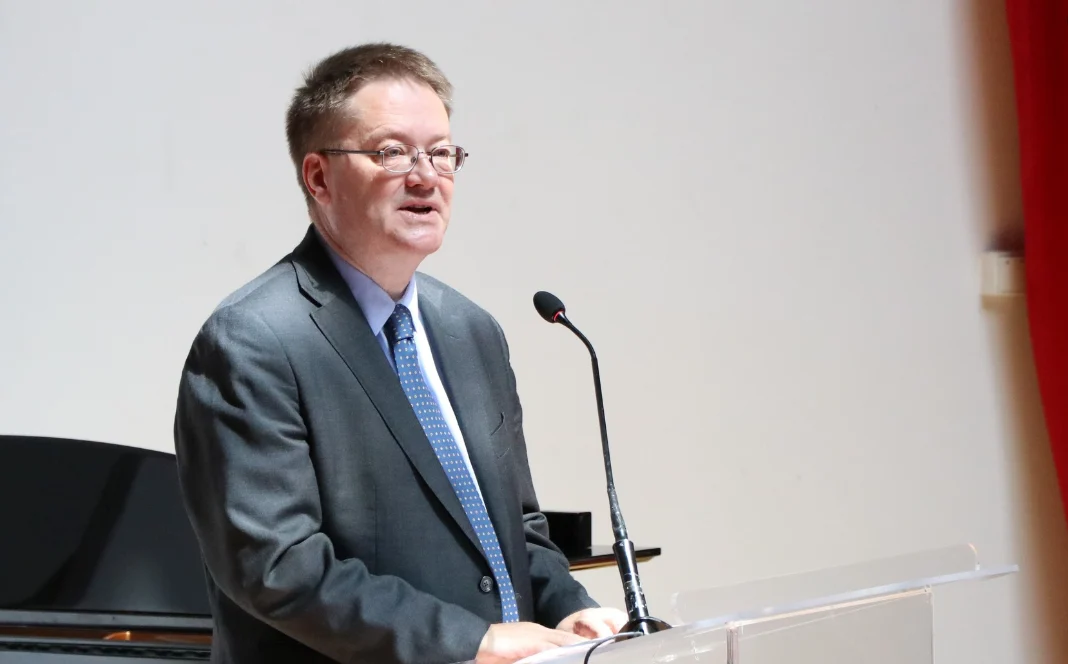
Tirana, Albania – [Date] – In a candid interview with Andrea Danglli on A2CNN’s "Off the Record" program, the British Ambassador to Albania, Nicholas Abbott, addressed a highly scrutinized issue: the permanent "non-grata" designation of former Albanian Prime Minister Sali Berisha by the United Kingdom. Ambassador Abbott firmly stated that the decision is a legal matter, not a political one, and its finality hinges on potential legal challenges within the UK’s judicial system. The ambassador also offered a critical perspective on the current state of Albanian politics, expressing concern over a perceived fixation on the past and a disconnect from contemporary global challenges.
The Definitive Stance: Legal Framework Governs Berisha’s Non-Grata Status
Ambassador Abbott’s remarks provide the most direct clarification to date regarding the UK’s stance on Sali Berisha’s status. When questioned about the finality of the "non-grata" declaration, the ambassador unequivocally stated, "In the United Kingdom, such a matter is not political; it is a legal issue. Therefore, as far as I am concerned, unless there can be any legal challenge, it will remain as such." This statement signals that the UK government’s decision is rooted in its domestic legal framework, suggesting a thorough process has been undertaken, and any potential reversal would necessitate a judicial intervention rather than a political negotiation.
The designation of individuals as "persona non grata" by governments typically stems from concerns related to national security, public interest, or ineligibility for entry based on various legal grounds. While the specific reasons for Berisha’s designation have not been publicly detailed by the UK authorities, the ambassador’s emphasis on the legal nature of the decision implies that the UK has invoked its sovereign right to control its borders and deny entry to individuals deemed undesirable based on established legal criteria. This approach underscores the UK’s commitment to upholding its laws and regulations independently, irrespective of political pressures or the individual’s standing in their home country.
A Broader Context: Implications for Albanian Political Figures
The interview also touched upon the sensitive topic of potential future reviews for other Albanian political figures. When pressed by journalist Andrea Danglli on whether further reviews were anticipated, Ambassador Abbott expressed a degree of uncertainty. "It is a question that is often asked of me, and I don’t know what answer to give," he admitted. This response, while not definitive, suggests that the UK’s scrutiny of individuals connected to Albanian politics is not necessarily a closed chapter. It implies that any future decisions would likely be based on evolving circumstances and the continuous assessment of individuals’ conduct and adherence to legal and ethical standards relevant to international engagement.
The ambiguity surrounding future designations could serve as a subtle warning to the Albanian political elite. It suggests that the UK maintains a watchful eye on political actors and their activities, particularly concerning issues of corruption, rule of law, and democratic governance. The possibility of further designations, however unspecified, could incentivize a more cautious and principled approach from those in power. It also highlights the UK’s role as a partner in promoting good governance and accountability within Albania, aligning with broader international efforts to combat corruption and strengthen democratic institutions.
A Critical Gaze: The Political Class’s Obsession with the Past
Ambassador Abbott’s most pointed critique was directed at the behavior of the Albanian political class. He articulated his significant concern by stating, "I think my biggest concern would be my feeling that the political class often gets caught up with the past. They believe that politics can be played as it was in the past. The political class itself is very caught up in Albania, and the reality of the world we live in is that the problems that affect us are increasingly beyond what we see with our eyes."
This statement is a powerful indictment of what the ambassador perceives as a stagnation in Albanian political discourse and practice. The emphasis on being "caught up with the past" suggests a tendency to rehash old political battles, ideological divides, and historical grievances, rather than focusing on contemporary challenges and future-oriented solutions. This can manifest in several ways:
- Perpetuation of Old Conflicts: Political parties and leaders may continue to engage in rhetoric and strategies that are rooted in past conflicts, hindering reconciliation and progress.
- Resistance to Modernization: A focus on the past can lead to resistance to necessary reforms and modernization efforts, as political actors may be more comfortable with familiar, albeit outdated, methods of governance.
- Lack of Vision: By dwelling on historical narratives, political leaders may fail to articulate a clear vision for Albania’s future, leaving citizens without a compelling roadmap for development and prosperity.
- Distraction from Real Issues: The constant engagement with historical narratives can serve as a distraction from pressing contemporary issues such as economic development, social inequality, environmental concerns, and the need for robust institutional reform.
The ambassador’s observation that "the reality of the world we live in is that the problems that affect us are increasingly beyond what we see with our eyes" is particularly prescient. In an era of globalization, interconnectedness, and complex challenges like climate change, cyber threats, and transnational crime, a myopic focus on domestic, often historical, issues is insufficient. Effective governance requires an understanding of these broader global dynamics and the ability to formulate strategies that address them.
This critique implies that the Albanian political class may be failing to adapt to the evolving global landscape. It suggests a need for a more forward-thinking, pragmatic, and internationally-aware approach to politics. The ambassador’s statement could be interpreted as a call for Albanian politicians to engage with contemporary issues, embrace innovation, and contribute to finding solutions for shared global challenges.
Supporting Data and Chronology: The Berisha Saga and UK Engagement
While Ambassador Abbott’s interview did not delve into a detailed chronology of the Berisha case, it is crucial to contextualize his remarks within the broader narrative of the UK’s engagement with Albania and its efforts to promote good governance.
The designation of Sali Berisha as "non-grata" by the United States in May 2021, followed by similar measures by the United Kingdom and Canada, marked a significant moment in Albanian politics. These designations were often accompanied by accusations of corruption and undermining democracy. For the UK, such actions are typically the culmination of intelligence gathering and legal assessments concerning individuals whose activities are deemed to be detrimental to its national interests or the principles it upholds.
- May 2021: The U.S. Department of State designates Sali Berisha and his immediate family members as ineligible for entry into the United States, citing allegations of corruption.
- July 2022: The United Kingdom follows suit, announcing its own "non-grata" designation for Sali Berisha, citing similar concerns related to corruption and undermining the rule of law. The specifics of the UK’s evidence are not publicly disclosed, adhering to standard government practice regarding such designations.
- Ongoing Scrutiny: Following these high-profile designations, there has been ongoing speculation and discussion within Albania and among international partners regarding the UK’s and other countries’ potential future actions concerning other political figures.
Ambassador Abbott’s recent statement directly addresses the nature of the UK’s action, reinforcing its legal basis. The lack of a political resolution or negotiation pathway for Berisha’s designation, as suggested by the ambassador, implies that the UK government is not currently open to political dialogue on the matter. This stance aligns with the principle that sanctions and entry bans are sovereign decisions based on legal assessments.
Official Responses and Implications for Albania’s European Path
Ambassador Abbott’s interview is not merely an observation but a reflection of the UK’s active engagement in promoting democratic values and the rule of law in Albania. The UK, as a key international partner, has consistently supported Albania’s aspirations for closer integration with the European Union and NATO. However, this support is often conditional on demonstrable progress in areas such as judicial reform, the fight against corruption, and the strengthening of democratic institutions.
The ambassador’s critique of the Albanian political class’s fixation on the past carries significant implications for Albania’s EU accession process. The European Union places a strong emphasis on forward-looking policies, institutional reforms, and the ability of candidate countries to adopt and implement the acquis communautaire (the body of EU law). A political class that is unable to move beyond historical narratives and address contemporary challenges may struggle to meet the EU’s stringent membership criteria.
Furthermore, the UK’s clear stance on the legal nature of the "non-grata" designation serves as a reminder that international partners hold Albanian political figures accountable for their actions. The perception of corruption and a lack of transparency can significantly hinder foreign investment, damage Albania’s international reputation, and ultimately impede its economic and social development.
The ambassador’s candid remarks can be seen as a diplomatic nudge towards introspection and reform within Albania’s political sphere. By highlighting the disconnect between the realities of the globalized world and the perceived backward-looking nature of Albanian politics, the UK is implicitly urging for a more dynamic, modern, and accountable approach to governance. This, in turn, is crucial for Albania to successfully navigate its path towards greater European integration and achieve its long-term development goals. The message is clear: the future of Albania hinges on its ability to confront present challenges with present-day solutions, rather than dwelling on the ghosts of the past.