
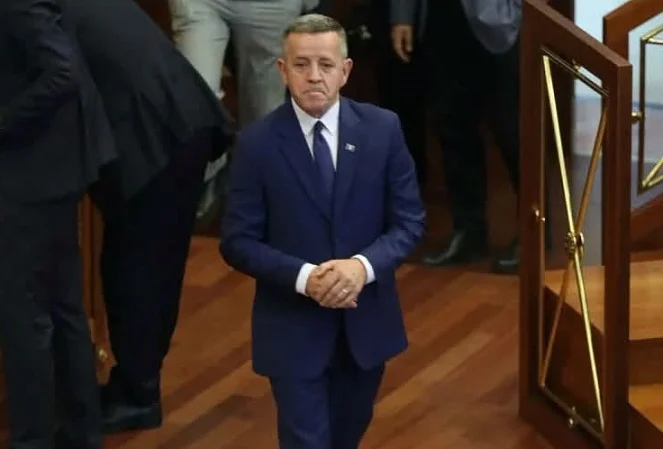
Pristina, Kosovo – October 24, 2026 – As the legal battle for four former leaders of the Kosovo Liberation Army (KLA) enters its critical appeal phase at the Kosovo Specialist Chambers (KSC) in The Hague, a powerful call for national unity and unwavering state responsibility has been issued by Rrustem Mustafa, a prominent Member of Parliament from the Democratic Party of Kosovo (PDK). Following a first-instance conviction that sent shockwaves across the nation, Mustafa’s plea underscores the profound national significance of the ongoing judicial process and the urgent need for a cohesive, multi-faceted strategy to defend figures revered by many as architects of Kosovo’s independence.
The conviction of Hashim Thaçi, Kadri Veseli, Rexhep Selimi, and Jakup Krasniqi, once at the helm of Kosovo’s liberation struggle and later key political figures, has reopened deep wounds and reignited passionate debates about the KLA’s legacy. Mustafa’s intervention comes at a moment when Kosovo grapples with the intricate balance between international justice, national identity, and the historical narrative of its fight for freedom. He insists that the defense of these "comrades-in-arms" necessitates sustained legal, diplomatic, and state engagement, arguing that the nation’s collective dignity and historical truth are on trial alongside the accused.
The Call for Unity Amidst Legal Battles
Rrustem Mustafa, himself a veteran of the KLA and a significant political voice, emphasized the necessity of a unified front, transcending partisan divides. His statement, delivered in the wake of the first-instance verdict, serves as a rallying cry for institutional coordination and a shared national purpose as the appeal process unfolds.
A Plea for Sustained Engagement
Mustafa’s central argument revolves around the concept of "continuous legal, diplomatic, and state engagement." This isn’t merely a symbolic gesture but a demand for concrete, coordinated action from all branches of the Kosovar government and society. He envisions a comprehensive strategy that would deploy all available legal avenues to challenge the first-instance ruling, while simultaneously engaging in robust diplomatic efforts to present Kosovo’s perspective on the historical context of the KLA’s actions. This includes leveraging international legal experts, engaging with foreign governments and international organizations, and ensuring that the narrative of Kosovo’s defensive struggle for self-determination is clearly articulated on the global stage. The appeal phase, he stressed, is not merely a legal technicality but a crucial opportunity to reinforce the historical truth as perceived by the vast majority of Kosovars.
Recalling Moments of National Cohesion
To underscore the feasibility and necessity of such unity, Mustafa pointed to recent events he believes exemplified national cohesion. He cited the parliamentary vote on the Law on Specialized Chambers – a contentious piece of legislation that ultimately paved the way for the KSC’s establishment – as a demonstration of a shared political will, despite initial reservations and fierce debate. Furthermore, he referenced the election of the current President, Vjosa Osmani, and the powerful, unified "KLA!" chants that often accompany significant national moments, particularly those touching upon the liberation war. These instances, according to Mustafa, serve as tangible proof that when the "interest of the homeland" is at stake, "national unity is possible and indispensable." He framed these past moments of consensus as a blueprint for the collaborative spirit now required to navigate the complexities of the KSC appeals. "This is a responsibility that transcends any party, interest, or political calculation," Mustafa declared, calling for "prudence, determination, and institutional coordination" to ensure that "the truth is heard and the rights of our comrades-in-arms are defended with all legal and diplomatic means."
Chronology of Justice: From Conflict to Courtroom
Understanding Mustafa’s call requires a grasp of the intricate and often contentious history leading to the KSC trials. The journey from the armed conflict of the late 1990s to the courtrooms of The Hague has been long, fraught with political sensitivities, and deeply impactful on Kosovo’s nascent statehood.
Genesis of the Kosovo Specialist Chambers
The Kosovo Specialist Chambers and Specialist Prosecutor’s Office (KSC & SPO), often referred to simply as "The Hague" in local parlance, represents a unique and controversial institution. Its establishment was the result of sustained international pressure following allegations of serious crimes committed during and immediately after the 1998-1999 Kosovo War. These allegations first gained significant international traction through a 2010 report by Council of Europe rapporteur Dick Marty, which detailed claims of organ trafficking and other grave offenses, implicating high-ranking KLA officials.
Marty’s report, while fiercely disputed by Kosovo, prompted the European Union Rule of Law Mission (EULEX) to launch its own special investigative task force. The findings of this task force ultimately led to the recommendation for a new, independent court. Given the political sensitivities and potential for witness intimidation within Kosovo, it was decided that this court would operate under Kosovar law but be located in The Hague, Netherlands, staffed by international judges and prosecutors, and funded by the European Union.
The process of establishing the KSC was highly contentious within Kosovo. Many viewed it as an affront to the KLA’s legacy and a selective application of justice, given that Serbian perpetrators of crimes during the war had largely been tried elsewhere. However, under immense international pressure, the Kosovo Assembly eventually ratified the constitutional amendments and the law creating the KSC in August 2015. This was the "Law on Specialized Chambers" that Mustafa referenced, a moment of reluctant but ultimately achieved political unity for the sake of Kosovo’s international standing. Its mandate is specifically to prosecute individuals for alleged crimes against humanity, war crimes, and other crimes under Kosovar law, committed between January 1, 1998, and December 31, 2000.
Indictments and Initial Proceedings
After years of investigations, the KSC began issuing indictments. The most high-profile of these were unsealed in 2020, targeting four of Kosovo’s most prominent political and military figures: Hashim Thaçi, who was President of Kosovo at the time; Kadri Veseli, former Speaker of the Parliament and intelligence chief; Rexhep Selimi, a long-serving MP and former KLA commander; and Jakup Krasniqi, former Speaker of the Parliament and KLA spokesperson.

The indictments accused them of a range of crimes, including persecution, imprisonment, arbitrary detention, other inhumane acts, cruel treatment, torture, and murder. These charges related to alleged offenses against hundreds of victims, including ethnic Serbs, Roma, Ashkali, and Kosovar Albanians deemed to be political opponents. All four men resigned from their positions and were transferred to the detention facilities of the KSC in The Hague in November 2020. Their joint trial commenced in April 2023, lasting for well over a year and involving extensive testimony from witnesses and presentation of evidence by both the prosecution and defense teams.
The First-Instance Verdict and the Road to Appeal
The first-instance verdict, delivered relatively recently (the exact date not specified in the original article, but implied to be prior to Oct 24, 2026), found the four former KLA leaders guilty on multiple counts. While the specific details of the convictions and sentences would have been publicly disclosed by the KSC, the impact in Kosovo was profound. For many, it represented a painful challenge to the narrative of a purely defensive and heroic struggle. For others, particularly victims and international observers, it was seen as a crucial step towards accountability and justice.
The transition to the appeal phase is a standard legal procedure, allowing the defense teams to challenge the findings of the trial chamber based on alleged errors of law or fact. This phase is critical, as it can potentially overturn, modify, or uphold the initial convictions. It is precisely this juncture that Mustafa addresses, recognizing the immense stakes involved and calling for a unified national response to support the defense in this final, decisive legal battle.
Deeper Context: Kosovo’s Struggle with its Past
The KSC trials are not merely legal proceedings; they are deeply intertwined with Kosovo’s national identity, its political landscape, and its relationship with the international community.
The KLA Legacy and National Identity
For the vast majority of Kosovar Albanians, the KLA is revered as the liberation movement that spearheaded the resistance against Serbian oppression and ultimately secured Kosovo’s independence. Its fighters are considered heroes, and the war itself is viewed as a just and necessary struggle for self-determination. This deeply ingrained national narrative makes the allegations and convictions of its former leaders particularly painful and sensitive. Any questioning of the KLA’s conduct is often perceived as an attack on Kosovo’s very foundation and its right to exist as an independent state. This emotional connection makes objective discourse challenging and fuels the calls for national solidarity that Mustafa articulated. The trials force Kosovo to confront the complexities of war and the often-uncomfortable realities that can emerge even from a liberation struggle.
Political Undercurrents and Public Sentiment
The political climate in Kosovo is perpetually influenced by the KLA legacy. Parties like PDK, founded by many former KLA commanders including Thaçi and Veseli, intrinsically link their identity to the liberation struggle. Their political platforms often champion the KLA’s cause and defend its historical narrative. Mustafa’s call for unity, therefore, resonates strongly within his own party and among a significant portion of the electorate.
Public sentiment regarding the KSC trials is largely characterized by a mix of anger, frustration, and a sense of injustice. Many Kosovars believe the court is biased, targeting only Albanians while failing to adequately prosecute Serbian war criminals. Protests and expressions of solidarity with the accused have been common since the indictments were issued. This public mood further reinforces the political imperative for leaders to demonstrate strong support for the former KLA figures. The trials thus become a potent political issue, capable of galvanizing public opinion and shaping electoral dynamics.
The Role of International Justice
The KSC operates within the broader framework of international criminal justice, aiming to hold individuals accountable for grave international crimes. For the international community, particularly the EU and the US, the KSC represents Kosovo’s commitment to the rule of law and its ability to confront difficult aspects of its past. The successful functioning of the KSC is often seen as a litmus test for Kosovo’s maturity as a state and its readiness for further integration into European structures.
However, the KSC’s very existence, perceived as an imposition by many Kosovars, highlights the complex relationship between domestic sovereignty and international legal obligations. While Kosovo officially accepted the court, the underlying tension remains. Mustafa’s emphasis on diplomatic engagement suggests an understanding that Kosovo must navigate this international dimension carefully, upholding its commitment to justice while also robustly defending its national narrative and its heroes.
Official Responses and Broader Political Reactions
Mustafa’s plea for unity and state responsibility is not an isolated voice but part of a wider, albeit sometimes fragmented, conversation within Kosovo’s political establishment regarding the KSC trials.

Government’s Stance and Actions
The official stance of the Kosovar government, including the President and Prime Minister, has generally been one of respect for the judicial process, while simultaneously affirming the KLA’s just struggle. President Vjosa Osmani, whose election Mustafa cited as a moment of national unity, has consistently reiterated Kosovo’s commitment to justice and accountability, but also emphasized the KLA’s role in liberating the country. Similarly, Prime Minister Albin Kurti and his government have maintained a delicate balance, acknowledging the judicial proceedings while offering support, within legal bounds, to the accused.
In practical terms, state support has included legal aid funds for the defense of the accused, though the extent and modalities of this support have sometimes been subject to political debate and public scrutiny. Mustafa’s call for "institutional coordination" likely refers to the need for a more streamlined and unified approach, ensuring that all state resources – legal, diplomatic, and financial – are effectively marshaled for the appeal phase. This would involve close collaboration between the President’s office, the Ministry of Foreign Affairs, the Ministry of Justice, and parliamentary bodies to ensure a coherent national strategy. The passage of the Law on Specialized Chambers, while initially controversial, is indeed an example of the state apparatus acting collectively, albeit under external pressure, to fulfill an international obligation.
Divergent and Convergent Views Across the Spectrum
While there is a broad consensus across the political spectrum in Kosovo regarding the KLA’s heroic status, Mustafa’s call for unity can still elicit nuanced reactions. Parties whose leaders are not currently facing trial, while generally supportive of the KLA’s legacy, might approach the issue with different political calculations. Some may be wary of being seen as directly interfering with a judicial process, even if it is an international one. Others might agree with the sentiment but question the practical implementation of a "unified state responsibility" strategy.
However, the sheer weight of public opinion and the profound national symbolism associated with the accused often compel all major political actors to express solidarity. Veterans’ associations, civil society organizations advocating for the KLA’s legacy, and families of the accused have consistently called for the state to do more to support their legal defense and to counter what they perceive as a biased narrative against the KLA. These groups often organize protests and public awareness campaigns, adding to the pressure on political leaders to demonstrate robust support. The "KLA!" chants mentioned by Mustafa are not merely spontaneous expressions but often organized affirmations of collective identity and solidarity with the accused.
Implications for Kosovo’s Future
The outcome of the KSC appeal process and Kosovo’s response to it will have far-reaching implications across its domestic politics, international standing, and societal cohesion.
Domestic Political Landscape
The KSC trials have already reshaped Kosovo’s political landscape. The absence of key figures like Thaçi and Veseli from active politics has created vacuums and shifts in party leadership, particularly within the PDK. The appeal phase will continue to be a dominant theme in political discourse, influencing coalition dynamics, electoral campaigns, and inter-party relations. A unified national response, as advocated by Mustafa, could temporarily bridge partisan divides, but the long-term political impact of the verdicts, whatever they may be, will be significant. The political careers of many current leaders are inextricably linked to the KLA’s narrative, making any outcome a potent political weapon or unifying force.
International Standing and Rule of Law
For Kosovo’s international standing, the handling of the KSC trials is critical. Kosovo has long sought closer integration with the European Union and NATO, and its commitment to the rule of law, human rights, and international justice is a key criterion. A perception of state interference or a failure to respect the KSC’s mandate could damage Kosovo’s reputation and hinder its Euro-Atlantic aspirations. Conversely, a dignified and legally robust defense within the framework of international law, coupled with a demonstrated commitment to accountability, could bolster its image as a responsible and mature state. The diplomatic engagement Mustafa calls for is thus crucial to manage this delicate international perception.
Reconciling History and Justice
Perhaps the most profound implication lies in Kosovo’s ability to reconcile its cherished historical narrative of a liberation struggle with the findings of an international court that has convicted its heroes of war crimes. This is a painful and complex process that many post-conflict societies have faced. It requires open dialogue, historical introspection, and a commitment to both justice for victims and respect for national dignity. The appeal verdicts, whether upholding or overturning the initial convictions, will inevitably reignite this debate. Mustafa’s warning against exploiting the issue for narrow political gains is particularly pertinent here, as such exploitation could further polarize society and impede the long-term process of healing and reconciliation. The "liberation struggle is part of our national history and dignity," he asserted, implying that the defense of the accused is also a defense of the national narrative itself.
A Warning Against Exploitation
Mustafa concluded his statement with a stern warning: "Whoever tries to exploit this issue for narrow interests, should know that they will not succeed." This admonition reflects a recognition of the immense emotional and political capital tied to the KLA trials. The issue is too sensitive, too central to Kosovo’s identity, to be reduced to mere political maneuvering. Any attempt to capitalize on the pain and solidarity surrounding the accused for short-term political gain could backfire, alienating those who seek genuine national unity and a principled defense of their historical figures. This warning also underscores the high stakes involved and the potential for the KSC trials to either unite or further divide Kosovo.
In conclusion, Rrustem Mustafa’s urgent call for national unity and comprehensive state responsibility comes at a pivotal moment for Kosovo. As the appeal phase for its former KLA leaders begins at The Hague, the nation faces not only a complex legal challenge but also a profound test of its internal cohesion, its commitment to justice, and its ability to navigate the intricate relationship between its past, present, and future on the international stage. "The time calls for unity, seriousness, and joint action: with dignity, with responsibility, and until the end," Mustafa concluded, encapsulating the daunting task ahead for Kosovo.


