
The cryptocurrency landscape experienced a week of intense turbulence, characterized by aggressive institutional capital movement, macroeconomic headwinds, and a palpable shift in investor sentiment. As the dust settles on the week’s trading, U.S. spot Bitcoin ETFs have managed to close in the green, albeit by a slim margin, ending a painful two-week losing streak. However, the victory is fragile, as recent outflow patterns highlight a growing apprehension among institutional investors regarding the short-term trajectory of digital assets.
Main Facts: The Institutional Tug-of-War
The week’s narrative was defined by a classic struggle between bullish optimism and risk-off sentiment. Spot Bitcoin ETFs, which have become the primary barometer for institutional interest in digital assets, witnessed a significant rollercoaster of activity.
According to Decrypt’s ETF tracker, the week began with a robust surge of interest, with inflows totaling $1.07 billion between Monday and Wednesday. This momentum, however, evaporated toward the end of the week. Friday saw a net outflow of $137.9 million, marking the second consecutive day of red, following a massive $635.6 million withdrawal on Thursday—the largest single-day exit for October.
Despite these late-week headwinds, the funds finished the week with a net positive balance of approximately $301 million. This modest gain is significant not for its size, but for its psychological role in snapping a two-week period of sustained outflows. Cumulative net inflows since the inception of these products in January 2024 now stand at an impressive $57.6 billion, with total net assets under management hovering around $100.2 billion.
Chronology of a Volatile Week
To understand the current state of the market, one must look at the day-by-day progression of capital flows and price action.
- Monday – Wednesday (The Bullish Opening): The week kicked off with a renewed sense of confidence. Encouraged by bullish forecasts—most notably from J.P. Morgan Asset Management, which projected a 10% annual return for Bitcoin over the next decade—investors poured capital into Bitcoin ETFs. This inflow period briefly pushed the cumulative monthly flows into positive territory.
- Thursday (The Pivot): The sentiment shifted dramatically mid-week. Following a broader sell-off in global financial markets, which saw oil prices breach $111 a barrel and a sharp correction in high-flying AI-related stocks, crypto investors hit the sell button. Thursday’s outflow of $635.6 million served as a harsh reminder that crypto assets remain sensitive to broader liquidity conditions and macroeconomic shocks.
- Friday (The Consolidation): The final trading day of the week saw continued pressure, with an additional $137.9 million exiting the Bitcoin funds. While the bleeding slowed compared to Thursday, the net result for the week left investors in a "wait-and-see" mode.
By the time the markets closed, Bitcoin was trading at approximately $80,490, reflecting a 1.1% decline over 24 hours and a 1.2% dip over the full week. Ethereum and Solana followed a similar downward trajectory, with total market capitalization for the sector slipping by 1.2% to $2.79 trillion.

Supporting Data: Broader Crypto Ecosystem Analysis
While Bitcoin remains the primary focus of institutional scrutiny, the broader crypto market, specifically Ethereum and Solana, struggled to find a foothold.
Ethereum ETFs experienced a particularly difficult week. While they managed to eke out a $4.4 million inflow on Friday, the overall weekly performance was negative, losing approximately $221 million. For the month of October, Ethereum funds are down roughly $1.18 billion, a stark figure that underscores the current lack of retail and institutional enthusiasm for the smart-contract giant.
Solana ETFs, meanwhile, remained stagnant. After shedding $8.9 million on Thursday, the funds saw no net movement on Friday, capping off a month that has seen them drop by roughly $68 million.
Prediction Markets and Sentiment Analysis
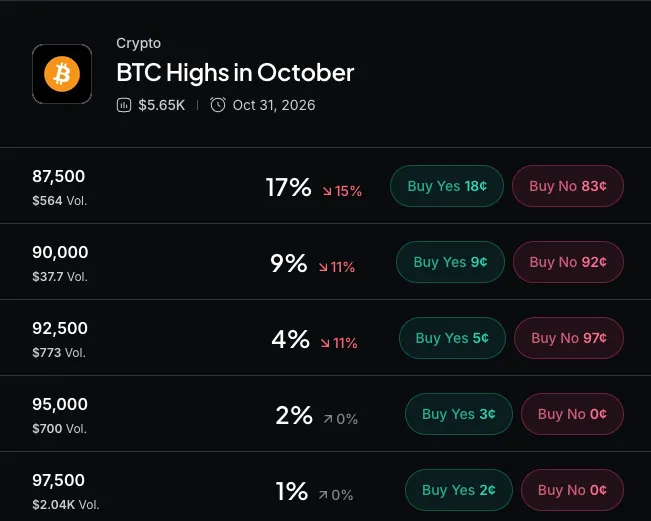
The cooling of investor sentiment is best captured by data from Myriad, a prediction market platform. As of the weekend, participants in these markets have grown increasingly bearish regarding Bitcoin’s performance for the remainder of October.
- Downside Risks: Traders now assign a 43% probability to Bitcoin hitting $77,500 before the month concludes, a sharp increase from the 32% probability assigned just 24 hours prior.
- Upside Potential: Conversely, the optimism for a massive rally has faded. The odds of Bitcoin topping $87,500 have plummeted from 17% to just 10%.
- Cross-Asset Outlook: While Ethereum traders remain somewhat confident, with a 61.3% probability of hitting $3,000 before $1,500, the overall market consensus is tilting toward caution.
Official Perspectives and Expert Context
Market analysts suggest that the current market environment is one of "price discovery through volatility." The introduction of spot crypto ETFs has fundamentally changed the asset class, making it accessible to financial advisers and large-scale institutional managers who previously shied away from the crypto-native exchange ecosystem.
Because these products trade on traditional stock exchanges, the daily flow reports have evolved into a critical metric for gauging institutional appetite. When these funds see outflows, it is often interpreted as a proxy for institutional de-risking. Conversely, sustained inflows are viewed as a vote of confidence in the long-term utility and scarcity of the underlying assets.
The "wait-and-see" mode described by analysts is a reaction to the lack of a clear catalyst. Following the post-ETF-launch frenzy, the market is currently searching for a new narrative. While the J.P. Morgan forecast provides a long-term anchor for bulls, the short-term reality is dictated by the Federal Reserve’s interest rate policy, geopolitical stability, and the performance of traditional tech stocks.
Implications: What Does This Mean for the Investor?
The recent outflows and price compression carry several implications for the crypto industry moving forward:
- Macro-Correlation: The events of this past week confirm that Bitcoin’s decoupling from traditional finance is still a work in progress. When global markets shudder—as they did with the rise in oil prices and the AI stock rotation—crypto assets are often sold to cover margins or reallocate capital to safer havens.
- Institutional Maturity: The fact that the market saw a $635 million outflow without a complete collapse of price suggests a level of maturity that did not exist in previous cycles. The liquidity provided by ETFs allows for larger players to enter and exit positions, which, while increasing volatility in the short term, provides a more robust structure for price discovery over the long term.
- The "October Effect": Historically, October has been a strong month for Bitcoin. The fact that the market is struggling to stay in the green this October suggests that the usual seasonal patterns may be secondary to macro-economic forces. Investors should remain cognizant that historical trends are not guarantees, particularly in an environment of high-interest rates and global instability.
- Strategic Positioning: For the retail investor, the disparity between the bearish sentiment on prediction markets and the massive cumulative inflows since January presents a complex picture. The "smart money" is currently in a defensive posture, waiting for a clearer signal before committing further capital.
In conclusion, while the crypto markets have shown resilience by keeping the week’s performance in positive territory, the path forward remains fraught with uncertainty. The transition from a retail-driven speculative market to one dominated by institutional inflows is inherently volatile. As we look toward the final days of October, the market will likely continue to react to every fluctuation in the global macroeconomic pulse. Investors are encouraged to maintain a long-term perspective, acknowledging that while the weekly charts may flash red, the underlying asset classes continue to see substantial, long-term capital interest.
Disclaimer: The views and opinions expressed in this article are for informational purposes only and do not constitute financial, investment, or other advice. Cryptocurrency investments involve significant risk, and readers should conduct their own research or consult with a qualified financial advisor before making any investment decisions.