By Jakub Krupa, Europe Correspondent
Sunday, 25 October 2026
As polls opened across Serbia this morning, the atmosphere in Belgrade and beyond is thick with an anticipation that has been building for two years. What began as a localized cry for justice has transformed into a national political movement, posing the most significant challenge to the twelve-year hegemony of Aleksandar Vučić and his Serbian Progressive Party (SNS).

For the citizens of Serbia, this is not merely an election; it is a referendum on the nature of their state. The ballot before them offers a stark choice between the entrenched, centralized power of the SNS and a grassroots, leaderless experiment that has emerged from the country’s universities.
The Catalyst: A Tragedy That Changed Everything
The roots of the current political earthquake can be traced back to a singular, devastating moment. In November 2024, the nation was brought to its knees by a catastrophe in Novi Sad, Serbia’s second-largest city. An outdoor concrete canopy at the local railway station, which had undergone recent renovations, suffered a catastrophic collapse, claiming the lives of 16 people.
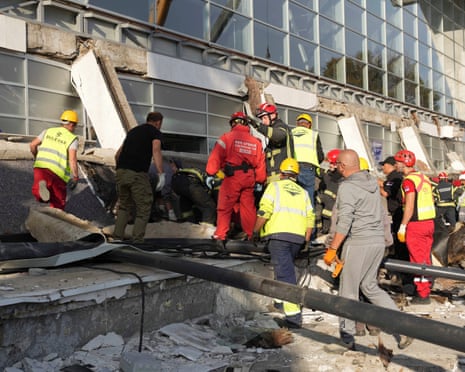
The immediate aftermath was not one of quiet mourning, but of furious, sustained inquiry. Investigations into the collapse quickly moved beyond simple engineering failure, uncovering a web of systemic "slipshod construction," allegations of state-level fraud, and deep-seated corruption. For a generation of students who had grown up under the long shadow of Vučić’s administration, the collapse became a grim metaphor for the state of the country itself: hollow, poorly maintained, and built on a foundation of patronage.
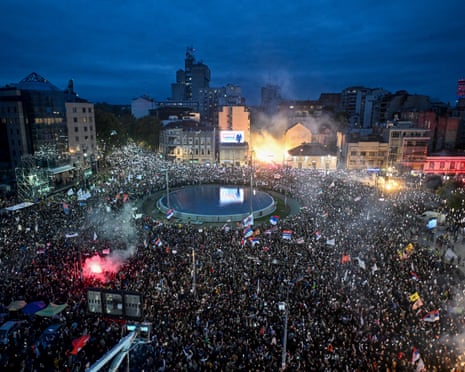
The public outcry was instantaneous. From the streets of Novi Sad to the capital in Belgrade, mass protests erupted, demanding transparency, accountability, and the resignation of those responsible for the oversight of public infrastructure.
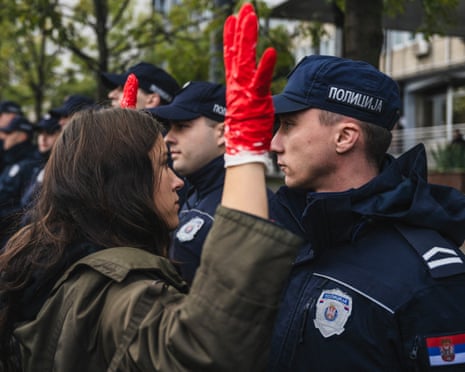
A Chronology of Resistance
The movement’s trajectory from street protest to political contender was neither quick nor peaceful. The authorities, led by the SNS, responded with a combination of denigration, surveillance, and, at times, open hostility.
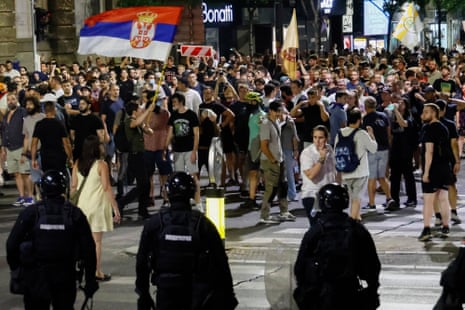
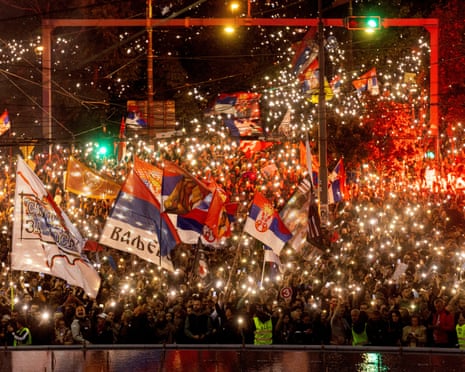
Three weeks after the Novi Sad disaster, a pivotal moment occurred in Belgrade. Students blocking a major thoroughfare during a peaceful vigil were confronted and attacked by a pro-government mob. The footage of the incident, which went viral, served as a lightning rod. Rather than being intimidated, the movement gained national momentum. The protests, which had been characterized by sporadic outbursts, began to coalesce into a more organized, yet remarkably horizontal, structure.
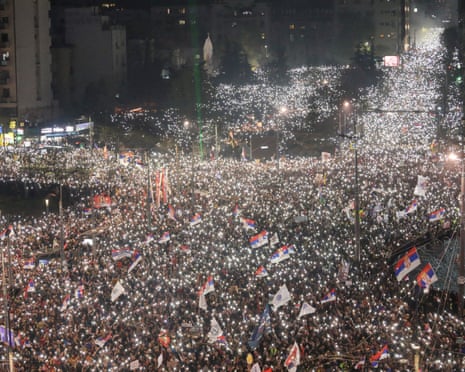
Throughout 2025 and into 2026, the movement survived attempts to split its ranks and smear its organizers as agents of foreign interference. Vučić, a seasoned political operator, attempted to neutralize the students by calling snap elections, a gamble intended to catch the movement in its infancy. Instead, the students responded by organizing the "Student List," a democratic experiment that saw 250 candidates—many of whom are academics, professionals, and doctors—vetted and approved through transparent, plenary sessions.
The Nature of the "Student List"
Perhaps the most defining characteristic of this movement is its refusal to adopt the traditional trappings of political parties. In sharp contrast to movements elsewhere in Europe—such as Péter Magyar’s Tisza in Hungary—the Student List has no single charismatic leader. It is decentralised by design, operating through a network of university faculties and grassroots community organizers.
At the top of their electoral ballot is 56-year-old cardiologist Ilija Srdanović. However, in keeping with the movement’s philosophy, Srdanović is not presented as a messianic figure or a presumptive prime minister in waiting. The focus remains on the collective.
The campaign has been marked by a surprising blend of humor, irony, and intense, door-to-door canvassing. They have successfully reached deep into the rural strongholds that have historically formed the backbone of the SNS vote, as well as minority groups who have long felt ignored by the political establishment.
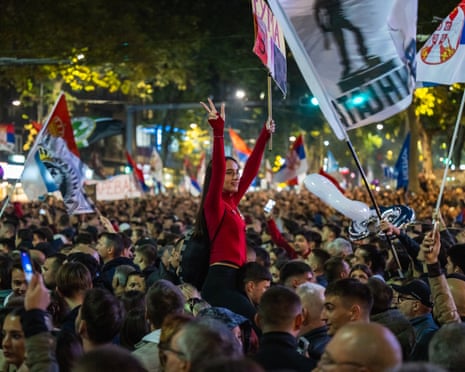
Nationalist Symbols, New Meanings
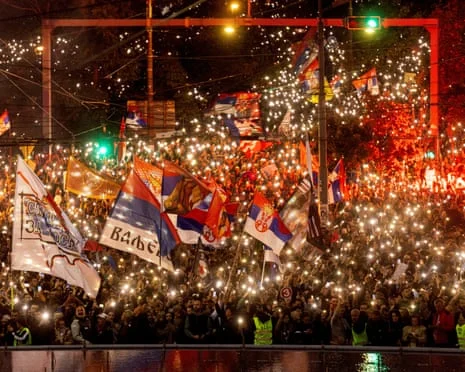
A complex aspect of the movement is its navigation of the nationalistic rhetoric that has dominated Serbian politics for decades. Ivan Đurić, of the Center for Research, Transparency and Accountability (CRTA), notes that the students have "adopted lots of national symbols"—including the prominent display of the Serbian flag and the three-finger salute, which has historically been associated with extreme nationalism.
However, Đurić stresses that the movement has effectively hijacked these symbols to give them a "new meaning." By reclaiming the flag as a symbol of the people rather than the party, the students have neutralized a primary weapon of the SNS propaganda machine. They have navigated a delicate path, crafting a manifesto that carefully addresses the country’s most volatile issues—including its relationship with Russia and the European Union—without alienating the more conservative segments of the population they seek to win over.
The Incumbent’s Playbook
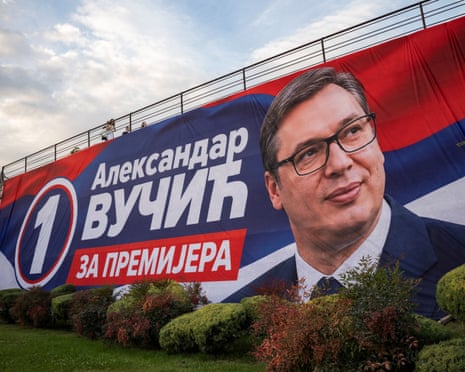
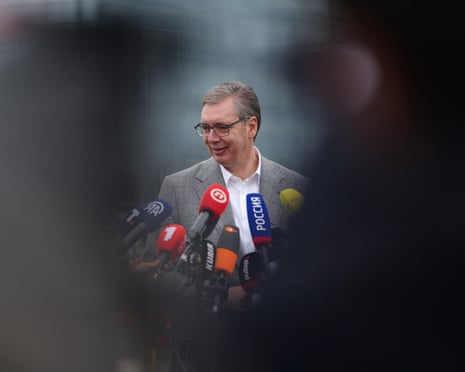
Aleksandar Vučić, who served as Slobodan Milošević’s information minister during the 1990s and has held power in various roles since 2012, remains a formidable opponent. His party, the SNS, continues to rely on the "United Serbia" list, leveraging control over the public purse and a media landscape that is overwhelmingly favorable to his government.
His strategy has been consistent: to frame the opposition as "stooges of foreign powers," a tactic that has worked effectively in the past. Yet, as the polls show, this narrative is losing its potency. Vučić’s recent attempts to associate himself with the international right—notably hosting Donald Trump Jr and Jared Kushner in an attempt to secure high-profile investment—have backfired, sparking further outrage over allegations of a "secretive and illegal" deal to hand over a protected site in Belgrade for a new Trump Tower.

Implications for Serbia and Europe
Marta Szpala of the Polish Academy of Science and the BiEPAG research group suggests that the Serbian student movement offers an "alternative model" for modern European politics. While many Western European protest movements have been characterized by disruption and, occasionally, violence, the Serbian model has focused on sustained mobilization, institutional oversight, and the creation of a "genuine political alternative."
"Serbia may be about to show that achieving change simply requires consistency, perseverance, and the building of broad-based alliances," Szpala notes.
However, the transition of this movement into a governing force would be fraught with difficulty. Should they succeed, the students would face the daunting task of "rewiring the state." After more than a decade of increasingly authoritarian rule, the institutional rot in Serbia runs deep. Clientelism, the blurring of lines between the party and the state, and a compromised judiciary will be the first hurdles for any new administration.
Furthermore, the movement will eventually have to drop its cautious approach to foreign policy. Serbia’s current balancing act between the EU, Russia, and China is becoming increasingly unsustainable. The student-led coalition will eventually have to choose a path, a move that will test the unity of their diverse, academic-led ranks.
A Decisive Evening
As of this afternoon, polling stations remain busy. The traditional opposition parties have been largely marginalized, with their collective support plummeting from a previous 30% to a mere 10-15%. Some of these parties have already folded their efforts into the Student List, while others, such as "European Serbia," risk falling below the 3% electoral threshold entirely.
On the other side of the spectrum, the nationalist right is in disarray, weakened by internal fractures and the withdrawal of the "We the Power of the People" party over rumors of Russian meddling. This, combined with the student mobilization, suggests that the political landscape in Serbia is undergoing a fundamental realignment.
Whether the students succeed in ousting the SNS or not, the "Student List" has already achieved something remarkable. They have broken the cycle of apathy and demonstrated that a decentralized, non-partisan group can command the attention of a nation.
As the sun begins to set in Belgrade and the final voters cast their ballots, one thing is certain: the Serbia that wakes up tomorrow will be different from the one that existed yesterday. The era of the "strongman" is being challenged, not by the old guard of political rivals, but by the very generation that the state failed at that railway station two years ago.

We will continue to track the results, the turnout, and the inevitable fallout of this historic evening. For now, the eyes of Europe are fixed on the streets of Belgrade, waiting to see if this democratic experiment can truly rewrite the future of the Balkans. Ajde.