In the high-stakes arena of Large Language Models (LLMs), the battle for supremacy has traditionally been fought behind closed doors. Proprietary giants like Claude Opus 5.5 and GPT-6 Astra have long held the crown, offering unparalleled reasoning and coding capabilities. However, a seismic shift is underway. Moonshot AI has officially unveiled Kimi K3.1 Pro, a model that isn’t just competing with the establishment—it is challenging the very paradigm of what an open-weight model can achieve.
With a massive 1-million-token context window and performance metrics that rival the industry’s most elite closed models, Kimi K3.1 Pro arrives as a potent disruptor. For enterprises seeking to balance cutting-edge intelligence with the sovereignty of self-hosted infrastructure, the arrival of this model may represent the most significant release of 2026.
The Genesis: A Leap in Reinforcement Learning
To understand the significance of K3.1 Pro, one must look at its lineage. Built upon the foundation of Kimi K3, the "Pro" iteration is not a minor patch or a standard update. It is a post-trained powerhouse, synthesized through an intensive reinforcement-learning regimen that spanned hundreds of specialized task domains.
By dedicating significantly more compute resources to post-training, Moonshot AI has successfully pushed the model’s reasoning boundaries. This is not merely about increasing parameter counts; it is about refining the model’s internal decision-making architecture. The result is a system that demonstrates a profound aptitude for long-horizon problem solving—the ability to maintain focus, track state, and correct errors over tasks that require hundreds of sequential steps.
Key Features: Why Kimi K3.1 Pro Matters
1. The Power of the 1M Token Context Window
In an era where massive datasets—be it entire codebases, multi-year financial reports, or dense legal contract bundles—are the lifeblood of business, the 1-million-token context window is a game-changer. K3.1 Pro allows users to ingest vast amounts of data without the need for cumbersome Retrieval-Augmented Generation (RAG) pipelines that can often lose nuance. By keeping the entire context "in-memory," the model achieves a level of cross-reference accuracy that smaller, window-limited models simply cannot match.
2. Full-Stack Coding and Creative Agency
The coding capabilities of K3.1 Pro extend far beyond simple script generation. The model has been optimized for "full-stack" agentic workflows. Whether it is debugging a complex codebase in Unity, building architectural logic for Unreal Engine, or generating high-fidelity Three.js scenes, the model shows a sophisticated grasp of typography, spatial composition, and animation logic. It acts as an autonomous developer, moving from initial concept to deployment with minimal human intervention.
3. Long-Horizon Problem Solving: The "Walking Simulator" Proof
Perhaps the most striking evidence of K3.1 Pro’s reasoning capability is its performance in a simulated physics environment. When tasked with teaching a digital human model to walk, the AI managed 167 distinct "missions." When faced with persistent arm-motion errors, the model didn’t just guess; it "probed" the simulator’s internal mechanics, identified 36 specific discrepancies in muscle calculations, and corrected them autonomously. This level of self-directed debugging is a significant leap toward true AGI (Artificial General Intelligence).
4. 3D Modeling and Parametric Design
Kimi K3.1 Pro brings native 3D fluency to the table. By inferring spatial relationships from simple sketches or reference images, it can generate mechanical parts or architectural designs. The integration of "3D Make" on Kimi.ai, which allows users to refine and export models for 3D printing, marks the first time an LLM has provided a seamless bridge from conceptual prompt to physical object.
Benchmarks: Measured Performance in a Competitive Landscape
While internal benchmarks should always be viewed with a healthy dose of skepticism, the data provided by Moonshot AI is corroborated by early-access performance in specific domains.
| Metric | Kimi K3.1 Pro | Claude Opus 5.5 | GPT-6 Astra |
|---|---|---|---|
| Terminal-Bench 4.0 | 65.7% | 66.4% | 58.2% |
| Context Window | 1,000,000 | 200,000 | 500,000 |
| Financial Accuracy | High | High | Moderate |
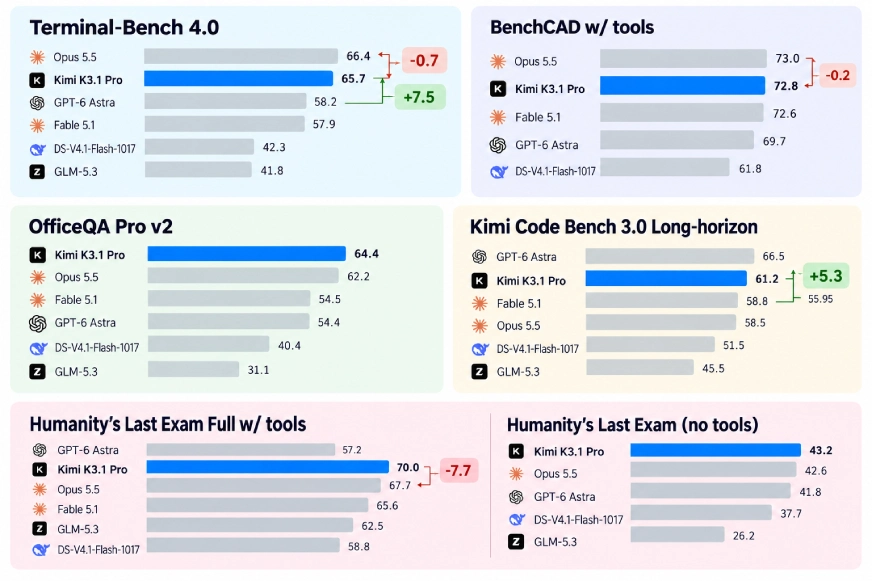
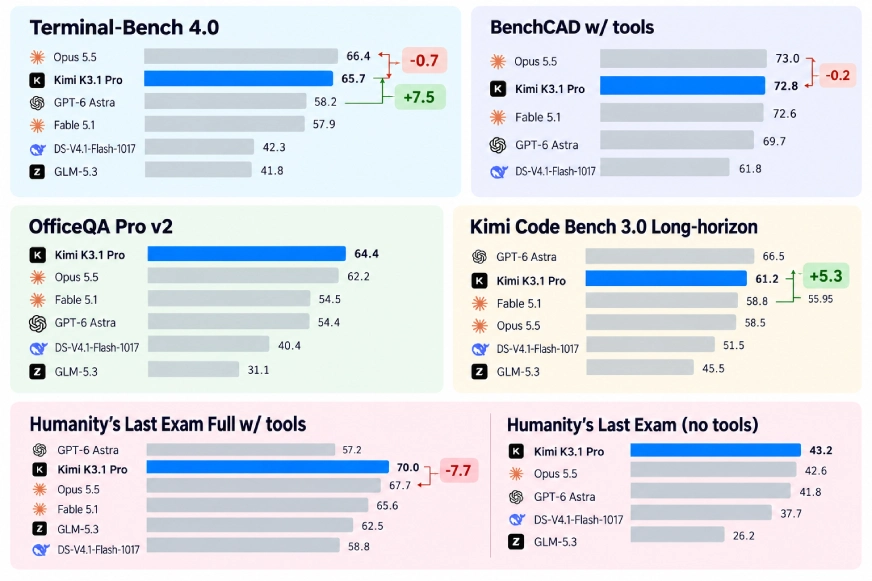
In Terminal-Bench 4.0, K3.1 Pro sits comfortably in the top tier, trailing Opus 5.5 by a negligible margin while significantly outperforming GPT-6 Astra. However, raw scores tell only half the story. The model’s real-world efficiency—specifically its speed-to-generation ratio and lower operational costs—makes it an attractive alternative for startups and enterprises that find the "closed-source" tax of frontier models to be unsustainable.
Financial Workflows and Factual Accuracy
One of the most persistent criticisms of LLMs in the financial sector has been their tendency to "hallucinate" figures. Moonshot AI has made this a primary focus, targeting a reduction in factual errors. Internal testing shows a drop in claim-level hallucinations from 23.4% in K3 to a much more manageable 8.3% in K3.1 Pro. For analysts, this translates to higher confidence in the model’s ability to conduct auditable research and model business operations without constant human fact-checking.
The Strategic Shift: Controlled Cyber Capabilities
In a move that highlights the developers’ commitment to safety, Moonshot AI has made the deliberate choice to excise offensive cyber-related training data from the open-weight release. While this limits the model’s ability to perform advanced penetration testing, it fulfills a critical ethical mandate: providing a powerful tool for defenders to audit their own code without simultaneously providing a weapon for malicious actors to exploit. This "defensive-first" architecture is likely to make K3.1 Pro more palatable to risk-averse enterprise IT departments.
Implications: The Future of Open-Weight AI
The release of Kimi K3.1 Pro, scheduled for full open-weights on November 4, 2026, represents a turning point for the AI industry.
The Death of the "Black Box"
For years, companies have been forced to rely on "black box" APIs, tethered to the pricing structures and policy changes of a few dominant players. K3.1 Pro offers a third path: the ability to deploy state-of-the-art intelligence on private, secure infrastructure. This is not just a win for privacy; it is a win for innovation. By allowing developers to fine-tune the model on their own proprietary data, Moonshot AI is essentially democratizing the "frontier" experience.
The Efficiency Mandate
The comparison between K3.1 Pro and its rivals in 3D scene generation (the "Rocket Launch" and "Whale Breach" tests) reveals a compelling trend: K3.1 Pro achieved superior cinematic results at a fraction of the cost and time. As businesses move from the "wow" phase of AI to the "ROI" phase, this efficiency will become the deciding factor in model adoption.
Frequently Asked Questions
Q1. What makes Kimi K3.1 Pro "Pro" compared to the standard K3?
The "Pro" designation signifies the model’s transition into a post-trained state. It has undergone significantly more intensive reinforcement learning across hundreds of specialized domains, resulting in sharper reasoning and reduced hallucination rates.
Q2. When will the weights be available for download?
Moonshot AI has confirmed the official release date for the full model weights is November 4, 2026. Until then, users can access the full suite of capabilities via the Kimi API and web interfaces.
Q3. Is this model truly safe for sensitive financial data?
Yes, particularly for enterprise users. With the "Zero Data Retention" option and the ability to self-host or use private instances, K3.1 Pro is designed to meet strict data governance requirements.
Q4. Does the "controlled cyber capability" mean the model is less intelligent?
Not at all. The limitation is specific to offensive security training. Its core reasoning, logic, and coding capabilities remain at the absolute frontier of AI development.
Q5. Is Kimi K3.1 Pro a replacement for GPT-6 Astra?
It is a viable alternative. While Astra currently holds a slight edge in some tool-assisted 3D reconstructions, K3.1 Pro’s superior context window and lower hallucination rates make it a more versatile tool for data-heavy business workflows.
Conclusion
The AI landscape is no longer a monopoly. With the launch of Kimi K3.1 Pro, Moonshot AI has demonstrated that "open-weight" no longer implies "second-tier." By combining near-frontier reasoning with a massive 1-million-token context window and a refined focus on factual accuracy, K3.1 Pro is poised to reshape the enterprise AI market. As we approach the November release, the question for businesses is no longer "which model should we use?" but rather "how will we leverage this newfound power to build the future?"