By Economic Analysis Desk
January 9, 2026
The U.S. residential construction sector is facing a period of renewed uncertainty as the latest figures from the Census Bureau reveal a contraction in housing starts. According to data released on Friday, January 9, 2026, housing starts fell to a seasonally adjusted annual rate of 1.246 million units in October. This dip serves as a critical indicator of the broader challenges facing the real estate market, as builders grapple with fluctuating interest rates, persistent supply chain headwinds, and the lingering effects of a volatile economic landscape.
Main Facts: A Stagnant October
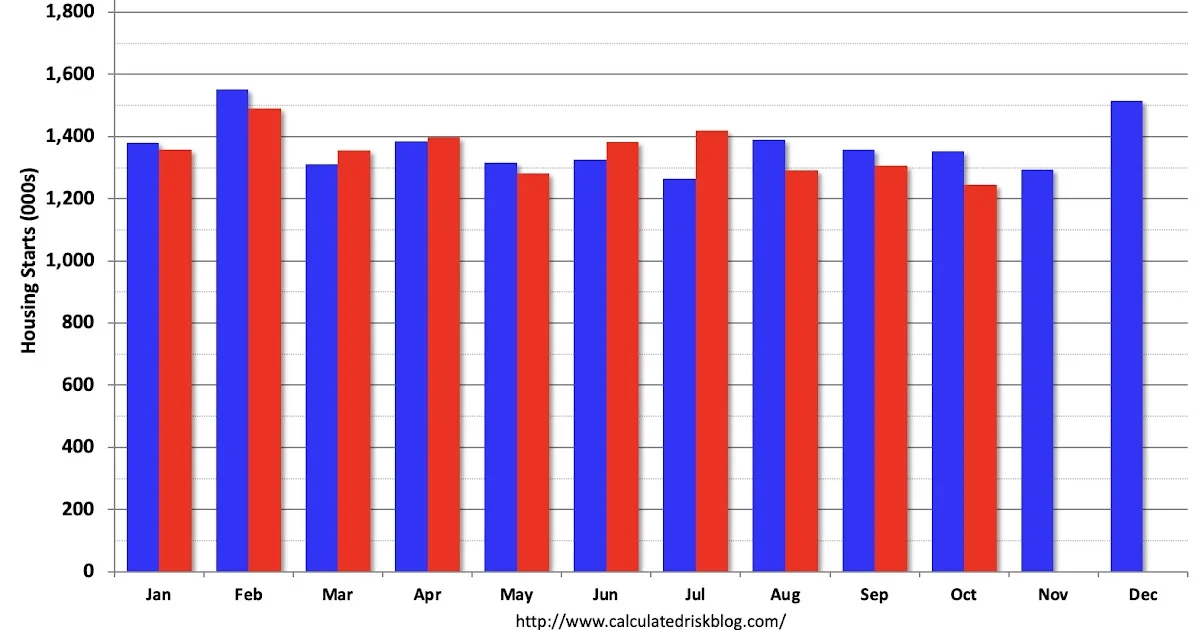
The headline figures for October underscore a cooling period for residential developers. The reported 1.246 million annual rate represents a significant deviation from the momentum seen earlier in the year. Perhaps most telling is the year-over-year comparison: total housing starts were down 7.8% in October compared to the same month in 2024.
While market analysts often look at single-family and multi-family units as distinct barometers of economic health, the aggregate data shows a complex tug-of-war. Year-to-date (YTD) starts are currently down 0.7% compared to the corresponding period in 2024. Within that metric, the divergence is stark: single-family housing starts—the traditional bedrock of the housing market—have fallen by 7.0% YTD, while the multi-family sector has surprisingly surged, posting an 18.0% increase YTD. This dichotomy suggests that while developers are hesitant to break ground on traditional suburban homes, the institutional push for rental apartments and high-density residential projects remains a primary driver of industry activity.
Chronology: The Road to the January 2026 Release
The data released this week carries an unusual caveat: the Census Bureau is currently operating under a backlog. The figures provided today cover the months of September and October 2025, yet November data remains conspicuously absent from the ledger.
This delay highlights the administrative challenges currently facing federal data collection agencies. For industry stakeholders, the lag creates a "blind spot" in the fourth quarter of 2025, making it difficult to determine if the October dip was a localized phenomenon or the beginning of a prolonged downward trend. Historically, the Census Bureau provides timely, granular insights into the health of the construction sector; however, the ongoing "catch-up" period has forced economists to extrapolate trends based on incomplete datasets, leading to a heightened state of caution among mortgage lenders and residential real estate investors.
Supporting Data: Visualizing the Shift
The graphical representation of the 2024 vs. 2025 construction cycles paints a picture of a sector struggling to regain its footing. Comparing the two years, the red line (2025) frequently fluctuates below the blue line (2024), particularly during the mid-to-late summer months.
The data indicates that the 7.8% decline in October was not merely a statistical outlier but a continuation of a tightening trend that began in late Q3. In the context of the broader macroeconomic environment—where the Federal Reserve has been navigating a delicate balance of inflation control and interest rate management—these numbers serve as a testament to the sensitivity of residential developers to the cost of capital. Construction lending, which is highly dependent on prime rates, has remained expensive, effectively pricing out smaller, independent builders while allowing larger, better-capitalized firms to maintain their multi-family pipelines.

Official Responses and Industry Context
While the Census Bureau has offered limited commentary on the reporting delays, the broader economic community has been quick to react. Analysts from institutions like Calculated Risk have pointed out that the reliance on historical benchmarks—like the comparison between October 2024 and October 2025—is the only reliable way to gauge progress given the volatility in the underlying reporting schedules.
"We are seeing a market that is fundamentally bifurcated," notes one industry analyst. "The decline in single-family starts is a reflection of the ‘lock-in’ effect, where existing homeowners are reluctant to move, thus suppressing the turnover that usually fuels new construction. Meanwhile, the strength in multi-family starts suggests that the demand for rental housing is filling the void left by the prohibitive costs of single-family homeownership."
The silence on the November data is particularly concerning for those who rely on high-frequency data to make capital allocation decisions. With the final month of the year still unaccounted for, the total impact of 2025’s monetary policy on the construction sector remains a matter of conjecture until the Bureau can clear the reporting backlog.
Implications: What This Means for the 2026 Market
The implications of a 0.7% YTD decline in starts are far-reaching. For prospective homebuyers, this contraction suggests that the "inventory drought" is unlikely to end in the immediate future. If developers are pulling back on single-family starts, the supply of new homes will remain constrained, putting continued upward pressure on home prices even as mortgage rates oscillate.
For the construction industry, the data suggests a period of consolidation. The 18% increase in multi-family starts implies that urban centers and suburban hubs are shifting toward a rental-heavy model. While this may provide relief for the rental market, it does little to address the affordability gap for first-time homebuyers looking to enter the equity-building phase of their lives.
Looking ahead to the remainder of the first quarter of 2026, the focus will shift toward the missing November data and the eventual December summary. If the trend observed in October holds, the industry may be looking at a period of stagnation that could last through the first half of the year. Builders are likely waiting for clearer signals regarding the Federal Reserve’s trajectory for the remainder of 2026. Until that clarity arrives, the construction sector will likely continue its pattern of cautious, selective development, focusing on high-density projects where demand is statistically verifiable and less sensitive to the individual mortgage rate environment.
In summary, the October housing start figures provide a sobering look at a sector in transition. While the surge in multi-family construction offers a silver lining, the structural decline in single-family starts remains a significant hurdle. As the Census Bureau works to normalize its reporting schedule, the industry will be watching closely to see if the final months of 2025 offer a path to stabilization or confirm a deepening trend of residential contraction. The coming weeks, as November and December data are eventually released, will be essential in determining whether the housing market is merely experiencing a temporary correction or if it is bracing for a sustained period of reduced activity in the year ahead.