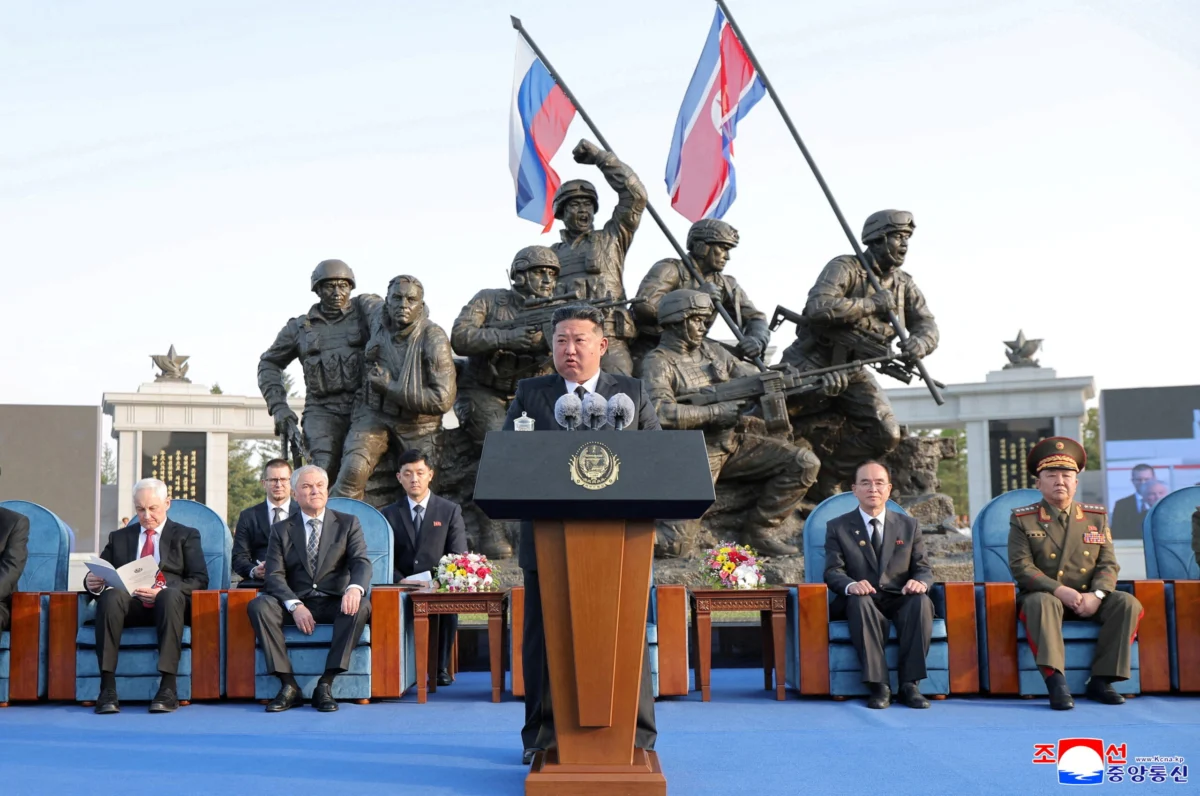
OMAHA — While ostensibly a peripheral observer to the grinding attrition of the Russia-Ukraine conflict, the Democratic People’s Republic of Korea (DPRK) has emerged as arguably the most significant geopolitical beneficiary of the war. As Moscow and Kyiv remain locked in a stalemate that shows few signs of resolution—despite sporadic, high-level diplomatic posturing—Pyongyang has leveraged the crisis to undergo a radical military and economic transformation.
What began as a transactional arrangement for artillery shells has evolved into a comprehensive strategic partnership. By trading its vast Cold War-era stockpiles and fresh manpower for Russian technology, cash, and combat validation, North Korea is no longer merely a regional rogue state; it is a burgeoning military power with newfound confidence and capability.
The Chronology of Convergence
The deepening of the Russia-North Korea alliance did not happen overnight, but it accelerated rapidly following the onset of the Ukraine invasion.
- June 2024: President Vladimir Putin and Kim Jong Un sign a "Comprehensive Strategic Partnership" in Pyongyang, formalizing a mutual defense pact that echoed Soviet-era military ties.
- October 2024: The first documented reports emerge of North Korean People’s Army (KPA) troops deploying to Russian soil.
- Early 2025: Western intelligence confirms that North Korean ballistic missile systems deployed in Ukraine have demonstrated increased accuracy, suggesting that battlefield feedback is being integrated into North Korean production lines.
- Late 2025: Kim Jong Un publicly unveils the hull of a nuclear-powered submarine, a project experts believe was accelerated by Russian technical assistance.
- 2026: North Korea continues to rotate troops through the Russian theater, with estimates suggesting the total number of personnel exposed to modern, high-intensity conflict has reached 25,000.
Supporting Data: The Scale of the Arsenal
The depth of the partnership is best measured in the sheer volume of material flowing from the Korean Peninsula to the front lines of Europe. According to the Center for Strategic and International Studies (CSIS), North Korea has funneled roughly 15 million artillery shells into the Russian war machine since 2022.
The logistics of this support are staggering. South Korean defense intelligence reports that Pyongyang has shipped at least 33,000 containers to Russia, laden with munitions, self-propelled artillery, and short-range ballistic missiles (SRBMs). During peak periods of the conflict, Ukrainian military analysts estimated that North Korean shells accounted for nearly 40% of the total artillery fire directed at their positions.
The financial windfall has been equally transformative for the isolated North Korean economy. Estimates from South Korean intelligence and independent financial analysts suggest that Russia has transferred between $13 billion and $22 billion in cash, commodities, and sanctioned goods to Pyongyang. This influx of capital has effectively insulated the Kim regime from the worst impacts of international sanctions, providing a lifeline that has allowed the state to prioritize high-tech military development.
The "Combat Laboratory" Effect
For the KPA, the war in Ukraine serves as an invaluable, real-world laboratory. Having not engaged in a significant, multi-domain conflict since 1953, the North Korean military had become a "paper tiger" in the eyes of many Western analysts. That is no longer the case.
The deployment of approximately 25,000 troops to the Kursk region has provided a generation of KPA officers with "hard-won" combat experience. They are observing the tactical utility of drone swarms, the necessity of electronic warfare, and the mechanics of modern integrated air defense—lessons that are being transmitted back to Pyongyang in real time.
Furthermore, the "combat testing" of indigenous systems has allowed North Korean engineers to close critical technological gaps. By observing how their missiles perform against Western-supplied air defense systems in Ukraine, North Korea is refining its guidance, thermal shielding, and payload delivery. This feedback loop is drastically reducing the development time for their own strategic weapons, effectively leapfrogging years of R&D.
Official Responses and Global Alarm
The international community has reacted with growing concern. The United States and its allies have repeatedly condemned the cooperation, with the U.S. State Department highlighting that the partnership violates multiple UN Security Council resolutions.
However, the efficacy of traditional diplomatic pressure has waned. Because Russia holds a veto on the UN Security Council, the usual mechanisms for enforcing sanctions have been paralyzed. The establishment of a "Multilateral Sanctions Monitoring Team" (MSMT) by Western nations represents a desperate effort to track the flow of goods, but it struggles to gain traction in an environment where Moscow is actively facilitating Pyongyang’s evasion efforts.
South Korea, meanwhile, finds itself on the front lines of this shifting paradigm. Seoul has expressed alarm over the possibility that Russia is providing the "missing pieces" to the North’s nuclear puzzle: specifically, space-launch technology, high-speed atmospheric re-entry vehicles, and potentially the propulsion systems required for the nuclear-powered submarines that Kim Jong Un showcased in 2025.
Strategic Implications: A New Indo-Pacific Reality
The implications for the Indo-Pacific are profound and potentially destabilizing.
1. Erosion of Deterrence
For decades, the strategic calculus on the Korean Peninsula relied on the assumption that North Korea’s military was constrained by its isolation and lack of real-world experience. If the KPA is now a "battle-hardened" force, the threshold for miscalculation lowers significantly. A more confident Kim Jong Un may feel empowered to engage in increased "missile coercion" or provocative border maneuvers, knowing he has a security guarantee from a major nuclear power (Russia).
2. The China Factor
A critical, yet unresolved, question is the perspective of Beijing. China has long valued a stable North Korea as a buffer against U.S. influence. However, the current "unlimited" nature of the Russia-North Korea partnership risks drawing unnecessary U.S. and NATO attention to China’s backyard. If Pyongyang becomes too bold—or if Russia’s influence over Kim eclipses that of Beijing—China may find its own strategic leverage diminishing.
3. Future Contingencies
For the United States, the Russia-North Korea alliance forces a rethink of global contingency planning. If the U.S. is forced to confront a crisis in the Indo-Pacific, it must now consider the possibility that a conflict could be exacerbated by Russian-supplied technology or intelligence. Conversely, the "insurance policy" North Korea has secured from Moscow makes traditional regime-change or containment strategies significantly more complex.
Conclusion: The Long Shadow of the War
As the conflict in Ukraine drags on, the world is witnessing the emergence of a new, dangerous axis. North Korea is no longer just a source of localized instability; it has become a strategic supplier to a major European war. By trading blood and steel for the secrets of modern warfare, Pyongyang has fundamentally altered the security architecture of the 21st century.
Regardless of how the war in Ukraine concludes, the "North Korean benefit" will outlive the ceasefire. The technological advancements, the influx of capital, and the battle-tested nature of the KPA mean that the Kim regime is better equipped to challenge the regional order than it has been in seventy years. The world’s focus remains on the fields of Eastern Europe, but the true, long-term shockwaves of this war may ultimately be felt in the waters of the Sea of Japan and the skies over the Korean Peninsula.