In an era defined by rapid information cycles and the ubiquity of mobile connectivity, the traditional gatekeepers of news—newspapers, television broadcasts, and radio—are finding themselves sharing the stage with a more dynamic, decentralized competitor. According to a landmark 2026 study conducted by the Pew Research Center, the landscape of American journalism has undergone a profound transformation. Social media is no longer merely a secondary or casual supplement to news consumption; it has evolved into a central pillar for how the majority of the U.S. adult population stays informed.
The findings, produced under the auspices of the Pew-Knight Initiative, reveal that 58% of U.S. adults now identify social media as an important vehicle for keeping up with daily news. Perhaps most striking is the segment of the population that has fully migrated their reliance toward these platforms: 13% of Americans now cite social media as their single most important source for news, a significant jump from previous years that signals a deepening entrenchment of digital-first consumption habits.
The Evolution of News Consumption: A Chronological Look
To understand how we reached this point, one must look at the trajectory of digital consumption over the last decade. For years, the rise of social media was viewed by media analysts as a peripheral trend—a place to share memes or personal updates rather than a destination for serious journalism.
The Foundation (2010–2018)
During the early 2010s, social media served as a "referral engine." News organizations would post links to their websites, and users would click through to read articles. During this period, the editorial control remained firmly in the hands of the legacy publishers. Trust in traditional institutions remained high, and while social media usage for news was growing, it was viewed as a secondary activity.
The Acceleration (2019–2022)
The pandemic years, characterized by widespread lockdowns and a global hunger for real-time information, served as a catalyst for digital adoption. By 2022, Pew Research data indicated that 43% of Americans saw social media as an important news source. However, only 5% at that time claimed it was their primary, "most important" source. The shift was underway, but the majority of the public still prioritized traditional outlets for their primary news diet.

The Current Landscape (2026)
As of June 2026, the data shows a seismic shift. The jump from 43% to 58% in those who deem social media "important" for news, and the more than doubling of those who call it their "most important" source (from 5% to 13%), suggests that social media has moved from a supplemental tool to a primary interface. Platforms like TikTok and Instagram have pivoted from entertainment-centric algorithms to news-rich feeds, effectively capturing the attention of a demographic that no longer feels compelled to turn on a television or subscribe to a physical paper.
Data-Driven Insights: Who is Driving the Change?
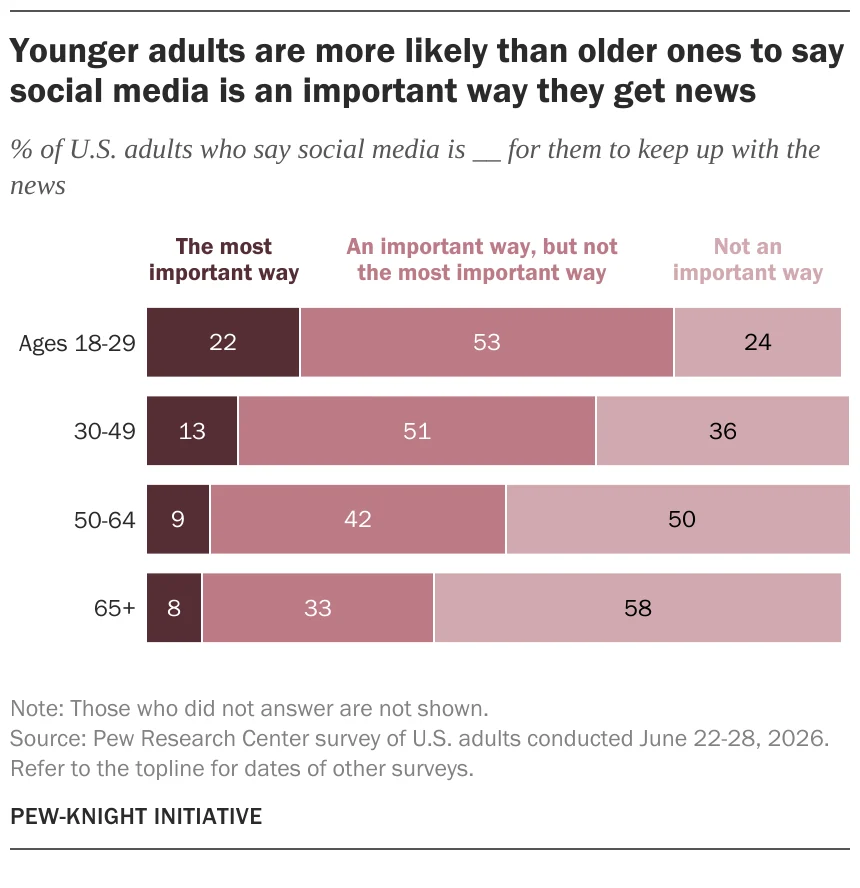
The demographic breakdown of the 2026 survey offers a stark look at the generational divide in information consumption. The reliance on social media as a news source is not distributed evenly across age brackets; it is heavily skewed toward younger cohorts, suggesting that this habit will likely continue to dominate the landscape for decades to come.
Generational Disparities
- Ages 18–29: This demographic leads the pack, with 76% of young adults identifying social media as an important way to track news. Notably, 22% of this group considers it their primary source, effectively bypassing the traditional news cycle entirely.
- Ages 30–49: A significant portion of middle-aged adults (13% citing it as the most important source) are mirroring the habits of their younger counterparts, suggesting that as these users age, their reliance on digital platforms is not diminishing.
- Ages 50–64 and 65+: While these groups are the least likely to rely on social media, the trend is still visible. Even among the 65+ demographic, a notable 41% report that social media plays a role in their news consumption, highlighting that digital transformation is reaching even the most traditional news audiences.
The Role of the Pew-Knight Initiative
The data underpinning this analysis was generated by the Pew-Knight Initiative, a collaborative effort between the Pew Research Center and the John S. and James L. Knight Foundation. The project was designed with the express purpose of understanding how American identity and civic engagement are formed in a digital-first world.
Pew Research Center, acting as a nonpartisan, nonadvocacy fact tank, has sought to bring empirical rigor to a topic often clouded by political rhetoric. By surveying 3,488 U.S. adults via the American Trends Panel, the researchers were able to capture a representative snapshot of a nation in flux. The goal is not merely to track numbers but to understand the quality of information consumption.
Implications for Democracy and Civic Life
The migration of news consumption to social media carries profound implications for the future of democratic discourse. As audiences shift away from traditional, vetted news outlets, the mechanisms of information delivery have fundamentally changed.

The Algorithm as Editor
In the traditional model, news editors decided the "front page" based on professional standards and journalistic ethics. Today, the "front page" is a personalized algorithm designed to maximize engagement. This shift raises critical questions about echo chambers and the potential for polarization. When the primary way an American learns about the world is through a feed curated by their past behavior and preferences, the shared reality necessary for robust civic debate becomes increasingly fragmented.
Trust and Verification
The report highlights that young adults are not only more likely to consume news on social media but also more likely to express "at least some trust" in that information. This represents a departure from the skepticism often associated with legacy media. While this trust may reflect a preference for peer-led or creator-driven reporting, it also introduces significant risks regarding the spread of misinformation. Without the traditional editorial oversight of legacy media, the responsibility for fact-checking is shifting toward the individual user—a burden that, according to experts, many are not equipped to handle.
The Future of Newsrooms
For traditional publishers, the message from the 2026 data is clear: survival requires meeting the audience where they are. This has led to an explosion in "social-first" journalism, where news organizations prioritize creating content specifically for TikTok, Instagram Reels, and other platforms rather than just funneling users to a web page. However, this strategy creates a dependency on platform algorithms, which can change overnight, potentially jeopardizing the financial stability of journalism outlets.
Expert Perspectives and Methodology
The methodology used for this report—a survey of 3,488 U.S. adults—provides a high degree of confidence in the findings. By utilizing the American Trends Panel, researchers ensured that the data was not skewed by self-selection bias.
Michael Lipka, an associate director at the Pew Research Center and a lead on this project, emphasizes that while the frequency of news consumption has been studied for years, the importance placed on social media is the new frontier. "By asking about the weight people place on these platforms, we are getting closer to understanding the psychological and societal shift that has occurred," Lipka notes.

The report also serves as a clarion call for media literacy. If the next generation of voters is receiving the bulk of their political and civic information through social feeds, the educational system must adapt. Teaching the mechanics of algorithms, the nature of engagement-based content, and the importance of cross-referencing sources has become a civic necessity rather than an academic elective.
Conclusion: A New Information Era
The 2026 Pew Research Center findings confirm what many have observed in daily life: the digital megaphone is the new primary conduit for information. While this offers unprecedented access to global events and diverse viewpoints, it also introduces systemic challenges that the American public is still learning to navigate.
As social media continues to integrate itself into the fabric of daily routines, the divide between "online" and "offline" news will likely vanish entirely. We are entering a phase where the information environment is entirely synthetic, shaped by code, user behavior, and the rapid-fire nature of the digital economy. Whether this shift will strengthen or weaken the democratic fabric remains the central question of our time—one that research institutions like the Pew-Knight Initiative will continue to monitor as the story unfolds.