For years, Aaron Graft, the CEO of Triumph Financial (NYSE: TFIN), has occupied a unique space in the corporate landscape. Unlike many of his peers who provide brief, boilerplate summaries for shareholders, Graft has consistently utilized his quarterly letters as comprehensive manifestos. In his most recent correspondence, the tone shifted from defensive posturing to a subtle, yet unmistakable, victory lap. After years of aggressive infrastructure spending that weighed heavily on profitability and frustrated investors, Triumph Financial appears to have reached a critical inflection point.
The Evolution of a Financial Infrastructure
At its core, Triumph Financial remains a bank. However, to view it solely through the lens of traditional banking is to miss the broader scope of its corporate ambition. For several years, Graft has articulated a singular vision: to transition the company into the primary financial support engine for the American trucking industry, serving everyone from large-scale fleets down to independent owner-operators.
This strategy has required a significant, multi-year capital outlay. To build this "freight ecosystem," Triumph has moved beyond basic lending, aggressively acquiring and developing tools to capture every facet of a trucker’s financial life.
The chronology of this expansion is clear:
- The Foundation: Factoring has always been the bedrock of Triumph’s business, providing the liquidity necessary for carriers to operate.
- 2021 Expansion: The acquisition of HubTran marked a watershed moment, allowing Triumph to scale its payment processing capabilities and automate the complex world of freight invoicing.
- Data Integration: The purchase of Green Sheets in 2023 provided the "intelligence" layer, giving Triumph deeper insights into market rates and credit risk.
- 2024 Launch: With the rollout of LoadPay, the company entered the digital wallet space, providing a streamlined tool for drivers to receive payments faster—a crucial competitive advantage in an industry plagued by slow payment cycles.
Navigating the "Freight Cycle"
The path to this ecosystem has not been easy. Over the last five years, Triumph Financial stock has faced significant headwinds, declining approximately 43.5%. Investors, often weary of the "long-term play," have frequently questioned whether the heavy investment in technology would ever materialize into tangible earnings.
"We told investors we would invest through the freight cycle, and we did exactly that," Graft wrote in his Q3 letter. "Not everyone agreed with the strategy, but we were true to our word."
The latest quarterly earnings report suggests that this patience may finally be rewarded. The data released was almost universally positive, indicating that the years of "pinched profitability" were, in fact, necessary building blocks for a more efficient, high-margin future.
North Star Metrics: A New Benchmark for Performance
Two quarters ago, Triumph introduced a set of "North Star Metrics"—specific performance indicators designed to hold leadership accountable to their growth targets. In the third quarter, these metrics demonstrated that the company is moving in the right direction. While the internal figures confirm strong momentum, the most significant takeaway is the company’s ability to drive efficiency while growing its client base.
The strategic importance of these metrics lies in their transparency. By setting clear goals for invoice processing, client acquisition, and margin expansion, Graft is providing Wall Street with a roadmap to measure the company’s success—or failure—in real-time.
The Inflationary Landscape and Diesel Sensitivity
A persistent question facing any freight-adjacent firm is the impact of macroeconomic volatility, particularly fuel prices. Since the onset of the conflict in the Middle East and the subsequent volatility in energy markets, diesel prices have played a massive role in the average invoice size of the truckers Triumph serves.
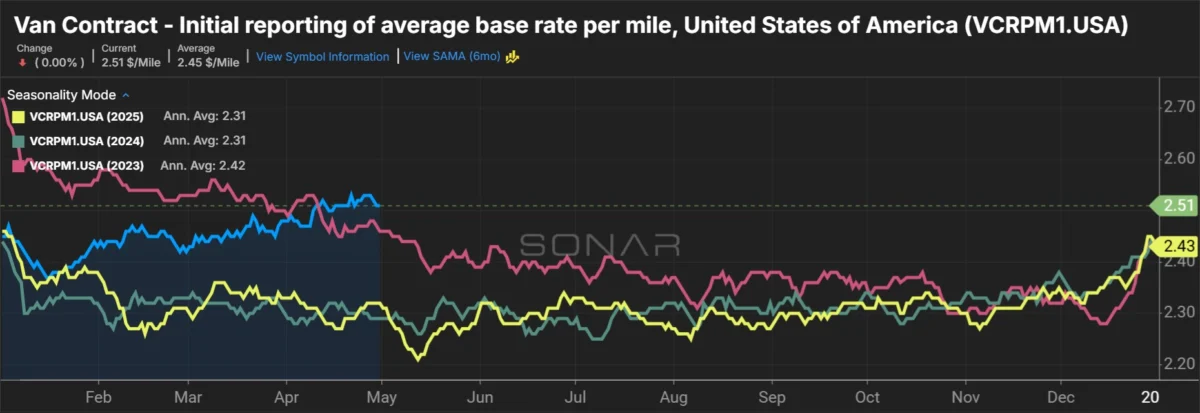
Graft addressed this head-on, noting that while linehaul rates remain relatively flat, the total invoice amount is skewed by fuel surcharges. He provided a stark comparison: while dry van revenue has risen 40% year-on-year, diesel costs at the pump have surged 67%. When combined with rising insurance premiums, equipment costs, and interest rates, the inflationary pressure on the average trucker is undeniable.
"As a result, the revenue per mile a trucker must generate—and thus the average invoice size—is almost certainly going to be double-digit percentages above historical norms until market forces change," Graft noted.
However, Triumph has developed a specific benchmark for its own exposure to these fluctuations. Graft estimated that for every $100 increase in the average invoice price, Triumph stands to generate approximately $12 million in incremental annual revenue, $8.5 million in pretax earnings, and 27 cents in earnings per share. Conversely, he warned that "the inverse is also true when invoice sizes decline," highlighting the company’s sensitivity to the broader health of the freight market.
Factoring: The Gateway to the Ecosystem
While the market has been infatuated with the high-tech potential of the Payments sector, Graft used his latest update to remind investors that Factoring remains the company’s "principal carrier-acquisition gateway."
According to Triumph’s internal data, there are over 90,000 "factored carriers" in the U.S. market. Triumph currently services roughly 8,000 of them, and that number is growing at a clip of 78 net new clients per month. More impressively, the cost to service each invoice has dropped by roughly 20% over the last year, a testament to the success of their digital integration.
"When we win a factoring relationship, we have an opportunity to serve that carrier through LoadPay, equipment finance, insurance, fuel, and Intelligence," Graft explained. "The economic value of Factoring therefore extends beyond the margin earned on an individual receivable. That broader relationship is one reason renewed growth in this business remains a strategic priority."
Implications for the Future
The implications of Triumph’s current trajectory are twofold. First, the company is signaling that its heavy spending phase is largely behind it. Having built the necessary infrastructure, the focus is now shifting toward "translating that potential into earnings performance."
Second, the company is positioning itself as an indispensable utility for the freight industry. By controlling the payment flow, data, and financing for thousands of carriers, Triumph is building a "moat" that is difficult for competitors to replicate.
As industry analysts and investors digest the latest report, the consensus seems to be shifting. If Triumph can maintain its pace of client acquisition while keeping service costs suppressed, the "victory lap" mentioned by Graft might be just the beginning.
The company is no longer just a bank trying to survive a cyclical freight market; it is an ecosystem orchestrator. The real test will be whether they can sustain this momentum if the freight market enters a period of prolonged stagnation or if inflation begins to erode the margins of their core client base. For now, however, the strategy of investing through the cycle appears to have been a calculated risk that is finally paying dividends for both the firm and its shareholders.
As Graft concluded in his letter, "Doing so will demonstrate the returns on the investments we have made." For a company that has spent years betting on its own vision, the next few quarters will be the ultimate validation of that promise.