By Josh Gallant | Updated July 21, 2026
In the modern landscape of Small and Medium-sized Business (SMB) growth, misalignment rarely manifests as an explosive corporate scandal. It doesn’t usually result in immediate layoffs or public PR disasters. Instead, it appears as a slow, corrosive friction: "qualified" leads that sales teams treat with skepticism, marketing campaigns that land with a thud because sales reps aren’t briefed on the messaging, and a revenue pipeline that looks deceptively healthy on a dashboard until the actual closed-won numbers start to stagnate.
According to a comprehensive new study of over 500 SMB go-to-market (GTM) professionals, the disparity between perception and reality is reaching a breaking point. While 87% of teams intuitively understand that better alignment would significantly boost performance, only 56% claim to be "highly aligned." This gap—nearly 30 percentage points—is where millions of dollars in potential revenue are being left on the table.
The Anatomy of the Misalignment Gap
To understand why this disconnect persists, one must look at what "alignment" actually means in practice. For most organizations, the effort to align stops at the surface level: scheduling recurring sync meetings, creating a shared Slack channel, or occasionally reviewing a lead report.
However, the data suggests that these teams are building a meeting cadence without fixing the underlying operating model. They may talk more often, but they remain fundamentally at odds regarding what constitutes a "good" lead, when sales should initiate outreach, or who deserves credit when a conversion finally occurs. In these scenarios, marketing counts the lead, sales counts the close, and the two sets of numbers never reconcile. The team is performing the labor of alignment, but the system remains fundamentally broken.

The Perception Gap: A View from the C-Suite
One of the most jarring findings in the 2026 report is the divergence in perspective between executives and front-line employees. When leadership is asked about the state of their GTM alignment, 69% report that it is strong. Conversely, only 47% of non-executives agree.
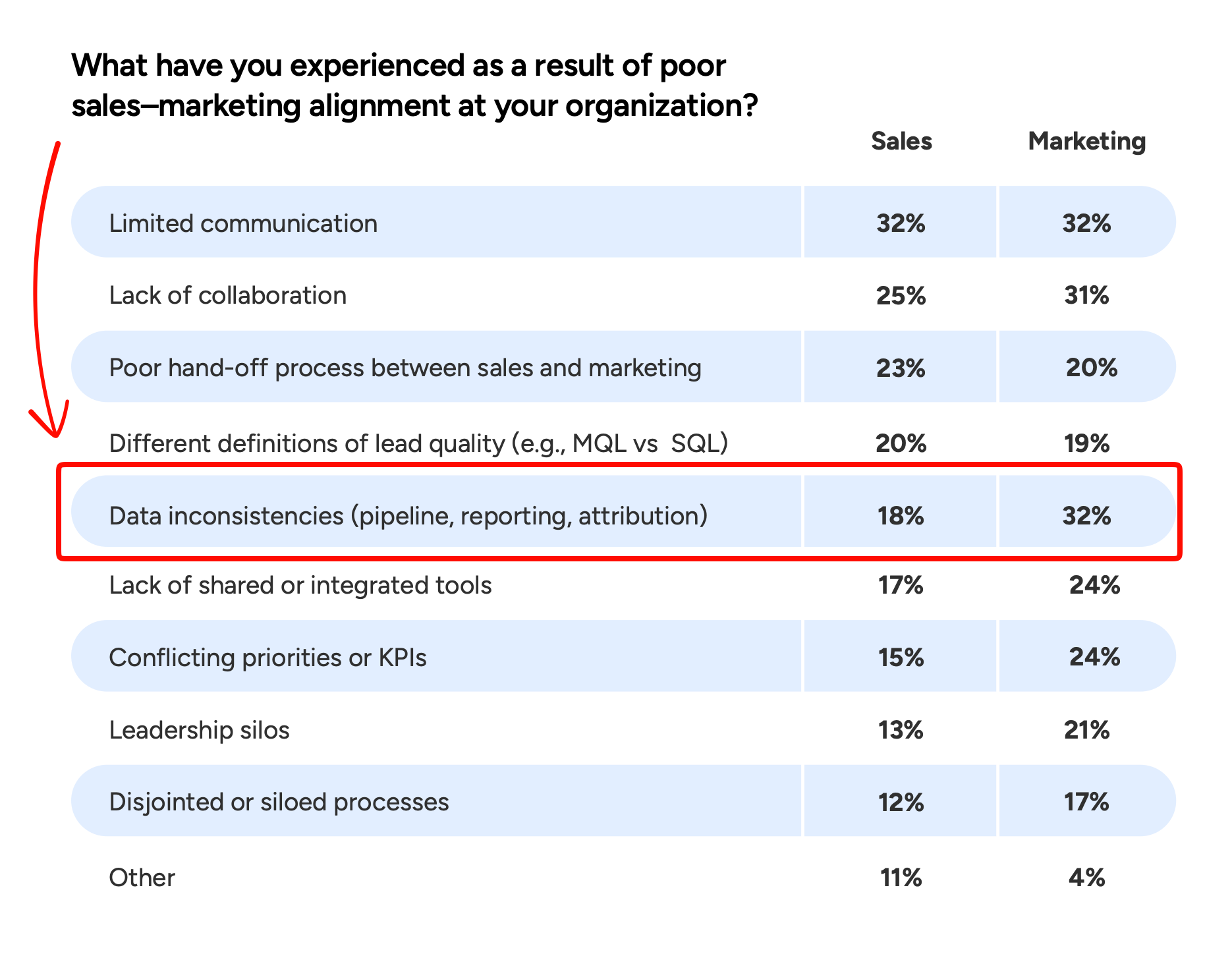
This "Executive Blind Spot" is more than a simple difference of opinion; it is a structural information lag. Executives often judge alignment by the existence of strategy decks and organizational charts. Non-executives, however, experience the daily reality of data inconsistencies, siloed communication, and the frustration of being told to hit targets with tools that don’t talk to each other. When 33% of non-executives cite "limited communication" as a primary barrier—compared to only 28% of executives—it becomes clear that the people closest to the customer are the ones suffering most from the lack of cohesion.
The Financial Implications: When Misalignment Becomes Costly
Misalignment often masquerades as a culture issue, but it is, at its core, an operational tax. The consequences of this disconnect compound over time, starting with employee frustration and moving quickly to tangible revenue loss.
When asked to identify the primary outcomes of poor alignment, 29% of professionals pointed to employee burnout. This is followed closely by:
- Delayed follow-up: Marketing generates demand, but if sales isn’t ready or doesn’t trust the source, that window of opportunity closes.
- Duplicated effort: When marketing and sales aren’t in lockstep, they often produce collateral and outreach that overlap, wasting precious budget.
- Conversion gaps: The discrepancy between the messaging a prospect sees in an ad and the pitch they hear on a sales call erodes trust, causing potential customers to drop out of the funnel.
Perhaps most damaging is the "blame cycle." When closed-won revenue dips, marketing blames the lead quality, while sales blames the marketing team’s inability to target the right decision-makers. Because there is no shared definition of success, there is no shared path to a solution.

The Tech Stack Trap: Why Buying Your Way Out Doesn’t Work
There is a common, dangerous instinct in the SMB space: when alignment fails, buy a new tool. Whether it’s a shiny new AI-powered CRM module or an additional automation layer, organizations frequently try to "buy" their way into cohesion.
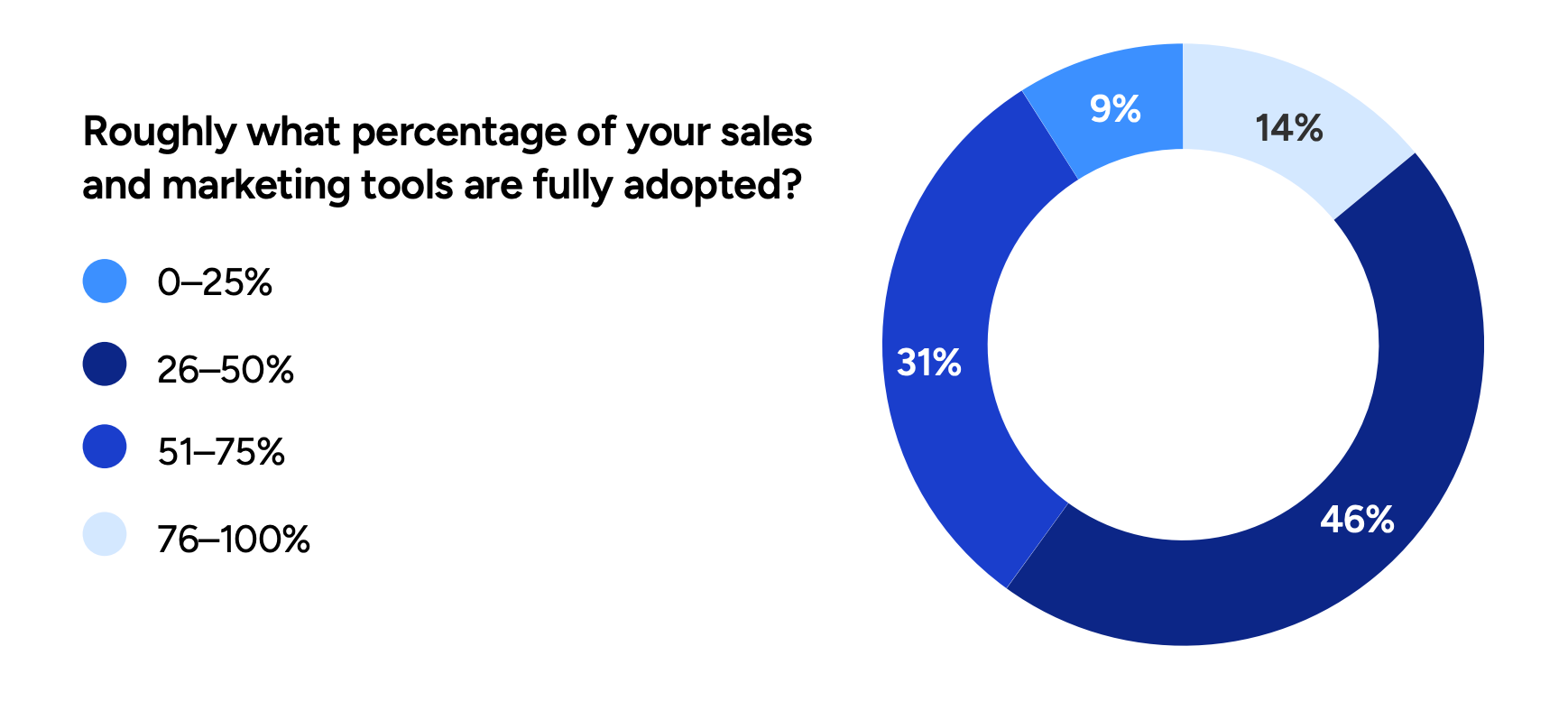
The data, however, paints a different picture. 56% of GTM professionals admit that tool bloat is a significant issue, with 60% of teams using less than half of the software they currently pay for. Furthermore, 14% of teams are using a mere 0% to 25% of their tech stack’s capabilities.
Leaner stacks with high adoption rates consistently outperform bloated, disconnected collections of software. The most successful teams aren’t the ones with the most tools; they are the ones that have consolidated their processes into a single, unified data source. When marketing and sales operate from the same CRM data, the "he said, she said" arguments over lead quality vanish.
Strategic Shifts: How Top-Performing Teams Do It
The 56% of teams that identify as "highly aligned" share specific, replicable operational habits. They do not just communicate more; they communicate differently.
1. Unified Data Infrastructure
Aligned teams are 3.5 times more likely to have strong cross-functional data sharing. They treat data as a single source of truth rather than a point of negotiation. By integrating their analytics, these teams ensure that when a sales rep looks at a lead, they see the same history and behavioral signals that the marketer used to generate that lead.
2. The Shared Persona Model
Top-performing organizations don’t create "marketing personas" and "sales targets" separately. They build a joint artifact. Sales reps, who hear the objections and pain points in real-time on discovery calls, are involved in defining the target audience before a campaign ever goes live. This ensures that the messaging resonates with the buyer’s reality, not just the company’s assumptions.
3. Rigorous Handoff SLAs
Alignment is most vulnerable at the handoff point. Aligned teams have established Service Level Agreements (SLAs) that dictate exactly what information must be included in a lead handoff, when follow-up must occur, and what the feedback loop looks like. When this is formalized, the "mystery" of what happens to a lead after it is generated disappears.
Implications for the Future of GTM
As we move further into 2026, the competitive advantage will shift toward companies that can successfully bridge the gap between their revenue-generating functions. The era of "siloed success" is coming to an end.
The path forward for SMBs is not to add more complexity, but to strip it away. It requires:
- Operationalizing, not just socializing: Moving away from "sync calls" as the primary alignment tool and toward shared KPIs and integrated workflows.
- Incentive Alignment: Recognizing that if marketing is paid for volume and sales for revenue, they will never be truly aligned. Compensation structures must be adjusted to reward shared outcomes, such as the total conversion rate of the entire pipeline.
- Culture of Transparency: Encouraging a culture where data is used to solve problems rather than assign blame.
Conclusion: The Path to Revenue Efficiency
The data is clear: 87% of teams recognize that alignment is the key to unlocking better performance. The 56% who have achieved it are already reaping the benefits of higher lead quality, shorter sales cycles, and more predictable growth.
For the remaining 44%, the mandate is simple. Stop treating alignment as a communication problem to be solved with more meetings. Start treating it as an operational model to be re-engineered through shared data, shared incentives, and a commitment to a leaner, more effective way of working.
The "Great Disconnect" is not a permanent state; it is a choice. By focusing on the fundamentals—the handoff, the data, and the buyer—SMBs can transform their go-to-market teams from two separate departments into a single, cohesive revenue engine.