In the rapidly evolving landscape of artificial intelligence, the infrastructure layer—the "plumbing" that connects large language models (LLMs) to real-world applications—is undergoing a significant transformation. One of the most notable developments in this space is the emergence of OGX, an open-source agentic API server that has arrived on the scene as the rebranded and evolved successor to Meta’s Llama Stack.
For developers navigating the complexities of local AI deployment, tool orchestration, and retrieval-augmented generation (RAG), the transition from Llama Stack to OGX represents more than a mere name change. It marks a strategic pivot toward a model-agnostic, multi-SDK, and production-grade architecture that addresses the fragmented nature of the current AI ecosystem.
The Core Facts: Understanding the Shift to OGX
The most critical takeaway for engineers and architects currently exploring agentic API servers is that OGX is the direct evolution of Llama Stack. The project’s official GitHub repository clarifies this trajectory: the name change accompanies a fundamental mission shift. While Llama Stack was inherently focused on the Llama ecosystem, OGX has been architected to be infrastructure-agnostic, allowing developers to build applications that are not tethered to a single model provider or vendor-specific SDK.
Key Characteristics of OGX:
- Open-Source and Extensible: Released under the MIT license, OGX has gained rapid community traction, boasting over 8,400 GitHub stars and 1,400 forks.
- Drop-in Compatibility: It serves as a comprehensive replacement for the OpenAI API. Any client or framework designed to interact with OpenAI can be pointed at an OGX server with minimal configuration.
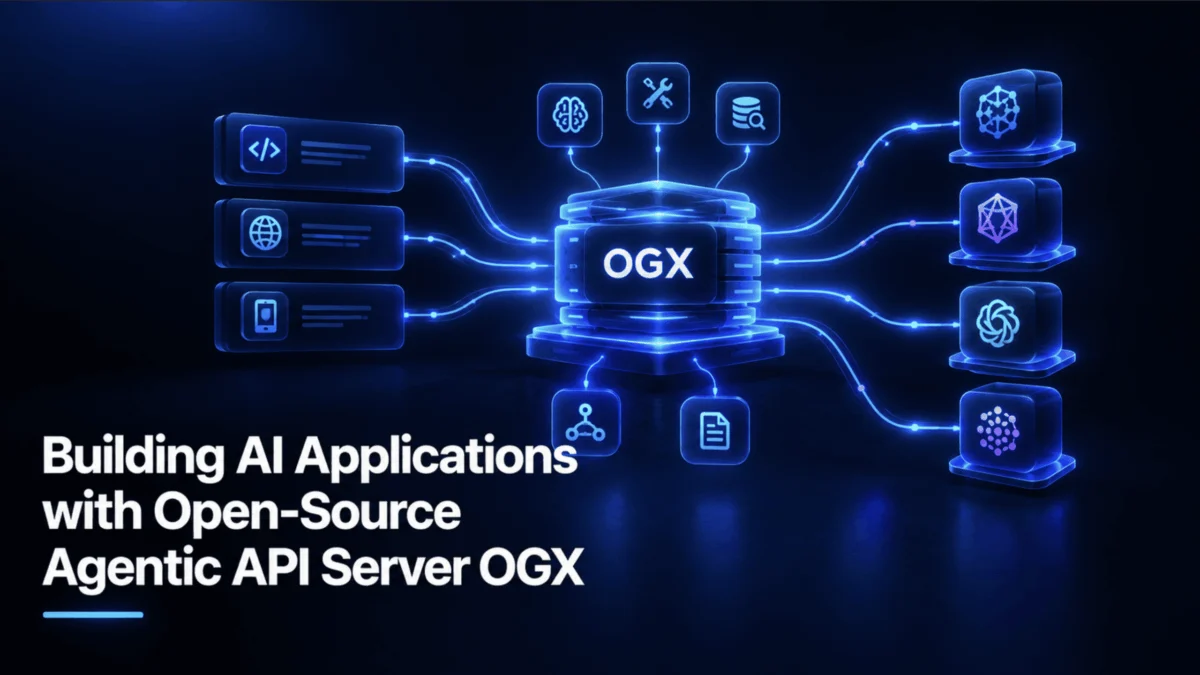
- Pluggable Provider Architecture: Developers can iterate locally using Ollama, scale to high-throughput production environments using vLLM, or connect to managed cloud-based services—all while maintaining the same API surface.
- Unified Orchestration: Beyond simple text generation, OGX provides native support for server-side agentic orchestration, tool calling, Model Context Protocol (MCP) integration, and built-in file search for RAG.
Chronology of the Project’s Evolution
The transition from Llama Stack to OGX did not happen in a vacuum. It reflects the broader industry move away from proprietary, vendor-locked development environments toward standardized, interoperable interfaces.
- The Llama Stack Era: Initially introduced to simplify the deployment of Llama-based applications, the project provided a modular structure for developers to access Llama models via standardized APIs. However, the ecosystem quickly demanded more flexibility.
- The Strategic Pivot: As developers began requesting support for non-Llama models and more complex agentic workflows, the maintainers recognized that a platform-wide rebrand was necessary to reflect its new, model-agnostic capabilities.
- The Launch of OGX: Today, OGX stands as an established project with regular community calls and active open-source development, signaling a mature approach to "production-grade" AI infrastructure. By detaching the server architecture from a specific model family, the developers have ensured that the platform remains relevant regardless of which model provider dominates the market.
Building "DocBrain": A Practical Implementation
To understand the practical utility of OGX, we can examine the construction of a sample application, "DocBrain." This project illustrates how OGX handles complex workflows—specifically RAG and custom agentic tool calling—within a single, unified interface.
The Prerequisites
The development workflow relies on uv, a high-performance Python package manager, and a local inference backend like Ollama. By initializing the project with uv init docbrain and adding ogx and openai as dependencies, developers create a robust foundation that avoids the limitations of temporary shell commands.
The Responses API and RAG
In traditional RAG pipelines, developers often struggle with the manual wiring of vector databases, chunking strategies, and embedding models. OGX simplifies this through the vector_stores and files APIs.
- File Ingestion: Using
client.files.create, documents are uploaded and tagged for "assistants," signaling to the server that they should be indexed for retrieval. - Automated Indexing: The
client.vector_stores.createcall triggers server-side processing, which handles the chunking and embedding, removing the need for a separate retrieval script. - Grounded Responses: By passing the
vector_store_idinto theresponses.createtool list, the model is automatically equipped with the context required to answer questions based on the uploaded documents.
Agentic Capabilities: Custom Tools
The true power of an "agent" lies in its ability to take action. In the DocBrain example, we define a custom Python function, save_action_item, which allows the model to write data to a local JSONL file.
The ACTION_ITEM_TOOL_SCHEMA acts as the interface between the model’s reasoning engine and the local filesystem. Because OGX natively supports tool calling, the model can inspect the available tools, determine if a task warrants a "save," and execute the function. This transforms the AI from a passive chatbot into an active participant in bookkeeping and task management.
Supporting Data and Technical Architecture
The technical strength of OGX lies in its pluggable architecture. When a developer writes code for DocBrain, they are interacting with an abstraction layer. The underlying provider configuration—managed via the model string (e.g., ollama/llama3.2:3b)—dictates the execution backend.
- Security by Design: OGX defaults to HTTPS, ensuring that even in local development, data transmission follows secure practices. The use of self-signed certificates is handled gracefully through standard Python
httpxconfigurations, ensuring security is never an afterthought. - JSON Lines (JSONL) Persistence: By using JSONL for the
action_items.jsonlfile, the architecture ensures data integrity. Appending single lines to a file is a non-blocking, atomic operation, which is significantly more resilient in an agentic environment than repeatedly reading and rewriting large JSON arrays.
Official Perspective and Community Adoption
The maintainers of OGX emphasize that the project’s value proposition is not just about convenience—it is about future-proofing.
"The real difference between an API wrapper and an actual agentic platform is what happens when you need to scale," notes the project’s documentation. By maintaining a clear separation between the application logic (the code that calls the tools) and the model infrastructure (the server providing the completions), OGX allows developers to move from a local laptop environment to a production datacenter simply by updating a configuration file.
This modularity is particularly important for enterprises that are wary of vendor lock-in. Companies can develop their RAG and agentic logic on open-source weights via Ollama or vLLM, and if their requirements shift toward a proprietary model, they can transition their infrastructure without rewriting their business logic.
Implications for the Future of AI Development
The rise of OGX signifies a broader industry shift toward "infrastructure maturity." For the past two years, the AI development space has been dominated by fragmented, brittle scripts that are difficult to move to production. OGX provides a path to stability.
Implications:
- Reduced Technical Debt: Because the application code is separated from the model provider, the technical debt associated with swapping LLMs or infrastructure backends is effectively eliminated.
- Democratization of Agentic Workflows: By abstracting away the complexity of vector databases and tool orchestration, OGX lowers the barrier to entry for developers who want to build sophisticated, document-aware agents.
- Standardization: As more tools adopt the OpenAI-compatible API surface, OGX provides a standardized way to test, deploy, and monitor AI applications, which will likely accelerate the adoption of local, privacy-first AI in enterprise settings.
In conclusion, OGX is not merely a tool for running Llama models; it is a sophisticated framework for building the next generation of intelligent, action-oriented applications. By prioritizing interoperability and production-grade design, the project provides a stable foundation for a field that is otherwise known for its rapid, often chaotic, pace of change. Whether you are building a simple RAG application or a complex, multi-agent system, OGX offers the necessary abstractions to turn prototypes into reliable, production-ready software.