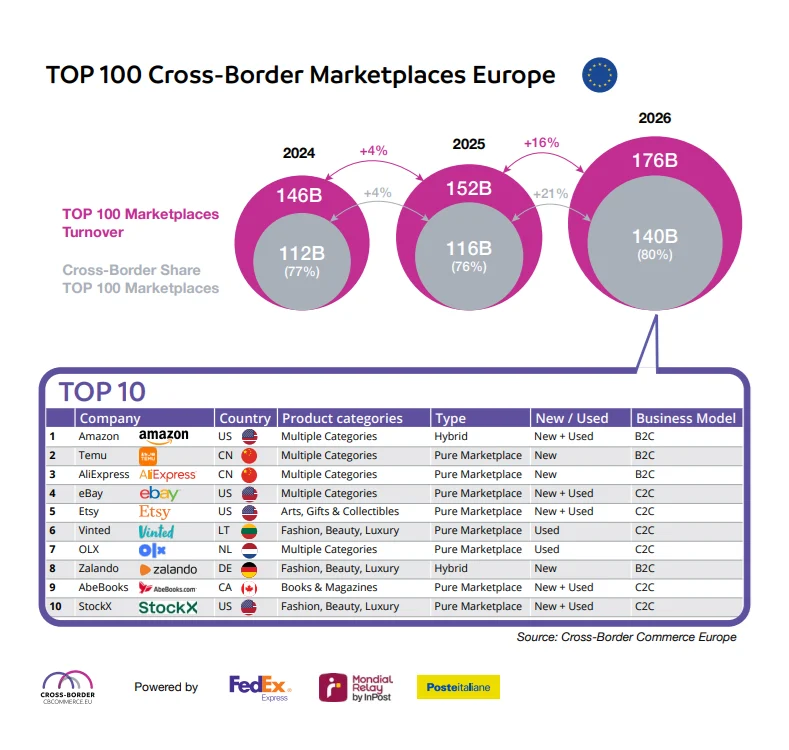
The European digital economy is undergoing a structural transformation. According to the seventh edition of the “Top 100 Cross-Border Marketplaces Europe” report, published by Cross-Border Commerce Europe (CBCommerce), the continent’s premier online platforms are poised to hit a staggering 175.8 billion euros in Gross Merchandise Volume (GMV). Perhaps more significantly, the data reveals that cross-border trade—sales conducted between different European nations or originating from outside the EU—now accounts for 79.5 percent of this volume, cementing a shift toward a truly integrated, borderless retail ecosystem.
Main Facts: The Acceleration of Cross-Border Dominance
The latest figures paint a picture of a market that has moved beyond its infancy. The top 100 marketplaces operating in Europe are no longer just domestic giants; they are international powerhouses navigating a complex regulatory and consumer landscape.
As of the current assessment, the aggregate GMV of these top 100 platforms stands at 175.8 billion euros. However, the composition of this figure is where the real story lies. Nearly four-fifths of this total (79.5%) is derived from cross-border activity. This metric is not static; it is projected to grow annually as consumer trust in international delivery, language-localized interfaces, and multi-currency payment systems reaches maturity.
By 2026, the report anticipates that cross-border sales will climb to 139.8 billion euros. Looking further ahead to 2027, the growth trajectory remains aggressive: total GMV for the top 100 is expected to rise by 8 percent to approximately 190 billion euros, while cross-border-specific GMV is set to surge by 10 percent, reaching 154 billion euros. By 2027, the reliance on cross-border transactions will account for 81 percent of the total market volume.
A Chronology of the European Marketplace Evolution
To understand how Europe reached this 175-billion-euro milestone, one must look at the evolution of the market over the past decade.
2015–2018: The Domestic Foundation
In the mid-2010s, European e-commerce was largely fragmented. Consumers preferred local marketplaces, and logistics networks were primarily national in scope. Cross-border trade was hindered by high shipping costs, divergent consumer protection laws, and limited payment options.
2019–2021: The Pandemic Catalyst
The COVID-19 pandemic served as a massive accelerant for digital adoption. As physical stores closed, European consumers were forced to look beyond their borders to secure essential and non-essential goods. This era saw the rapid expansion of fulfillment infrastructure, as major players realized that to capture the European market, they had to be "local" everywhere.
2022–2024: The Era of Regulation and Consolidation
During this period, the European Union introduced stringent regulations, including the Digital Services Act (DSA) and updates to VAT rules for e-commerce. These regulations forced smaller players to exit or merge, leading to a consolidation of the market. This phase also marked the entry of aggressive global competitors, such as Temu, which utilized high-volume, low-cost supply chains to disrupt the status quo.
2025–2027: The Age of AI and Social Commerce
We are currently in a phase defined by technological integration. The focus has shifted from mere "access" to "discovery." AI-driven product recommendations and the rise of social commerce—where social media platforms act as storefronts—have fundamentally changed how European consumers discover products.
Supporting Data: The Drivers of Growth
The Top 100 Cross-Border Marketplaces Europe report utilizes a sophisticated scoring methodology to rank platforms. This scoring is based on four key pillars:
- Cross-Border Sales Volume: The absolute value of goods sold outside the country of origin.
- SEO Performance: The ability of the platform to rank across various European search engines and capture organic traffic.
- Geographic Coverage: The number of European countries in which the marketplace has an active, localized presence.
- Website Traffic: A proxy for consumer engagement and brand loyalty.
The Top Tier
The podium of this year’s list remains occupied by global titans: Amazon, Temu, and AliExpress. These platforms have successfully leveraged their massive economies of scale to dominate the European landscape. Amazon, with its long-standing infrastructure, continues to lead through reliability and Prime integration. Temu and AliExpress, meanwhile, have captured a massive segment of the budget-conscious consumer market, utilizing direct-to-consumer logistics models that bypass traditional European retail intermediaries.

Official Responses and Industry Sentiment
The researchers behind the study, led by the team at CBCommerce, suggest that the European marketplace is entering a "new era of complexity." In recent statements, industry analysts have noted that the competitive landscape is no longer just about pricing.
"While low prices and fast delivery were the catalysts of the last decade, the next phase of growth will be defined by the quality of the ecosystem," notes a senior analyst involved in the report. "Platforms that invest in local European fulfillment infrastructure are winning, not just because they are cheaper, but because they provide a level of service parity that domestic retailers struggle to match."
However, there is a note of caution regarding the regulatory environment. The "extra layer of complexity" mentioned in the report refers to the increasing burden of compliance. From sustainability requirements—such as the Digital Product Passport—to strict data privacy laws, marketplaces are finding that the cost of doing business in Europe is rising. Yet, because the market is so lucrative, few major players are willing to retreat.
Implications: What This Means for the Future
The shift toward a cross-border dominant market has profound implications for stakeholders across the supply chain.
For Local Retailers
The dominance of the top 100 marketplaces presents a "coopetition" dilemma for local retailers. While smaller brands rely on these platforms for traffic and reach, they also face the risk of being sidelined by the platforms’ own private-label goods or by deep-pocketed international competitors. The implication is clear: local retailers must diversify their digital presence and focus on niche markets that AI-driven, high-volume platforms might overlook.
For Logistics and Infrastructure
The 10 percent projected growth in cross-border GMV by 2027 places an immense burden on logistics providers. We can expect to see a massive increase in demand for decentralized warehousing. Platforms are increasingly moving away from centralized "one-hub-for-all" models, instead investing in regional distribution centers located closer to the end consumer to manage returns and delivery times more efficiently.
For Consumers
European consumers are the primary beneficiaries of this transformation. Competition between the top 100 has led to increased price transparency, better delivery options, and a wider variety of goods. However, there is a growing concern regarding product safety and the environmental impact of the "fast commerce" model. As regulations tighten, consumers can expect to see a greater focus on sustainability labeling and ethical supply chain disclosures.
For Regulatory Bodies
The findings suggest that the EU’s vision of a "Digital Single Market" is becoming a reality, albeit through the lens of private marketplace dominance rather than purely organic trade. This presents a challenge for regulators: how to encourage competition and innovation while ensuring that a handful of non-European platforms do not hold excessive power over the European consumer experience.
Conclusion: The Path Ahead
The data provided by the seventh edition of the “Top 100 Cross-Border Marketplaces Europe” is a clear signal that the European retail sector has fundamentally changed. With 175.8 billion euros in GMV and a trajectory that points toward further consolidation and growth, the "borderless" era of European e-commerce is no longer a future goal—it is the present reality.
As marketplaces continue to integrate AI, refine their logistics, and navigate the tightening web of European regulations, the competition for the consumer’s attention will only intensify. Whether through social commerce, hyper-personalized AI discovery, or the expansion of local infrastructure, the top 100 platforms are setting the pace for the rest of the industry. For businesses and consumers alike, the message is the same: the future of European trade is digital, global, and highly competitive.