Introduction: A Nation Under Siege
Indonesia is currently facing one of its most severe environmental crises in a decade, as a combination of extreme drought conditions driven by the El Niño climate pattern and systemic land-management failures have ignited massive wildfires across the archipelago. The infernos have decimated infrastructure, displaced thousands of civilians, and triggered a regional health crisis due to suffocating haze. As the government struggles to contain the blazes, the long-term ecological consequences for the nation’s critically endangered wildlife have reached a tipping point.
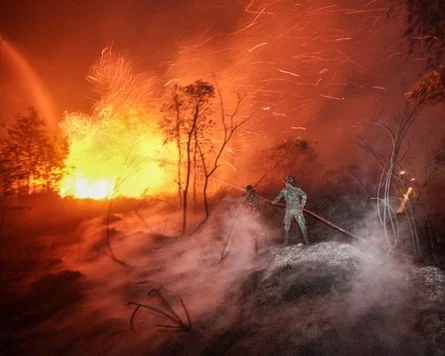
The situation in Sumatra’s Bangka Belitung province serves as a harrowing microcosm of the wider disaster. What began as a local effort to extinguish a minor flare-up ended in the destruction of nearly 300 homes, forcing an evacuation of approximately 1,000 residents. Experts warn that unless the intensity of the current weather cycle subsides, the country risks matching the catastrophic records of 2015, a year that remains etched in the national psyche as an environmental catastrophe of global significance.
Chronology: From Smoldering Peat to Total Loss
The disaster in Bangka Belitung did not happen overnight; it was a slow-motion catastrophe rooted in the volatile nature of peatland ecosystems.
Saturday: The False Sense of Security
The crisis in the South Bangka regency began on a Saturday, when residents identified smoke approaching the perimeter of their village. In an act of desperate communal defense, locals utilized portable water pumps to combat the advancing flames. For a moment, it appeared they had succeeded. However, the reality of peatland fires—which can smolder deep underground for weeks, hidden from the naked eye—meant the danger was far from over.
The Shift: A Wind-Driven Disaster
"They thought it was taken care of," explained Riza Herdavid, the head of South Bangka regency. "But it’s peatland, and there was still a fire smoldering underneath. So, when they assumed it was over, the wind shifted and quickly drove the fire toward the settlement."
The transition from a controlled situation to total devastation was instantaneous. By the time the wind shifted, the fire had effectively bypassed the perimeter, sweeping through the village and consuming homes in its path. For many residents, there was no time to salvage belongings.
"My house is gone," said Leni, 55, who is currently sheltering with her family. "There’s nothing left. I could only save myself and take my kids with me… I panicked and didn’t have the time to grab anything."
The Human Toll and Regional Haze
The destruction in Bangka Belitung is only one front in a nationwide battle. The fires have generated thick, acrid haze that has blanketed local provinces and drifted across national borders, impacting air quality in neighboring Singapore and Malaysia.

Public health officials in Indonesia have reported tens of thousands of cases of acute respiratory infections directly linked to the poor air quality. The haze serves as a stark reminder that the environmental impact of the fires does not respect borders. As the pollution levels rise, the socio-economic strain on regional economies grows, prompting international concern over Indonesia’s ability to manage its land-use policies during extreme climate events.
Supporting Data: An Unprecedented Challenge
Meteorological data confirms that the current conditions are the most severe in ten years. Indonesia, historically vulnerable to the droughts associated with El Niño, is witnessing a compounding effect where human-driven land degradation meets climate-induced heat.
Tracking the 2015 Precedent
Analysts tracking the trajectory of this year’s fire season suggest that the total area burned and the resulting carbon emissions are currently on track to mirror the 2015 disaster. In 2015, the fires consumed 2.6 million hectares of land, releasing approximately 333 megatonnes of carbon into the atmosphere. The 2026 season is displaying similar characteristics, with high-intensity burns occurring across multiple islands simultaneously.
The Problem of Land Conversion
The vulnerability of these areas is often exacerbated by human intervention. Riza Herdavid noted that the destroyed village in South Bangka had been constructed on former peatland within a protected area. The conversion of this land into a residential complex just last year highlights a critical failure in land-use regulation. Peatlands are natural sponges; when they are drained or disturbed, they become highly flammable, transforming from carbon sinks into massive carbon sources once they ignite.
The Ecological Emergency: A Silent Massacre
While the loss of human property is heartbreaking, the impact on Indonesia’s biodiversity is potentially irreversible. The fires are sweeping through habitats that support some of the most endangered species on the planet.
The Plight of the Orangutan
The orangutan, an iconic symbol of Indonesia’s rainforests, is at the center of this crisis. According to the International Union for Conservation of Nature (IUCN), fires have now affected habitats containing 52% of the total orangutan population in Borneo.
Since August, the West Kalimantan Natural Resources Conservation Agency has rescued at least 46 of these primates. In a recent operation, eight orangutans were transported by car and boat to the relative safety of the Batu Nyambu protected forest. However, for every individual rescued, countless others are lost to the flames or succumb to the subsequent loss of food and water sources.
Cascading Wildlife Impacts
The ecological impact extends far beyond primates. Reports indicate that silvered langurs, long-tailed macaques, and proboscis monkeys have been found dead in the wake of the fires or near dried-up water sources. Larger mammals, including elephants, as well as smaller species like pangolins and turtles, are facing a desperate struggle for survival. Even after the fires are extinguished, the lingering effects of the drought—scarce prey, destroyed canopy, and water shortages—will likely continue to drive mortality rates among wildlife for months.
Official Responses and Strategic Mobilization
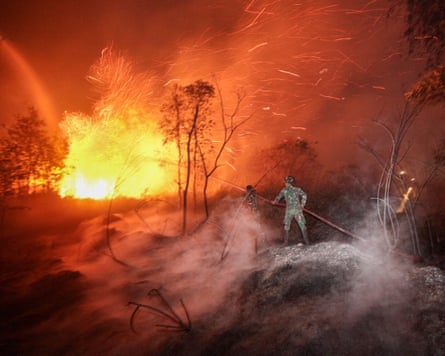
The Indonesian government, under the leadership of President Prabowo Subianto, has acknowledged the gravity of the situation. On Monday, the President issued a directive ordering the government to mobilize "maximum efforts" to suppress the wildfires, some of which have been burning for three months.
Massive Resource Deployment
The response is unprecedented in scale. According to Cabinet Secretary Teddy Indra Wijaya, the government has deployed more than 60,000 personnel to the front lines. This massive ground force is tasked with manual firefighting, constructing firebreaks, and managing local evacuations.
However, technology has struggled to keep pace with the sheer density of the smoke. In several provinces, the haze has become so thick that water-bombing aircraft have been grounded, rendering them useless at a time when they are needed most. This reliance on manual labor, while necessary, underscores the limitations of the current containment strategy.
Implications: The Long Road to Recovery
The crisis is far from over. Authorities have warned that the fires could persist until November, when the El Niño event is expected to reach its peak. This timeline creates a precarious period for the thousands of displaced villagers and the surviving wildlife populations.
Accountability and Future Policy
The lawsuit filed against Indonesia alleging "gross negligence" regarding the wildfires is a sign of growing domestic and international pressure for systemic change. The legal argument centers on the failure to protect vulnerable peatlands and the lack of foresight in land-use planning. As the world watches, the Indonesian government faces the dual challenge of immediate disaster relief and the long-term necessity of reforming its environmental policies.
The combination of climate change and human expansion into protected areas has created a "perfect storm." Without a fundamental shift in how the nation manages its forests and peatlands, the cycles of burning—and the human and ecological tragedies that accompany them—are likely to become the new, devastating norm.
For the families in the temporary shelters and the conservationists working to save the last of the orangutans, the focus remains on the present. But for the nation as a whole, the question remains: how much more of the country’s natural heritage can be lost before the cost becomes too high to recover?