The Port of Columbia, a vital logistical hub situated in the heart of Northeast Louisiana, has taken a significant step toward modernizing its infrastructure. A new $1 million loan, awarded by Louisiana Economic Development (LED) through its specialized "FastSites" program, has successfully bridged a critical funding gap for a $7 million rail spur project. This infrastructure enhancement is set to physically connect the 400-acre port facility directly to the Union Pacific (NYSE: UNP) main line, a development that regional leaders argue will fundamentally transform the economic landscape of the Ouachita River valley.
The Core Project: Connecting to the Main Line
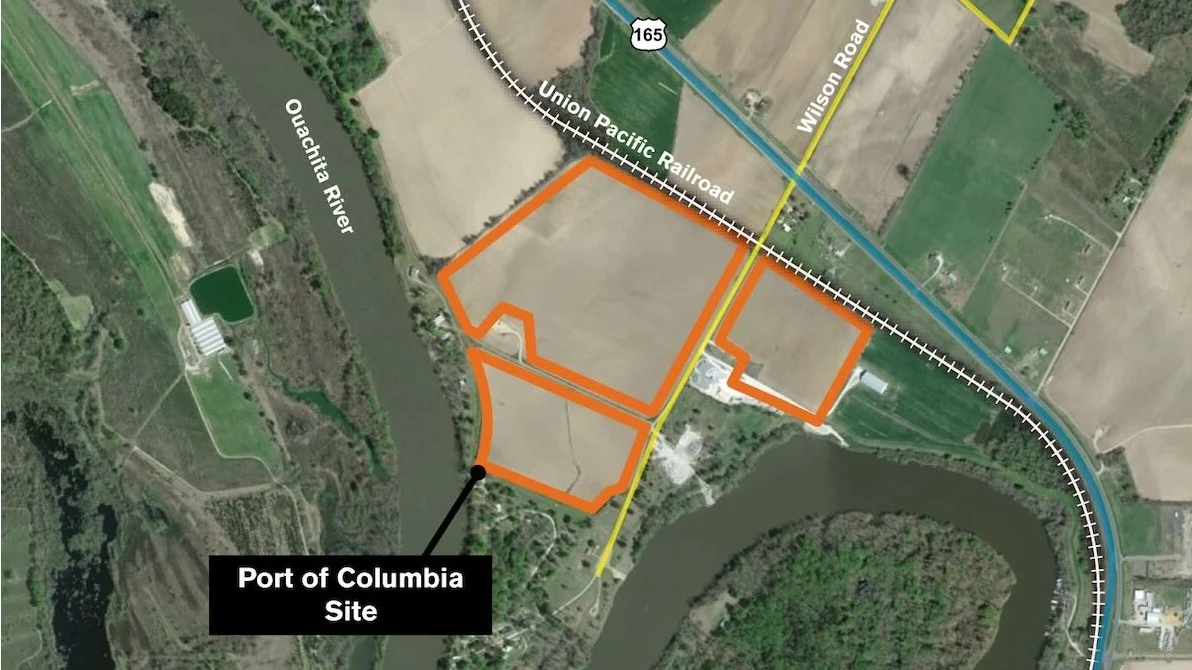
The project centers on the construction of a heavy-duty rail spur that will link the Port of Columbia—located approximately 30 miles south of Monroe—to the Union Pacific’s Monroe Subdivision. Currently, the port relies on its dual access to the Ouachita River for barge traffic and U.S. Route 165 for trucking. While these modes of transport are essential, the lack of direct rail connectivity has historically limited the port’s ability to compete for high-volume industrial tenants and bulk commodities that require the cost-efficiencies and long-haul capabilities of rail.
The $7 million project is a collaborative financial undertaking. In addition to the $1 million infusion from the state’s FastSites program, the initiative is supported by the Louisiana Department of Transportation and Development (DOTD) and federal grants secured through the Delta Regional Authority’s (DRA) Community Infrastructure Fund. By finalizing this funding package, the Port of Columbia is now positioned to move from the planning phase to active implementation.
Chronology of Development
The path to this rail expansion has been a multi-year effort involving local, state, and federal coordination.
- Initial Planning and Site Assessment: Following the identification of the 400-acre site as a prime location for industrial expansion, the Port of Columbia Commission initiated feasibility studies to determine the cost and regulatory requirements for a rail link.
- Funding Acquisition: Over the past two years, the commission worked to patch together disparate sources of capital. The complexity of the project—spanning environmental permitting, rail engineering, and land acquisition—required a phased approach to funding.
- The FastSites Catalyst (2024): The recent award from Louisiana Economic Development served as the "closing" capital, providing the liquidity necessary to commit to a formal construction schedule.
- Bid Solicitation (November 2026): The port is currently preparing the documentation for public bids, which are scheduled to be released in November. This will open the project to heavy civil engineering and rail construction firms.
- Construction Phase (Q1 2027 – 2028): Pending the selection of a contractor, groundbreaking is slated for the first quarter of 2027. The project is anticipated to reach completion by 2028, at which point the port will officially gain the capacity to handle rail-to-barge and rail-to-truck transfers.
Supporting Data and Economic Context
The economic logic behind the Port of Columbia’s expansion is rooted in the "intermodal" trend currently sweeping the U.S. logistics sector. According to industry reports, intermodal rail volumes have seen robust growth, often outpacing general commodities traffic as companies look for more reliable and fuel-efficient ways to move freight.
The Monroe Subdivision of Union Pacific represents a strategic artery for the region. By tapping into this line, the Port of Columbia is not merely adding a track; it is integrating its local businesses into a national supply chain network. The region is already seeing interest from sectors such as green energy and chemical production, which require consistent, high-capacity transport.
Louisiana Green Fuels, a major prospective industrial investment in the area, has been cited by local officials as the type of entity that requires this specific infrastructure. The facility’s ability to attract such "anchor tenants" is directly proportional to its logistical capabilities. Without the rail spur, the port would be unable to provide the competitive transport rates necessary to secure long-term, high-value industrial contracts.
Official Responses and Strategic Vision
The importance of this project was underscored by Darron McGuffee, President of the Columbia Port Commission, who emphasized the necessity of "gap financing" for rural infrastructure.
"For a rural port like Columbia, FastSites provides critical gap financing that allows us to turn committed infrastructure funding into a project under construction," McGuffee stated. He noted that the financial flexibility offered by the state program is the primary driver behind the port’s ability to adhere to its ambitious timeline.
"The FastSites investment gives the port the financial flexibility needed to keep the project moving and maintain our construction schedule," McGuffee added. "More importantly, this rail spur will provide public access to Union Pacific’s main line for our region, creating new transportation opportunities for existing businesses while strengthening our ability to attract future industrial investment."
State Sen. Glen Womack echoed these sentiments, framing the rail spur as a regional economic development tool rather than a localized project. "Adding rail access at the Port of Columbia opens another path for businesses across Northeast Louisiana to move goods and reach markets," Womack said. "That kind of connectivity strengthens our ability to support the industries already operating here while creating more possibilities for companies looking to invest in the region."
Implications: A New Era for Northeast Louisiana
The implications of the Port of Columbia’s rail connectivity are manifold:
1. Enhanced Industrial Recruitment
In the world of industrial site selection, "rail-served" is often a baseline requirement for large-scale manufacturing and processing plants. By securing this link, the Port of Columbia moves into a higher tier of competitiveness, capable of bidding for projects that previously would have looked to sites in larger metropolitan areas.
2. Diversification of Transport Modes
The current dependence on trucking and river barge traffic leaves the region vulnerable to fluctuations in river levels (impacting barge draft) and fuel prices (impacting trucking). Rail provides a third, stable leg to the stool, ensuring that even if one mode faces disruption, local businesses retain a path to market.
3. Regional Supply Chain Resilience
The integration of a rural port into a Class I railroad’s main line improves the overall resilience of the Louisiana supply chain. As seen in recent years, when supply chain bottlenecks occur, regional hubs with diverse transport access points become essential for keeping essential goods—such as energy products, agricultural commodities, and chemical components—moving smoothly.
4. Long-term Job Creation
Infrastructure projects of this scale are inherently job-intensive, but the secondary effect is the long-term industrial employment that follows. Once the rail spur is operational, the capacity for expanded operations at the port will likely lead to an increase in logistics, warehousing, and maintenance roles, bolstering the local economy of Columbia and surrounding parishes.
Looking Ahead: The Future of Freight
As the Port of Columbia moves toward its 2028 completion date, the project will serve as a bellwether for how state-led initiatives can revitalize rural infrastructure. With the backing of Union Pacific’s network and the financial support of state and federal agencies, the port is poised to become a critical link in the broader American freight network.
The industry will be watching closely as the project goes to bid this November. For companies operating in Northeast Louisiana, the prospect of direct rail access offers a clear path toward lower transportation costs and expanded market reach. For the state of Louisiana, the success of this project could provide a blueprint for future infrastructure developments in other rural, river-adjacent sites, reinforcing the state’s position as a gateway for international and domestic commerce.
As the construction phase approaches in early 2027, the focus will shift from funding and planning to execution. The successful completion of this rail spur will not only represent a win for the Port of Columbia but will also serve as a vital piece of the puzzle in strengthening the region’s overall economic competitiveness for decades to come.