The current state of relations between Israel and Turkey—two of the Middle East’s most formidable military and economic powers—is frequently framed as an inevitable clash of civilizations or an inescapable byproduct of historical friction. However, a deeper analysis reveals a more nuanced reality: the intensifying rivalry is not a historical destiny, but a calculated manifestation of each nation’s pursuit of strategic autonomy and long-term self-preservation. As the regional order undergoes a profound transformation, both Jerusalem and Ankara are positioning themselves to navigate a world where Western security guarantees are increasingly viewed as transitory.
For policymakers in the West, the challenge lies in avoiding the trap of viewing these two powers as inherently incompatible. By understanding that their competition is driven by parallel desires for sovereignty, the international community may find pathways to manage this volatility before it devolves into direct confrontation.
The Architecture of Modern Friction: Main Facts
The contemporary breakdown in Turkish-Israeli relations is not merely a diplomatic spat; it is an escalation rooted in conflicting visions for the Levant and the Eastern Mediterranean. Since the outbreak of the Israel-Hamas war in 2023 and the subsequent collapse of the Bashar al-Assad regime in late 2024, the two nations have found themselves on divergent paths regarding regional stability.
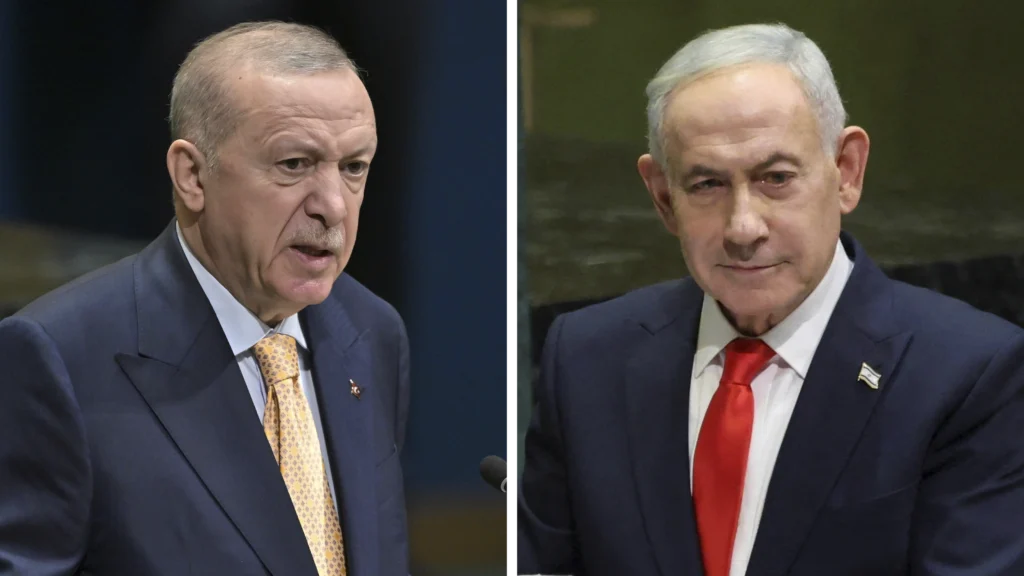
President Recep Tayyip Erdogan has utilized the Palestinian cause as a cornerstone of his geopolitical branding, frequently lambasting Prime Minister Benjamin Netanyahu’s military conduct. Beyond rhetoric, the rivalry has manifested in tangible economic warfare, with Turkey severing nearly all commercial ties with Israel, demanding a permanent ceasefire in Gaza. In return, the Israeli establishment has accused Erdogan of fostering an authoritarian, antisemitic regime, effectively freezing the intelligence-sharing and diplomatic cooperation that once defined their relationship.
This friction is not confined to the diplomatic arena. In Syria, the risk of a kinetic clash has risen sharply. Israel’s recent strike on the Abu Al-Duhur airbase was a clear warning shot against Turkey’s anticipated troop deployments in the area. Meanwhile, in the Eastern Mediterranean, a high-stakes competition over hydrocarbon exploration and maritime boundaries has pitted Israel’s energy-grid projects with Greece and Cyprus against Turkey’s insistence on its own sovereign drilling rights.
A Chronology of Escalation and Alignment
To understand the present, one must look at the historical pendulum of this relationship:
- 1948–1950s: Despite initial opposition to the UN partition plan, Turkey became the first Muslim-majority nation to recognize the State of Israel. This move, while creating friction with the rising tide of Pan-Arabism, solidified a pragmatic, if often quiet, strategic partnership.
- 1958: David Ben-Gurion formalized the "Periphery Doctrine," aiming to secure Israel by forging alliances with non-Arab regional powers. The clandestine Trident intelligence-sharing pact between Turkey and Israel became the bedrock of this strategy, defining the region’s security architecture for decades.
- 2010s: The relationship suffered a series of high-profile ruptures, most notably the Mavi Marmara incident, which saw diplomatic ties strained to the breaking point as domestic Turkish politics shifted toward a more assertive, neo-Ottoman foreign policy.
- 2023–2024: The Gaza conflict and the power vacuum in Syria catalyzed a total breakdown. Erdogan’s overt support for Hamas leaders and Netanyahu’s refusal to tolerate Turkish influence in the Levant turned a strained relationship into a hostile one.
- 2025–2026: The emergence of competing regional blocs—Turkey’s "Mecca Pact" (with Pakistan and Saudi Arabia) and Israel’s "Abraham Accords"—has formalized the current standoff, creating two distinct security umbrellas that rarely overlap.
Supporting Data: The Drivers of Autonomy
The rationale for this rivalry is rooted in a mutual, profound sense of vulnerability. Both nations feel "encircled." For Turkey, the Kurdish question remains a primary existential concern. Despite ongoing peace processes attempting to bring the PKK into a political framework, the Turkish state continues to view autonomy for Kurdish factions as a threat to its territorial integrity.
Israel operates under a different, yet equally acute, sense of insecurity. Without internationally recognized, stable borders and facing constant pressure from non-state actors like Hezbollah and the potential for a resurgent Hamas, Jerusalem maintains a "preemptive" military posture. Both nations have increased defense spending by over 20% in the last three years, focusing heavily on indigenous supply chains to reduce reliance on US or European military aid.
The energy sector provides further data points for this competition. Turkey’s electricity and oil needs are projected to triple and double, respectively, by 2050. Israel, conversely, has achieved energy self-sufficiency via the Leviathan and Tamar gas fields. Israel’s decision to integrate its power grid with Greece and Cyprus is viewed by Ankara not as a commercial project, but as a strategic maneuver to deny Turkey a seat at the regional energy table.
Official Responses and Diplomatic Posturing
The rhetoric from both capitals remains hardened. President Erdogan has consistently framed his opposition to Israel as a moral crusade, positioning himself as the primary defender of the Palestinian people against what he terms a "terror state." His hosting of Hamas officials is not merely a diplomatic gesture; it is a signal of his intent to lead the "Muslim world" in a way that bypasses traditional Western-aligned structures.
Prime Minister Netanyahu’s office has countered by branding the current Turkish government as a destabilizing force that undermines the progress made by the Abraham Accords. Official Israeli statements emphasize that Turkey’s "hostile" interference in Syria and its maritime claims are incompatible with the security interests of Israel and its new regional partners. Despite this, there remain "back-channel" mechanisms. Intelligence agencies in both countries continue to maintain a "hotline" to prevent accidental military escalations in Syria, proving that even in periods of high hostility, the necessity of survival keeps a narrow door to communication open.
Strategic Implications: The Future of the Levant
The implications of this rivalry are significant for the broader Middle East. If the current trend of "managed hostility" fails, the region risks a proxy war that could draw in global powers, complicating the already fragile stability of the post-Assad era.
However, there is a path toward de-escalation. The rivalry is largely fueled by the current leaderships’ personal animosities and a misreading of their long-term interests. Israel is not a natural adversary of Turkey, nor is it a permanent ideological ally of the Greece-Cyprus axis; these are strategic alignments formed out of necessity rather than historical affinity.
Key areas for stabilization include:
- Syrian De-confliction: The West must facilitate a more robust, formalized security framework in Syria that recognizes Turkey’s need for border security and Israel’s need to counter Iranian-backed militias. By delineating zones of influence, the risk of a kinetic clash can be minimized.
- Energy Diplomacy: The Eastern Mediterranean energy disputes could be transformed into a multilateral forum. If Israel were to include Turkey in long-term transit agreements, it would mitigate Ankara’s sense of isolation and reduce the urgency for Turkey’s aggressive drilling tactics.
- Decoupling Ideology from Geopolitics: The Palestinian issue will remain a point of contention, but it does not have to be the sole determinant of relations. By separating the ideological dispute over the Palestinian state from the structural requirements of regional security, both nations could return to a model of "cooperative competition."
Conclusion
The Turkish-Israeli rivalry is not a historical inevitability, but a modern tactical standoff. Both nations are reacting to a world where they can no longer rely on external superpowers to ensure their safety. While their current trajectories appear to be on a collision course, their underlying national interests—energy security, the containment of non-state actors, and regional stability—are not inherently mutually exclusive.
If the international community can move beyond the "zero-sum" narrative and encourage these two regional pillars to engage in transparent security dialogues, the Middle East may yet see a return to a more stable, albeit complex, status quo. The alternative—a continued drift toward open conflict—serves the interests of neither Ankara nor Jerusalem, and would leave the entire region vulnerable to the very instability they both claim to be preventing.