By International News Desk
October 12, 2026
Spain celebrated its National Day on Monday with a spectacle of aerial prowess and technological advancement, yet the grandeur of the Paseo del Prado was overshadowed by a distinct absence and a palpable climate of political unrest. While the skies over Madrid roared with the engines of 82 aircraft, the ground-level proceedings reflected a nation grappling with significant border pressures and an impending general election.
Main Facts: A Parade Marked by Absence and Innovation
The 2026 National Day parade was defined by two contradictory narratives: the unveiling of next-generation military hardware and the notable exclusion of the autonomous city of Ceuta. For the first time in recent memory, no soldiers from the Ceuta garrison marched through the streets of Madrid.
The Spanish Ministry of Defence confirmed that forces typically reserved for ceremonial displays in the capital were kept at their posts in the North African enclave. This tactical decision follows the escalating crisis that began in July, when an unprecedented surge of thousands of migrants crossed the border from Morocco, placing immense strain on the territory’s infrastructure and security forces.
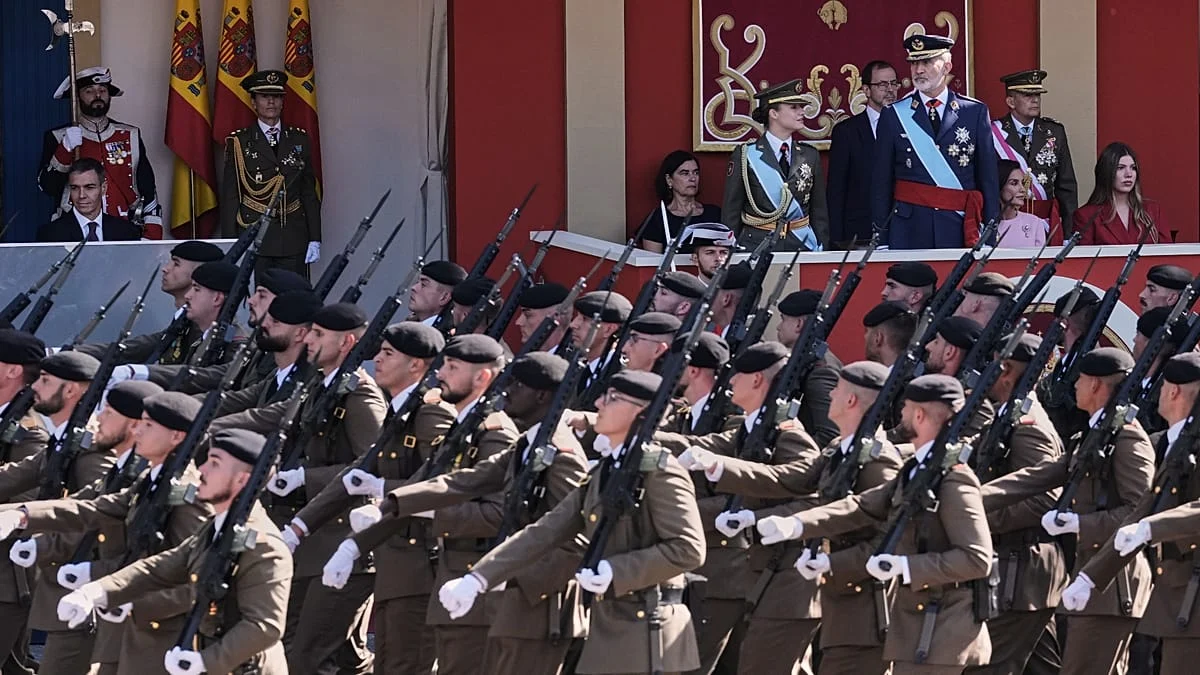
The parade featured 4,380 participants—3,850 men and 530 women—marching in disciplined formation. However, the true stars of the event were the technological additions to the Spanish arsenal. The 8×8 Dragón armoured vehicles, a cornerstone of the army’s modernization efforts, made their official debut, signaling a pivot toward higher-mobility land warfare. Furthermore, the inclusion of the Aracne anti-drone system and Asturcón drones from the Military Emergencies Unit (UME) underscored the Ministry’s commitment to addressing the evolving threats of 21st-century combat.
Chronology of Events
The day’s events unfolded with the precision expected of the Spanish Armed Forces, though the underlying political friction was apparent from the onset.
- 09:00 GMT+2: Crowds began gathering along the Paseo del Prado, despite the charged political atmosphere following Prime Minister Pedro Sánchez’s surprise announcement of an early general election, scheduled for November 29.
- 10:30 GMT+2: King Felipe VI and Queen Letizia arrived to preside over the ceremony. As Prime Minister Sánchez arrived, the public’s frustration with the current political impasse was made audible through a chorus of jeers and whistles from the sidelines.
- 11:00 GMT+2: The aerial display commenced under clear blue skies. The flypast was led by two F/A-18 jets, followed by a total of 82 aircraft showcasing the interoperability of the Spanish Air and Space Force.
- 11:45 GMT+2: The land parade proceeded, highlighting the heavy armour units and the newly integrated anti-drone technologies.
- 13:00 GMT+2: The formal proceedings concluded, transitioning to a reception at the Royal Palace, where the King and Queen hosted dignitaries to discuss the state of the nation.
- Looking Ahead: The King and Queen are scheduled to travel to Ceuta this coming Tuesday, a visit intended to signal royal support for the border city during its ongoing period of crisis.
Supporting Data: The Modernization of the Spanish Military
The 2026 parade served as a high-profile laboratory for the Ministry of Defence’s procurement priorities. The data provided by the Ministry highlights a clear transition from traditional heavy armour to modular, multi-threat systems.
The 8×8 Dragón Armoured Vehicle
The Dragón is more than just a vehicle; it represents the backbone of the "Force 35" modernization project. Designed to replace older platforms like the BMR and VEC, the 8×8 provides superior protection against improvised explosive devices (IEDs) and boasts advanced network-centric capabilities, allowing real-time data sharing between ground units and command centers.
The Anti-Drone Shift
Perhaps the most telling addition was the Aracne anti-drone system, deployed by the Marine Corps. With the proliferation of low-cost, high-impact Unmanned Aerial Systems (UAS) in modern conflicts, the Spanish military is accelerating its defensive capabilities. The integration of the Asturcón drones from the UME also highlights a dual-use strategy: leveraging surveillance technology for both natural disaster management and border surveillance.
Personnel Demographics
The participation of 530 women out of 4,380 personnel underscores the ongoing, albeit slow, progress in gender integration within the Spanish Armed Forces. While the military remains male-dominated, the professionalization of the force continues to be a strategic objective for the Ministry.
Official Responses and Political Implications
The absence of Ceuta’s troops was not merely a logistical matter; it was a political statement. By keeping the troops deployed at the border, the government is signalling that the security of the North African territories remains a higher priority than symbolic representation in the capital.
The Sánchez Factor
Prime Minister Pedro Sánchez arrived at the parade in an unusually precarious position. Having dissolved parliament just days prior, his attendance at the National Day celebrations served as a reminder of the fragility of his current administration. The jeers directed at him from the crowd reflect a deep-seated polarization within the Spanish electorate.
"The parade is a moment for unity," a government spokesperson stated, "but we must acknowledge that the challenges we face—whether at our borders or in our domestic political arena—require a focused and present leadership."
Critics, however, have argued that the exclusion of Ceuta’s troops from the parade was a missed opportunity to show national solidarity during a time of crisis. Opposition leaders have characterized the move as an attempt to "hide" the reality of the border situation from the public eye during the election campaign.
Implications for the Future
The 2026 National Day parade will likely be remembered not for the aircraft that flew overhead, but for the vacuum on the ground where the Ceuta contingent usually stands. The implications are multi-faceted:
- Security Policy: Spain is signaling a shift toward a "border-first" defense posture. The focus on anti-drone technology and mobile armoured units indicates that the Ministry of Defence is preparing for a future defined by hybrid threats rather than conventional land invasions.
- Domestic Stability: The upcoming general election on November 29 is shaping up to be one of the most consequential in modern Spanish history. The fact that the Prime Minister faced public dissent at such a patriotic event indicates that the housing crisis and immigration concerns will be the primary battlegrounds of the campaign.
- The Monarchy’s Role: The planned visit by King Felipe VI and Queen Letizia to Ceuta is a vital diplomatic maneuver. By visiting the site of the crisis, the Crown is attempting to act as a unifying force, distancing itself from the partisan squabbles of the Prime Minister and the opposition.
As the dust settles on the Paseo del Prado, the Spanish public is left with a clear picture of a nation in transition. The military is evolving, the borders are under strain, and the political climate remains volatile. With the election just weeks away, the imagery of this year’s National Day—the absent soldiers, the advanced drones, and the jeering crowds—will undoubtedly serve as a backdrop for the debates to come.
The parade was, in essence, a reflection of a country that is physically projecting power through technological advancement while simultaneously trying to manage significant fractures within its own borders and its own political institutions. The coming months will determine whether Spain can reconcile these tensions or if the divides displayed on October 12 will only widen as the nation approaches the ballot box.