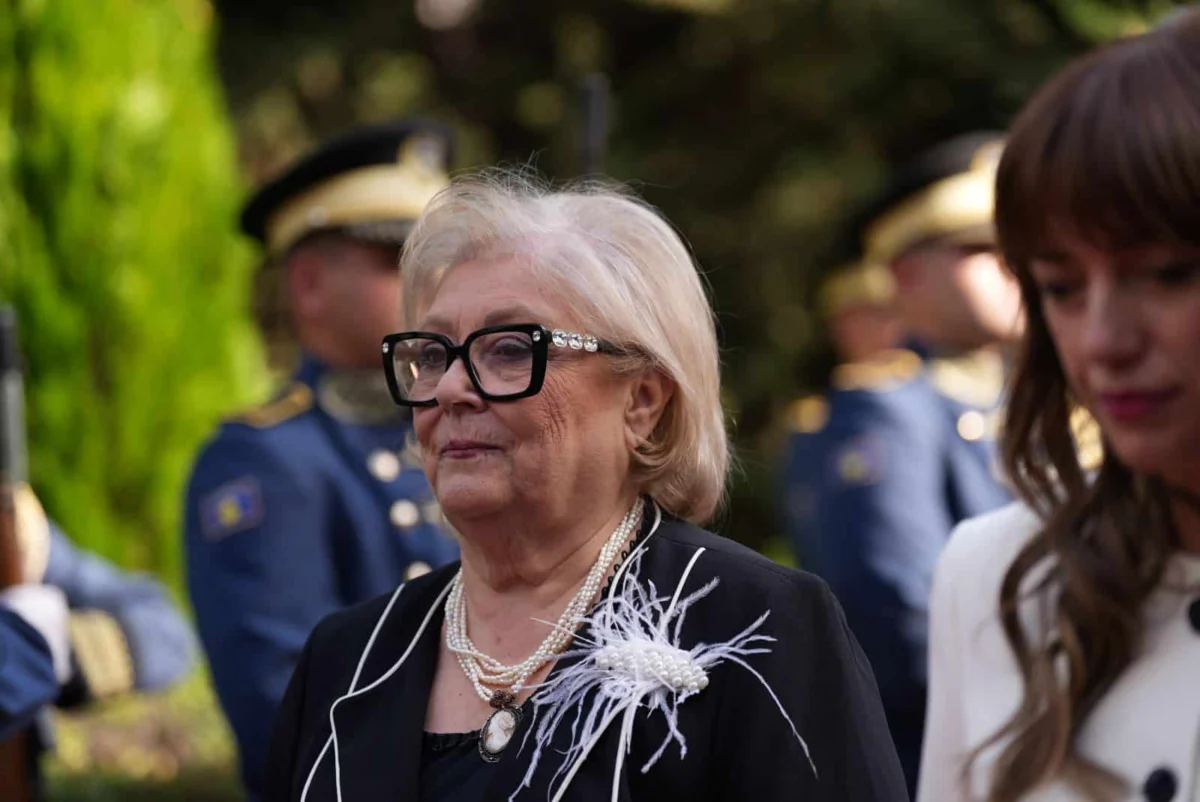
Pristina, Kosovo – October 7, 2026 – In a breathtaking turn of events that captivated the nation and pushed the boundaries of political negotiation, Justina Shiroka Pula was elected the new President of Kosovo late last night. The academician and former minister’s ascension to the highest office came after a tense and protracted period of deliberation, culminating in a last-minute consensus that averted the prospect of early elections.
The historic vote, held in the Kosovo Assembly, saw Shiroka Pula secure 81 votes in favor, a decisive margin that surpassed the two-thirds majority required. This outcome brought an end to weeks of political stalemate following the conclusion of President Vjosa Osmani’s term on April 4th, during which Assembly Speaker Albulena Haxhiu served as Acting President.
Shiroka Pula, a figure respected for her academic achievements and past contributions to public service, found herself thrust into the national spotlight under extraordinary circumstances. Her selection as a presidential candidate was not a planned campaign, but rather a strategic maneuver born out of a complex political deadlock.
The Eleventh Hour: A Presidency Forged in Urgency
The narrative of Shiroka Pula’s path to the presidency is one of dramatic urgency and unexpected turns. On the evening of October 7th, with the Constitutional Court’s midnight deadline looming, the nation held its breath. The prospect of further premature elections, a recurring theme in Kosovo’s recent political history, hung heavy in the air.
Justina Shiroka Pula herself was reportedly enjoying a quiet Tuesday evening, engaged in conversation with guests from Sarajevo, when her phone rang. The call, from a television studio broadcasting a prime-time political debate, was the first indication that her life was about to change irrevocably. Unbeknownst to her, she was being considered for the nation’s most esteemed position, a mere two hours before the constitutional deadline for the election of a new president.
Her initial reaction, captured in the moments following that call, was one of measured surprise and a need for consultation. "We’ll hear more later," she reportedly said, ending the television call. Minutes later, another phone call brought the gravity of the situation into sharper focus. "I can’t say anything at the moment. I haven’t yet spoken with the people I need to speak with. Let me discuss it with them a bit longer," she stated, as the clock relentlessly ticked towards midnight.
The urgency of the situation was palpable. The Constitutional Court had mandated the election of a president by midnight, threatening a constitutional crisis and a potential snap election by mid-November, barely two years after the last general election.
The final hours leading up to the vote were marked by intense behind-the-scenes negotiations and public pronouncements that painted a picture of a deeply divided political landscape. Albin Kurti, leader of the ruling Vetëvendosje party, and Bedri Hamza, head of the Democratic Party of Kosovo (PDK), engaged in a public dance of offers and counter-offers, their press conferences echoing through the corridors of power, often within earshot of each other.
Around 5:00 PM, Kurti appealed to PDK deputies to vote for Bekim Sejdiu, a candidate with whom Kurti had previously agreed in August with another opposition party, the Democratic League of Kosovo (LDK). However, this initiative faltered due to internal divisions within the LDK regarding their chosen candidate.

Three hours later, Kurti presented PDK with further options: either support Glauk Konjufca, the current Foreign Minister and Deputy Leader of Vetëvendosje, or Feride Rushiti, a civil society activist. This offer was made in exchange for PDK’s vote on proposed amendments to the law concerning the Specialist Chambers in The Hague, amendments that would have curtailed the court’s jurisdiction. Hamza, however, rejected these proposals.
As the clock neared 10:00 PM, amidst ongoing protests outside the Assembly building in support of the proposed amendments to the law on the Specialist Chambers, Kurti emerged to announce Shiroka Pula’s candidacy, describing it as an "exceptionally generous proposal." Minutes later, Hamza confirmed his party’s acceptance, signalling a breakthrough that many had considered improbable.
A Consensus Candidate: Meeting the Criteria
The emergence of Justina Shiroka Pula as a consensus candidate was the result of intricate political maneuvering and a shared desire to avoid further institutional paralysis. Analyst Shenoll Muharremi, an economist and political analyst based in Kosovo, described her as "the best option and fulfills most of the criteria for a consensual President."
Her background as an academic and former minister provided a degree of credibility and experience that resonated across the political spectrum. The decision to nominate her, particularly in the final hours, underscored the pragmatic approach taken by key political actors to resolve a critical constitutional impasse.
Following her election, Shiroka Pula addressed the Assembly, pledging to serve as "President of all citizens, regardless of their political, ethnic, or social background." Her inaugural speech emphasized the collective nature of her mandate, stating, "This mandate does not belong to one person alone, but to the citizens and the state."
This historic vote marks a significant moment for Kosovo, positioning Shiroka Pula as the third woman to hold the office of President since the country’s democratic transition in 2001. She follows in the footsteps of Atifete Jahjaga (2011-2016) and Vjosa Osmani (2021-2026). Her presidency, alongside Assembly Speaker Albulena Haxhiu, places two women at the helm of two of the country’s three main institutions, a symbolic advancement for gender representation in Kosovo’s leadership.
A Trailblazer in Academia and Public Service
Justina Shiroka Pula’s journey to the presidency is underscored by her pioneering role in both academic and public spheres. Her election is not her first foray into breaking barriers. In December of the previous year, she made history by becoming the first woman to head the Academy of Sciences and Arts of Kosovo (ASAK).
At the time of her election to ASAK, she was the sole woman among the 26 regular living members of the Academy. She had been a member since 2016, demonstrating a long-standing dedication to the institution. Her leadership at the Academy was seen as a crucial step forward for female representation in the nation’s highest academic body.
The Kosovo Women’s Network, an organization advocating for women’s rights, remarked on the significance of her ascension, stating, "Her election to this post signifies a significant step forward for the representation and leadership of women in the country’s highest institutions." They further noted that the inclusion of women in high institutional positions contributes to building a more equitable and democratic society.

Reflecting on her role at the Academy, Shiroka Pula emphasized the need for greater gender inclusivity. "We need to find different ways to promote the gender aspect within the Academy through projects and engagements," she stated in an interview with the YouTube channel "Nerv" about a month after her election to lead ASAK.
Born in Pristina in 1953, Shiroka Pula’s academic journey began at the University of Pristina, where she earned a degree in Economics in 1976. She further honed her expertise at the University of Zagreb, completing postgraduate studies in economic development theory and policy in 1984.
After a brief stint in the banking sector in Pristina during the socialist era, she embarked on her academic career at the university in 1978 as an assistant. She steadily climbed the academic ranks, achieving the position of full professor in 2004. Her academic leadership extended to roles such as Head of the Department of Management and Informatics at the Faculty of Economics, a member of the University of Pristina Senate, and a member of its Governing Council. Her commitment to academic excellence was further demonstrated through post-doctoral studies and training abroad, including at the University of Linz in Austria and the University of Arizona in the USA.
Her foray into politics began in 2008 when she joined the cabinet of former Prime Minister Hashim Thaçi as the Minister of Energy and Mining, a position she held until 2011. Subsequently, she served as a Member of Parliament for Thaçi’s PDK party from 2011 to 2014.
Averting Crisis: The Broader Implications
The election of Justina Shiroka Pula is viewed by many as a pivotal moment that has averted a deeper political crisis in Kosovo. Political analyst Shenoll Muharremi highlighted the significance of this compromise, stating that it has prevented "the capitulation of the state and the brutal capture of all institutions by a single party."
For years, Kosovo has grappled with political blockades and frequent early elections, often failing to form stable governing institutions due to a highly fragmented political landscape. Muharremi credits the recent compromise to public protests and shifts in the opposition, specifically mentioning the PDK and the Alliance for the Future of Kosovo (AAK), which prevented the installation of a president solely influenced by Vetëvendosje, a party that has steadily consolidated its control over state institutions.
"This is undoubtedly a good day for Kosovo," Muharremi concluded, underscoring the relief and optimism that the resolution has brought to a nation weary of political uncertainty. The election of Justina Shiroka Pula represents not only a personal triumph but also a significant step towards institutional stability and a more inclusive future for Kosovo.