The XRP Ledger (XRPL) has officially entered a new era of transactional efficiency. The highly anticipated "Batch" feature has successfully deployed to the mainnet, marking a significant milestone in the network’s architectural evolution. By enabling the execution of multiple transactions within a single operation, this amendment addresses long-standing demands for greater throughput and more complex, atomic-like transaction capabilities.
As the blockchain ecosystem moves toward more sophisticated financial instruments, the ability to bundle transactions is not merely a convenience—it is a foundational necessity for institutional-grade finance. With this deployment, the XRPL solidifies its position as a robust infrastructure layer capable of supporting everything from decentralized finance (DeFi) to complex cross-border settlement.
The Core Mechanics: What is the Batch Amendment?
At its simplest, the Batch feature allows an XRPL user to construct a single request that contains multiple distinct transactions. Historically, XRPL users were required to submit transactions sequentially, each requiring individual signature verification and ledger processing. While the ledger has always been high-speed, this sequential requirement created bottlenecks for complex operations, such as multi-asset swaps or large-scale institutional rebalancing.
With the Batch amendment (BatchV1_1), the network now supports atomic bundling. This means that a user can define a set of instructions that the ledger processes as a cohesive unit. If one part of the batch fails, the design philosophy ensures greater reliability and logical flow, significantly reducing the "gas" or transaction fee overhead and latency involved in coordinating disparate movements of assets.
Chronology: From Proposal to Mainnet Activation
The road to the deployment of the Batch feature was marked by careful deliberation and rigorous testing, adhering to the XRPL’s decentralized governance model.
- Initial Proposal and Technical Design: The concept was introduced to the developer community to address the need for "atomic execution" of multi-step processes. Engineers sought a solution that would not compromise the ledger’s security or performance.
- The Voting Process: The amendment entered the voting phase, where XRPL validators—the backbone of the network’s consensus mechanism—reviewed the code. The support was overwhelming, with 30 validators casting "Yes" votes, signaling strong consensus across the community, while only five validators opposed the change.
- Threshold Achievement: Roughly two weeks ago, the proposal crossed the majority threshold required for activation. This triggered the countdown to the mainnet release.
- Mainnet Activation: As of October 9, 2026, the feature is officially live. Data from XRPScan confirms that the amendment has been fully integrated into the mainnet, allowing developers and institutions to begin building applications that leverage the new functionality immediately.
Supporting Data and Technical Implications
The shift toward batch processing is a strategic move to optimize the XRP Ledger for a future dominated by institutional adoption. Currently, the ledger handles thousands of transactions per second, but the efficiency of those transactions is what determines the network’s utility for high-frequency trading firms and banking institutions.
1. Reducing Latency in OTC Markets
Over-the-Counter (OTC) trading relies on speed and the simultaneous movement of assets. Previously, if an institution needed to move five different assets to five different wallets, it required five separate transactions. With Batching, these can be streamlined, reducing the "execution window" and mitigating the risk of slippage or market volatility during the settlement phase.
2. Delivery vs. Payment (DvP)
The Batch feature is a cornerstone for Delivery vs. Payment (DvP) models. DvP is a settlement method that guarantees the transfer of securities only happens when payment is made. By bundling these two distinct actions (the asset transfer and the payment) into one batch, the XRPL removes the "trust" requirement between parties, as the batch ensures that one cannot occur without the other.
3. NFT Swaps and Programmable Logic
The NFT (Non-Fungible Token) space on XRPL has been growing, and the Batch feature acts as a catalyst for more complex marketplaces. NFT-for-NFT swaps, which previously required escrow or third-party intermediaries, can now be executed trustlessly within a single transaction, significantly reducing the cost and risk for retail users and collectors.
Expert Perspectives: The "Big Unlock"
The community response has been overwhelmingly positive, with prominent voices in the XRPL ecosystem framing this as a turning point for the network.
XRPL validator Vet, who has been a vocal proponent of the upgrade, described the functionality as a "massively important" milestone. In a recent statement, Vet noted, "Its a massively important functionality for the XRP Ledger to allow crucial use cases for institutions and also retail builders. Think of OTC trades, DvP, NFT for NFT swap, trustless transaction execution dependencies and so much more."
Vet emphasized that the true power of this amendment lies in the "unlimited creativity" it affords developers. By lowering the friction associated with complex transaction chains, the ledger opens the door for innovative financial products that were previously deemed too costly or technically inefficient to implement on-chain.

The Broader Context: XRPL’s Evolving Ecosystem
The arrival of the Batch feature does not exist in a vacuum; it is part of a concerted effort by the XRP Ledger community to modernize the network’s feature set. Simultaneously, the network is advancing its new lending protocol, which is currently open for validator voting.
The Lending Protocol Connection
The proposed lending protocol aims to introduce closed-ended vaults and cash-basis accounting to the XRPL. While the Batch feature focuses on execution efficiency, the lending protocol focuses on capital efficiency. Together, these updates represent a maturation of the XRPL from a simple payment network into a comprehensive financial ecosystem.
As the network adds these layers, the institutional appeal grows. Banks and financial institutions look for exactly this kind of roadmap: a network that is not only secure and fast but also possesses the programmable complexity required to replicate traditional financial services in a decentralized environment.
Market Impact and Future Outlook
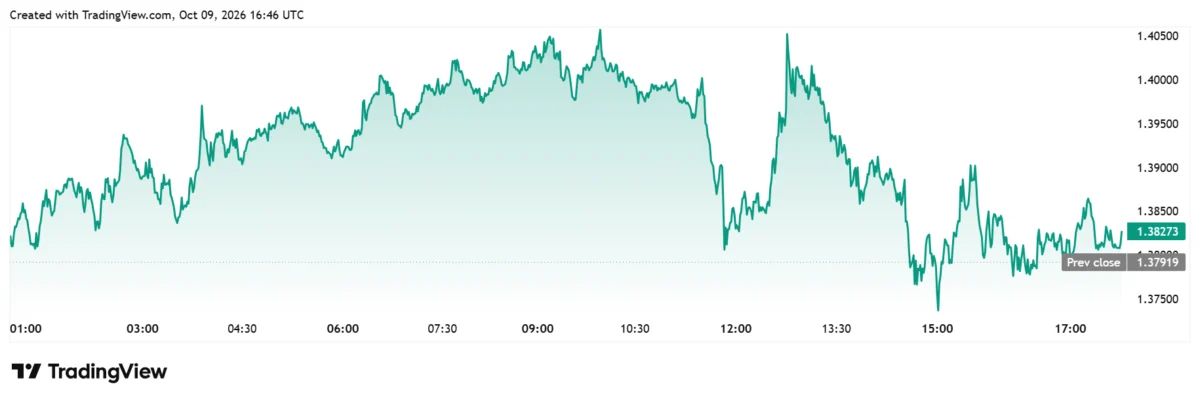
Following the announcement of the Batch feature’s live status, the price of XRP saw a modest uptick, reflecting a positive sentiment among investors. While the broader cryptocurrency market has faced volatility, the consistent delivery of technical upgrades on the XRPL has provided a foundation for long-term value.
Market Performance Analysis
As of October 9, 2026, XRP is trading at approximately $1.38. Despite a slight downward trend over the preceding week (a decrease of roughly 7%), the immediate reaction to the Batch deployment was green, suggesting that the market views the technological advancement as a net positive for the asset’s utility.
Investors are increasingly focusing on "utility-based" assets. In a landscape crowded with speculative tokens, the XRP Ledger’s focus on enterprise-grade infrastructure provides a clear narrative for institutional investors who prioritize reliability and technical scalability over short-term hype.

Looking Ahead
The next phase for the XRPL will be the adoption curve. As developers begin to integrate the Batch functionality into their wallets, decentralized exchanges (DEXs), and enterprise software, the real-world utility will manifest. We expect to see a surge in dApp development that utilizes these atomic batch operations to create safer, cheaper, and faster financial services.
For the retail user, the benefit will be felt in lower transaction complexity and more robust trading platforms. For the institution, the benefit is a cleaner, more reliable path to on-chain settlement.
Conclusion: A Milestone for Decentralized Finance
The successful deployment of the Batch feature on the XRP Ledger marks a transition from a network that handles individual payments to a network that orchestrates complex financial workflows. By allowing multiple actions to be bundled into one, the XRPL has effectively lowered the barrier to entry for high-stakes, professional-grade financial activity.
With the lending protocol on the horizon and the Batch feature now fully operational, the XRP Ledger is rapidly evolving into a multi-faceted platform. The synergy between these technical updates and the growing interest from institutional players suggests that the network is well-positioned for the next cycle of blockchain adoption. As Vet and other key stakeholders have noted, this is not just an update—it is a "big unlock" for the future of digital finance.