Executive Summary: A Balancing Act of Expansion and Expenditure
Werner Enterprises (NASDAQ: WERN) has laid out a definitive roadmap toward achieving double-digit truckload margins, yet the carrier’s latest quarterly performance serves as a stark reminder of the volatile landscape currently defining the freight industry. While management remains optimistic about a long-term freight upcycle, they cautioned that immediate cost pressures—specifically surrounding fuel volatility and aggressive driver recruitment—will likely suppress earnings growth through the remainder of the year and into the early months of 2027.
In its third-quarter earnings report released Tuesday, Werner posted adjusted earnings per share (EPS) of 16 cents. This figure, while meeting the company’s own revised profit warning issued earlier in the month, fell significantly short of the 36-cent consensus estimate held by analysts prior to the warning. Despite the earnings miss, consolidated revenue reached $951 million, a 23% year-over-year increase that landed at the top end of management’s expectations, bolstered primarily by strategic acquisitions and fuel surcharges.
Chronology of the Quarter: From Growth to Margin Compression
The third quarter was characterized by a push for scale that required heavy front-loaded investment. Werner successfully integrated the January acquisition of FirstFleet, a dedicated carrier that contributed significantly to the company’s fleet expansion. However, the costs associated with this growth—and the general operating environment—created a substantial drag on the bottom line.
The EPS Bridge
A detailed breakdown of the third-quarter financials reveals an 18-cent EPS drag attributed to sequential cost increases. The primary culprits included:
- Fuel Volatility: Escalating diesel prices throughout the quarter created a significant expense burden. Because fuel surcharges operate on a one-week lag, the rapid 10% sequential increase in August and 15% in September outpaced the company’s ability to recover costs in real-time.
- Labor Procurement: Aggressive efforts to bolster the driver workforce resulted in higher recruiting and training expenses.
- Claims Reserves: A reserve adjustment for prior insurance claims further weighed on profitability.
These negative factors were partially offset by a 4-cent tailwind generated from asset sales, which rose to $8 million compared to $4.5 million in the same period last year. Management emphasized that the significant investment in human capital—adding 130 dedicated trucks and drivers—was a "deliberate decision" to capture market share, even though the revenue generated by these assets did not materialize until late in the quarter.
Supporting Data: Operational Performance Metrics
Werner’s operational data provides a granular view of how different segments are responding to the shifting freight cycle.
Dedicated Segment Dominance
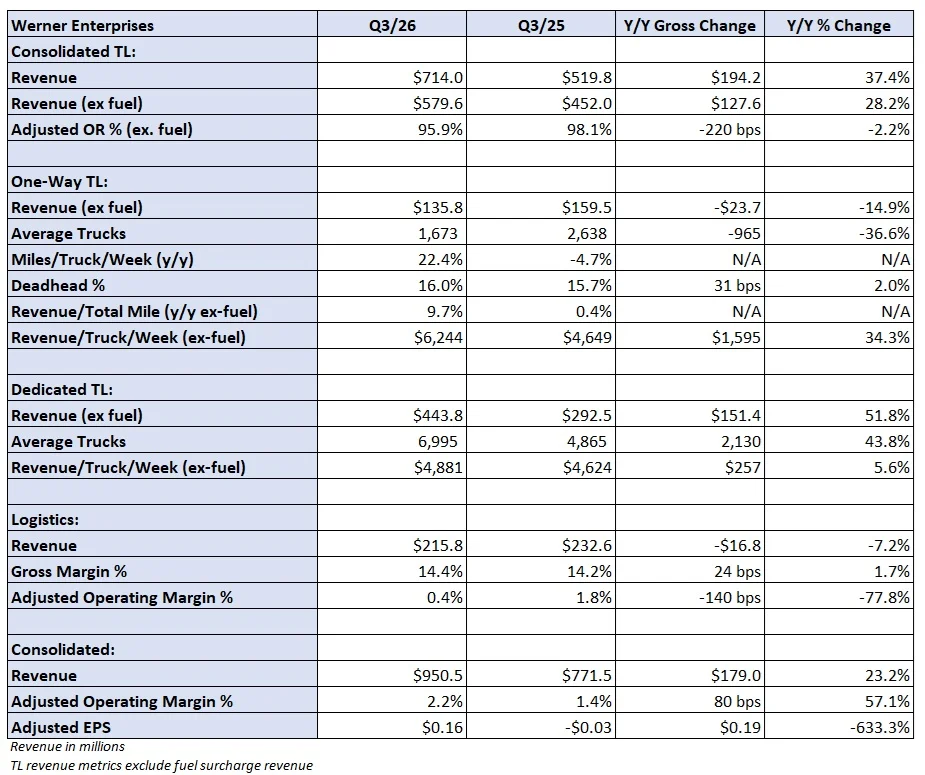
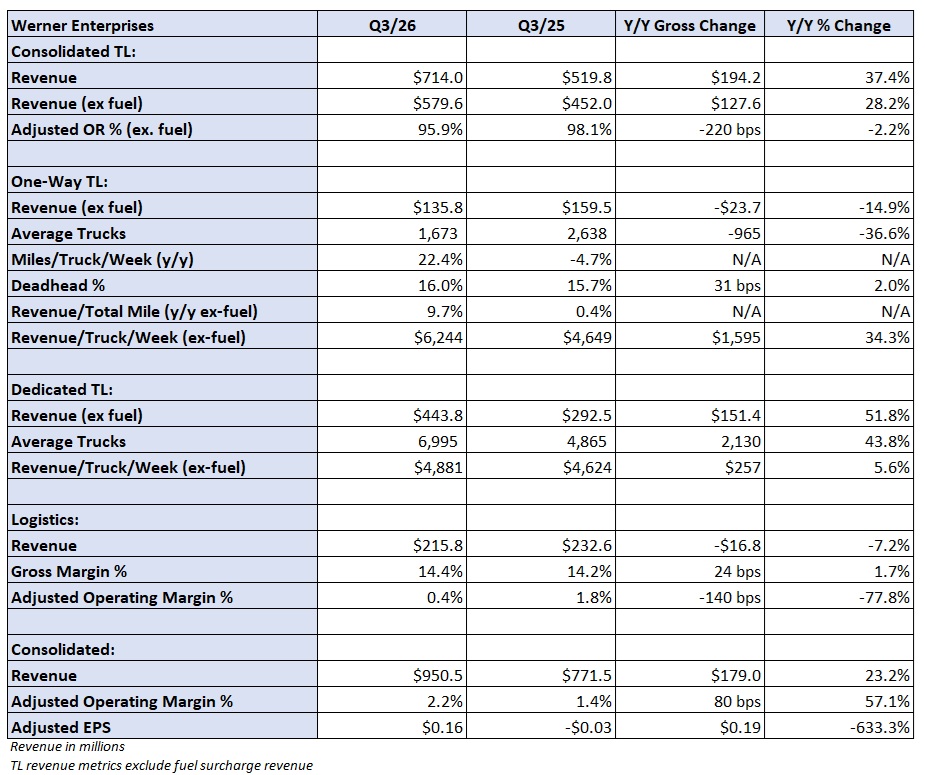
The dedicated segment, which now accounts for 81% of the total truck fleet, demonstrated robust growth. Revenue (excluding fuel) climbed 52% year-over-year, supported by a 44% expansion in the average truck count to nearly 7,000 units. The FirstFleet integration played a pivotal role here, contributing over 2,400 tractors and $615 million in annual revenue run-rate. Revenue per truck per week rose 6% year-over-year, and management has signaled confidence in this segment, raising their full-year 2026 outlook for revenue growth per truck to 4–5%.
One-Way Fleet Restructuring
The one-way segment showed a dramatic shift in operational philosophy following a major restructuring earlier this year. While the total number of trucks in this division declined by 37% year-over-year, the efficiency of the remaining assets surged. Revenue per truck per week increased by 34%, driven by a 22% increase in miles per truck and a 10% increase in revenue per mile.
Although the company noted that longer lengths of haul—which typically carry lower per-mile rates—impacted the rate-per-mile metric, the overall margin improvement for the one-way fleet was impressive, showing an 800-basis-point gain year-over-year. Werner is now looking to pivot back to growth in this segment, with plans to leverage upcoming contract renewals in the first half of 2027 to capture double-digit rate increases.
Logistics Unit Stability
Werner’s logistics division reported $216 million in revenue, a 7% decline from the previous year. However, the unit achieved a key milestone by returning to profitability with a 0.4% adjusted operating margin. Within this unit, the truckload brokerage segment saw a 600-basis-point sequential improvement in operating margins, suggesting that the company’s efforts to streamline its non-asset-based business are beginning to bear fruit.
Official Responses: Management’s Vision
Chairman and CEO Derek Leathers remains steadfast in his assessment of the market trajectory. Addressing shareholders and analysts, Leathers framed the current financial "pain" as a necessary investment for long-term dominance.
"We made the deliberate decision to accelerate investments in driver recruiting and onboarding to capture rising customer demand and support fleet expansion as industry capacity tightens," Leathers stated. "We remain confident in our trajectory and our ability to capitalize on the early stages of this freight upcycle."
The company’s leadership maintains that the 18-cent EPS drag is not representative of "structural labor inflation." Instead, they attribute roughly one-third of the costs to temporary recruitment and sign-on bonuses, while the remaining costs are linked to fuel and insurance—factors that are expected to normalize as the industry moves into 2027.
Implications: The Road Ahead
The path to double-digit truckload margins is clearly defined in Werner’s strategic plan, but the journey will be non-linear. The company’s guidance for the fourth quarter indicates only "modest sequential improvement" in EPS, a projection that remains materially below current market consensus.
Factors Influencing the Near Term
- Earnings Tailwinds: As diesel prices eventually revert, the current fuel-related headwind is expected to transform into a tailwind. Furthermore, the company anticipates that higher insurance and fuel costs will largely dissipate by the end of the year.
- Structural Headwinds: Conversely, the company faces lingering pressures, including lower gains from asset sales (projected at only $1.7 million for the fourth quarter), rising interest expenses, and a higher effective tax rate.
- Contract Renewals: With approximately 60% of the one-way revenue book set for renewal in the first half of 2027, Werner’s ability to successfully implement double-digit rate hikes will be the primary determinant of whether they reach their margin goals.
Market Context
Werner’s third-quarter results highlight the "early upcycle" dilemma: carriers are successfully generating top-line growth through acquisitions and increased utilization, but the bottom line is being squeezed by the very costs required to support that expansion. For investors, the takeaway is one of cautious optimism. While the industry is clearly recovering from the depths of the recent freight recession, the timeline for a return to historical profitability benchmarks remains tethered to the stabilization of operational costs and the successful negotiation of upcoming contract cycles.
As Werner prepares for the upcoming Future of Freight Festival in Chattanooga, industry observers will be watching closely to see if the carrier’s aggressive recruitment and fleet expansion strategies provide the competitive edge needed to outpace the industry’s broader cost inflation. For now, the carrier is firmly in a "build-and-invest" phase, prioritizing capacity and network efficiency over immediate quarterly earnings beats.