In the rapidly evolving landscape of digital retail, the metrics of success are shifting beneath our feet. As artificial intelligence transforms from a buzzword into the primary interface for consumer discovery, a new paradigm has emerged: the AI Commerce Rankings. Launched in July 2026 as a collaborative venture between Digital Commerce 360 and ReFiBuy, this index serves as a critical barometer for measuring how effectively online retailers are navigating the shift toward "Agentic Commerce."
The latest quarterly data reveals a startling disconnect between traditional web-sales dominance and AI-driven visibility. While the industry has long relied on the Top 1000 Database—which tracks North America’s largest retailers by revenue—the AI Commerce Rankings suggest that massive digital scale does not guarantee relevance in an AI-powered future. In this new era, search engine optimization is being superseded by "Agentic Commerce Optimization," where the goal is not just to rank on Google, but to be recommended by AI shopping agents.
The New Hierarchy: Why Size Doesn’t Always Matter
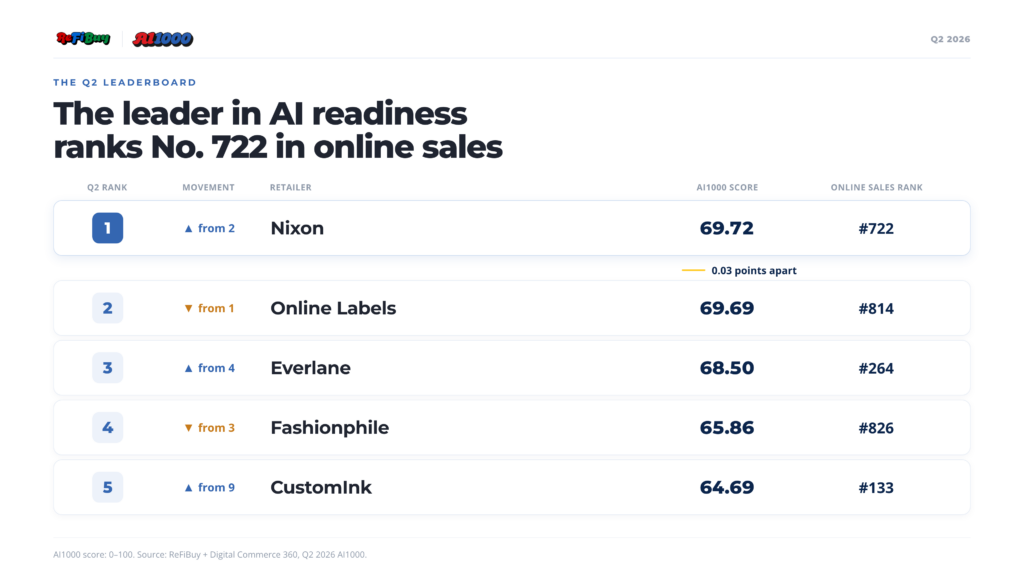
The most compelling takeaway from the Q2 2026 data is that the retailers winning the AI race are often not the industry titans found at the top of traditional revenue lists. The AI Commerce Rankings evaluate retailers based on their visibility across AI channels and the velocity at which their AI-associated reach is improving.
The rankings demonstrate that the factors driving AI-based discovery are distinct from those driving traditional search traffic. Consequently, niche players like Nixon, Online Labels, and CustomInk are finding themselves in the spotlight, frequently outperforming legacy brands that hold top-tier positions in the Top 1000. For instance, the top five performers in the Q2 AI rankings held spots as low as 826 in the traditional web sales rankings. This inversion suggests that AI agents prioritize specific product attributes, brand intent, and availability in ways that favor agility and specialization over sheer volume of sales.
A Chronology of the AI Shift
The journey toward this current snapshot began in early 2026, when Digital Commerce 360 and ReFiBuy first observed a fundamental shift in consumer behavior. Data from the first quarter of the year indicated that what shoppers purchase through AI agents often diverges sharply from their traditional shopping habits.
- Q1 2026: The inaugural assessment highlighted a nascent trend: consumers were using AI to bypass traditional discovery funnels. Retailers who had already invested in structuring their product data for AI consumption began to see an immediate, disproportionate advantage.
- April – June 2026 (Q2): The market experienced significant volatility. The watch brand Nixon successfully unseated Online Labels for the top position. Despite the movement, the top five retailers remained remarkably consistent in their presence, proving that once a brand establishes a foothold in the AI ecosystem, it can sustain that momentum through consistent data optimization.
- July 2026: The official launch of the public-facing AI Commerce Rankings provided retailers with a new, standardized metric to track their progress. This period also marked the beginning of "Agentic Commerce Optimization" as a formal business strategy for forward-thinking merchants.
Supporting Data: Category-Based Fluctuations
The granular data from Q2 2026 paints a vivid picture of which sectors are adapting to the AI revolution most effectively. The rankings are not static; they are deeply influenced by seasonal demand and the varying ability of different categories to provide the structured data AI agents require.
Automotive Parts & Accessories, for example, saw a surge in the rankings, climbing an average of 20.1 positions. This likely reflects the high degree of technical specificity required to purchase parts, where AI agents can excel by matching vehicle-specific data with compatible components. Conversely, the "Flowers & Gifts" category experienced a decline of 17.8 points. This downturn suggests that while AI is adept at transactional, logic-heavy shopping, it may face challenges in areas driven by highly subjective or sentiment-based purchasing decisions where current AI models may not yet fully grasp the nuance of the consumer’s intent.

Further analysis at the subcategory level revealed that lawn and garden, tools, and sporting goods (specifically fishing and hunting) are currently enjoying a "golden age" of AI-driven traffic. In contrast, sectors such as beer, wine, and spirits, as well as books and musical instruments, are facing headwinds. These discrepancies highlight the necessity for retailers to understand the "AI-friendliness" of their specific product category.
Official Perspectives: The "Agentic" Imperative
The industry consensus, led by experts like Scot Wingo, CEO and co-founder of ReFiBuy, is that the old rules of ecommerce are becoming obsolete.
"We built the AI1000 as a quarterly index because AI shopping moves on a different clock from traditional ecommerce," says Wingo. "Q2 showed how much the market can shift in a single quarter and why retailers can’t treat Agentic Commerce Optimization as a one-time project."
Wingo’s assessment carries a warning for the retail sector: the holiday season, traditionally the most critical period for ecommerce, will be drastically different this year. Retailers that are not currently optimizing their catalogs for AI agents risk being invisible to the growing demographic of consumers who use these tools for product research and procurement. The "head start" mentioned by Wingo refers to the time required to train and feed the LLMs (Large Language Models) and agents that now act as the gatekeepers for consumer spending.
Implications for the Future of Retail
The emergence of the AI Commerce Rankings signals a permanent shift in the digital retail landscape. The implications for stakeholders are profound:
1. The Death of Generic SEO
As AI agents increasingly aggregate information and provide direct answers rather than lists of links, traditional search engine optimization will become less effective. Success will rely on "Machine Readable Retail," where product data, inventory, and pricing are formatted in ways that AI models can ingest and interpret without error.
2. The Rise of the Specialist
The fact that smaller, specialized retailers are outranking massive, broad-market retailers indicates that AI agents prioritize "truth" and "relevance" over brand ubiquity. If a small retailer provides better structured data regarding the specific specifications of a product, the AI will favor that retailer over a large generalist store that provides vague, unoptimized data.
3. The Need for Continuous Optimization
The high degree of turnover in the rankings, even within the top five, illustrates that the AI-driven landscape is a dynamic, competitive field. Retailers must move away from viewing website updates as "projects" and instead adopt a model of "continuous optimization." This involves constant monitoring of how AI agents are representing their products and adjusting metadata accordingly.
4. Strategic Data Ownership
Retailers must now treat their product data as their most valuable asset. The ability to control how a product is described, categorized, and presented to an AI model is the new "storefront" of the digital age. Those who fail to govern their data will find their market share eroded by competitors who have embraced the algorithmic reality.
Conclusion: A Call to Action
The data provided by the latest AI Commerce Rankings serves as both a map and a warning. For the retailers listed in the top tiers, the strategy is clear: maintain the pace of data refinement. For those falling behind, the message is equally urgent: the transition to Agentic Commerce is not a future prospect—it is happening now.
As we move deeper into the latter half of 2026, the retail industry stands at a crossroads. The divide between those who understand the mechanics of AI discovery and those who do not will only widen. By leveraging tools like the Top 1000 Database and the new AI Commerce Rankings, retailers can begin to decipher the language of the machines and ensure that when a consumer asks an AI for a product, their brand is the one the machine recommends.
For companies looking to determine where they fit in this new hierarchy, the path forward involves rigorous data submission and an unwavering focus on the technological infrastructure that powers modern, agent-based discovery. The holiday season of 2026 will likely serve as the first major battlefield for this new form of competition, and only those who are "AI-ready" will claim the spoils.