In the high-octane world of e-commerce, the narrative has long been one of relentless expansion. Founders are told that growth is the primary metric of success: higher revenue, more headcount, and larger office footprints. Yet, a quiet shift is occurring among the most profitable store owners. They are discovering that the path to true financial health is not paved with more, but with less.
The Myth of Scaling by Headcount
Consider the case of a store owner who once managed 35 full-time employees. By all traditional metrics, he was a success story—his revenue was robust, and his brand was established. However, beneath the surface, his business was suffering from the "management tax." Profitability remained perpetually thin, squeezed by the massive overhead of payroll, benefits, and the administrative burden of leading a mid-sized team.
He was essentially working two full-time jobs: one running the business and another managing the people who ran it.

His breakthrough came when he abandoned the conventional playbook. He moved his operations to a remote model, outsourced his logistics to a Third-Party Logistics (3PL) provider, and replaced his bloated full-time staff with a lean, agile team of one employee and eight specialized contractors. The result? His profitability soared to record highs, and his personal stress levels plummeted. This is not an isolated anecdote; it is a signal of a structural pivot occurring across the industry.
Research Findings: The Anatomy of High-Profit Stores
When analysts examine the divergence between struggling businesses and high-profit leaders, the results are often counterintuitive. Many founders assume that the key to profitability lies in superior marketing—a higher Return on Ad Spend (ROAS) or a more sophisticated SEO strategy.
The data, however, tells a different story.

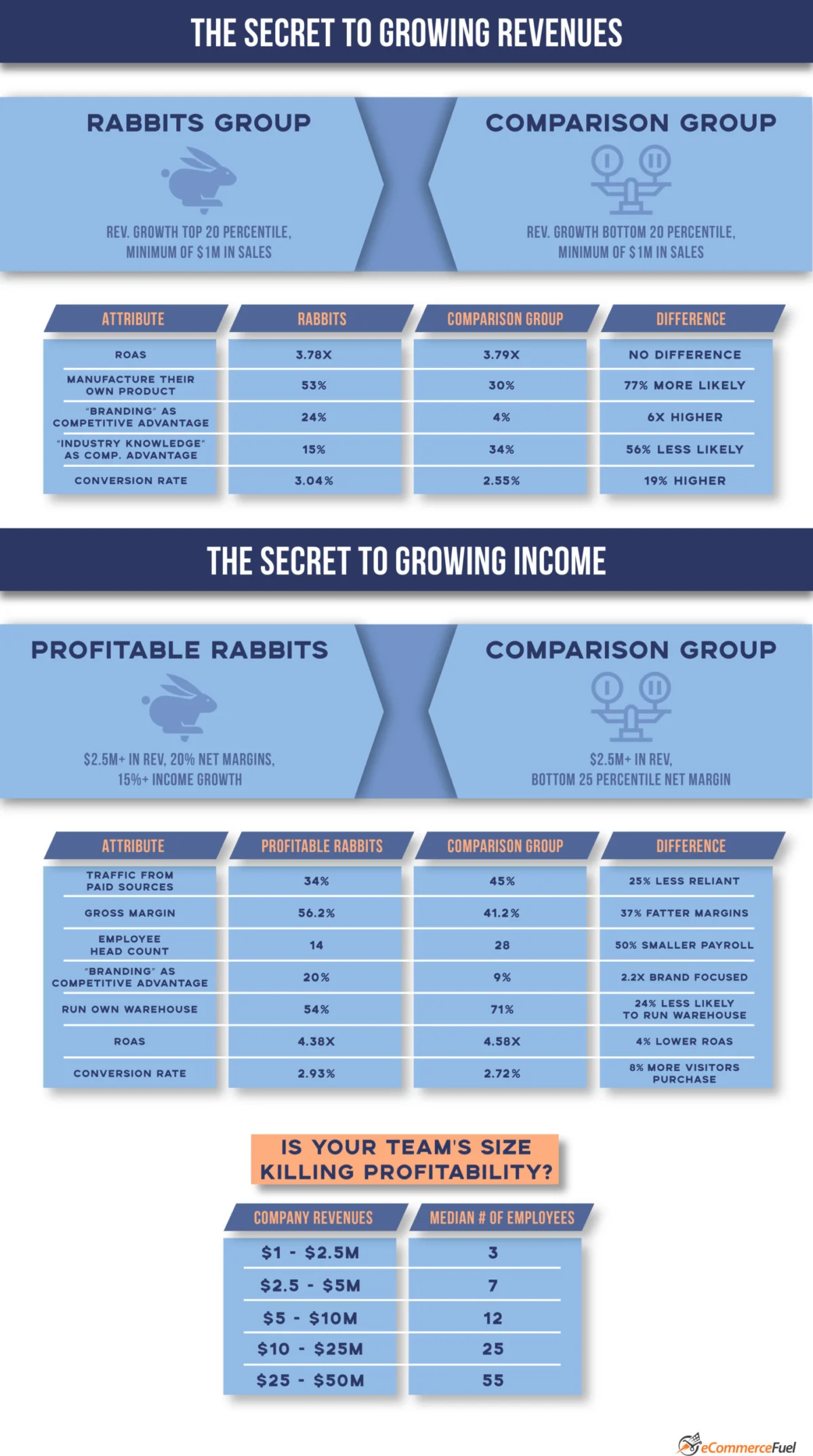
When comparing hundreds of e-commerce businesses, the disparity in marketing efficiency between the top performers and the bottom-tier companies is surprisingly negligible. Mastery of Facebook ads or Google search rankings does not necessarily correlate with higher net profit margins. The real differentiator is operational efficiency.
Key Data Points:
- Payroll Optimization: The most profitable stores operate with half the payroll of their peers.
- Outsourcing: High-performers are 25% more likely to utilize 3PL services for warehousing and fulfillment.
- Traffic Independence: Top-tier stores are 25% less reliant on paid traffic, indicating a stronger focus on organic growth and customer retention.
Operational leanness, it seems, beats marketing cleverness every time. While marketing is an engine for growth, overhead is the anchor that prevents that growth from translating into bankable profit.
Defining "Lean" Beyond Simple Layoffs
When the topic of "staying lean" arises, many founders instinctively recoil, fearing that it necessitates indiscriminate layoffs. However, true operational leanness is a holistic audit of overhead. It is about identifying the friction points in a business model that bleed capital.

The Hidden Costs of Inefficiency
- The "Legacy" Office: Many businesses are still paying for physical office leases that were deemed essential in 2019 but now sit largely vacant in a remote-first world.
- Inefficient Fulfillment: Managing an in-house warehouse often incurs costs in labor, rent, and management that far exceed the price of a professional 3PL provider.
- The SaaS Tax: In the digital age, companies often accumulate a graveyard of auto-renewing software subscriptions—small, monthly costs that, in the aggregate, amount to significant annual losses.
The most successful owners apply a simple, ruthless filter: Is this function core to my brand’s competitive advantage? If the brand is built on unique design, keep the design in-house. If packing boxes and managing inventory is simply a commodity task, outsource it to those who can do it at scale.
The Courage of Hard Conversations
Business growth is often constrained by a founder’s inability to have difficult, necessary conversations. Most leaders wait until a crisis—a recession, a liquidity crunch, or a sharp dip in earnings—to address their cost structure.
The most profitable operators, however, engage in these conversations proactively. They treat their business as a living entity that requires constant pruning. They ask the uncomfortable questions: "Did we hire this person because we needed them, or because we felt busy?" and "Is this tool essential to our workflow, or just a habit?"

By modeling a 25% budget reduction in a "what-if" scenario, they gain the clarity to make strategic cuts during periods of strength, rather than waiting for a period of weakness to force their hand.
The Second Lever: The Tax Efficiency Gap
Beyond operational costs, there exists another, often-overlooked lever for profitability: tax optimization. While many business owners view taxes as an inevitable, fixed burden, the most sophisticated operators view them as a variable expense that can be managed with intention.
A Tale of Two Owners
To illustrate this, consider two store owners, both generating $2.5 million in revenue with $250,000 in net profit.

- Owner A treats tax as an afterthought, relying on a "fine" accountant who simply files paperwork. He pays $75,000 in annual taxes.
- Owner B treats tax strategy as a core business function. By utilizing profit-sharing retirement plans, donating appreciated stock, maximizing Health Savings Accounts (HSAs), and employing family members in legitimate roles, he reduces his tax liability to $21,000.
The $54,000 annual difference is not the result of tax evasion; it is the result of tax strategy.
Common Underutilized Tax Strategies:
- Profit Sharing: Utilizing retirement vehicles that exceed standard 401(k) limits.
- Appreciated Asset Donation: Donating stocks rather than cash to charity to avoid capital gains taxes while retaining full deduction value.
- Inventory Donations: Donating slow-moving or obsolete inventory to charity at fair market value, a strategy that is particularly effective for e-commerce retailers.
- Strategic Family Employment: Compensating children for actual work performed, which can then be funneled into tax-advantaged Roth IRAs.
Implications: Why These Strategies Stay Invisible
The reason these opportunities remain invisible is that they are fragmented. Tax data is split across personal returns, business filings, payroll reports, and brokerage statements. There is rarely a centralized dashboard that allows a founder to see their total tax exposure.
Furthermore, there is a fundamental misconception about the role of a CPA. A standard accountant is trained to be a historian—they record what has already happened. A high-value CPA is a strategist—they tell you what should happen. If your accountant does not reach out to you with proactive suggestions, they are merely processing your data, not managing your wealth.

Conclusion: The Path Forward
The obsession with ROAS, Customer Acquisition Cost (CAC), and Lifetime Value (LTV) is well-founded, as these metrics drive the front end of the business. However, they are only half of the profitability equation.
The most successful entrepreneurs in the modern e-commerce landscape are those who have mastered both sides of the ledger. They don’t just focus on making more; they focus on keeping more. By maintaining a lean operational structure and treating tax strategy as an active, year-round discipline, they insulate themselves from market volatility and ensure that their hard-earned revenue actually remains in the business.
As you look toward the next fiscal year, ask yourself: Are you scaling for the sake of scale, or are you building a foundation of sustainable, intentional profitability? The answer may lie in the hard conversations you haven’t yet had.