In the ongoing debate surrounding the UK’s cost-of-living crisis, a persistent narrative has taken root in both the media and political discourse: the claim that the UK’s legally binding net-zero targets are the primary driver of sky-high household energy bills. However, a comprehensive new analysis from the thinktank Nesta provides a sobering reality check. The data reveals that the surge in energy costs is not a byproduct of environmental ambition, but rather the result of a profound and ongoing vulnerability to volatile wholesale gas markets.
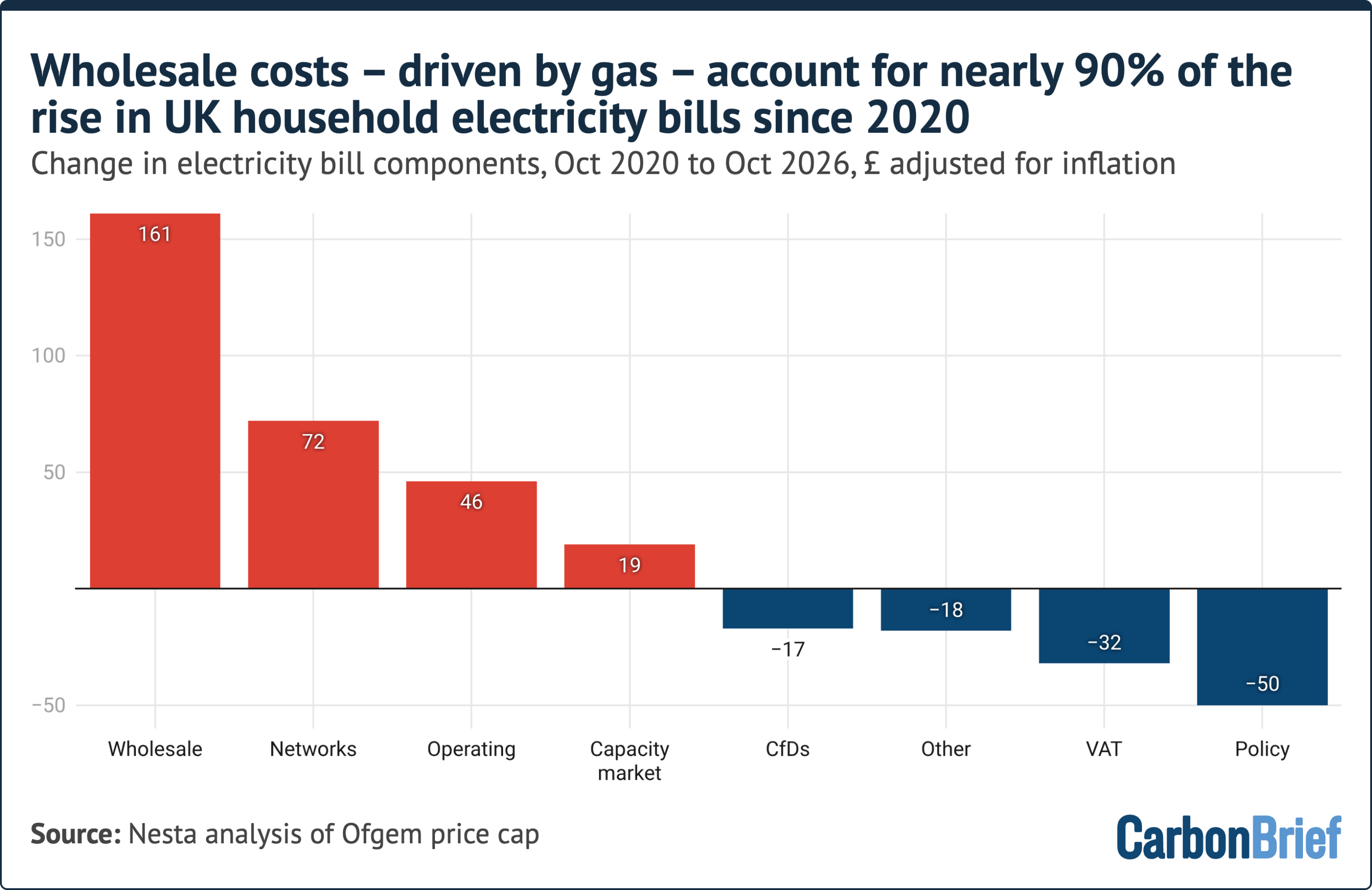
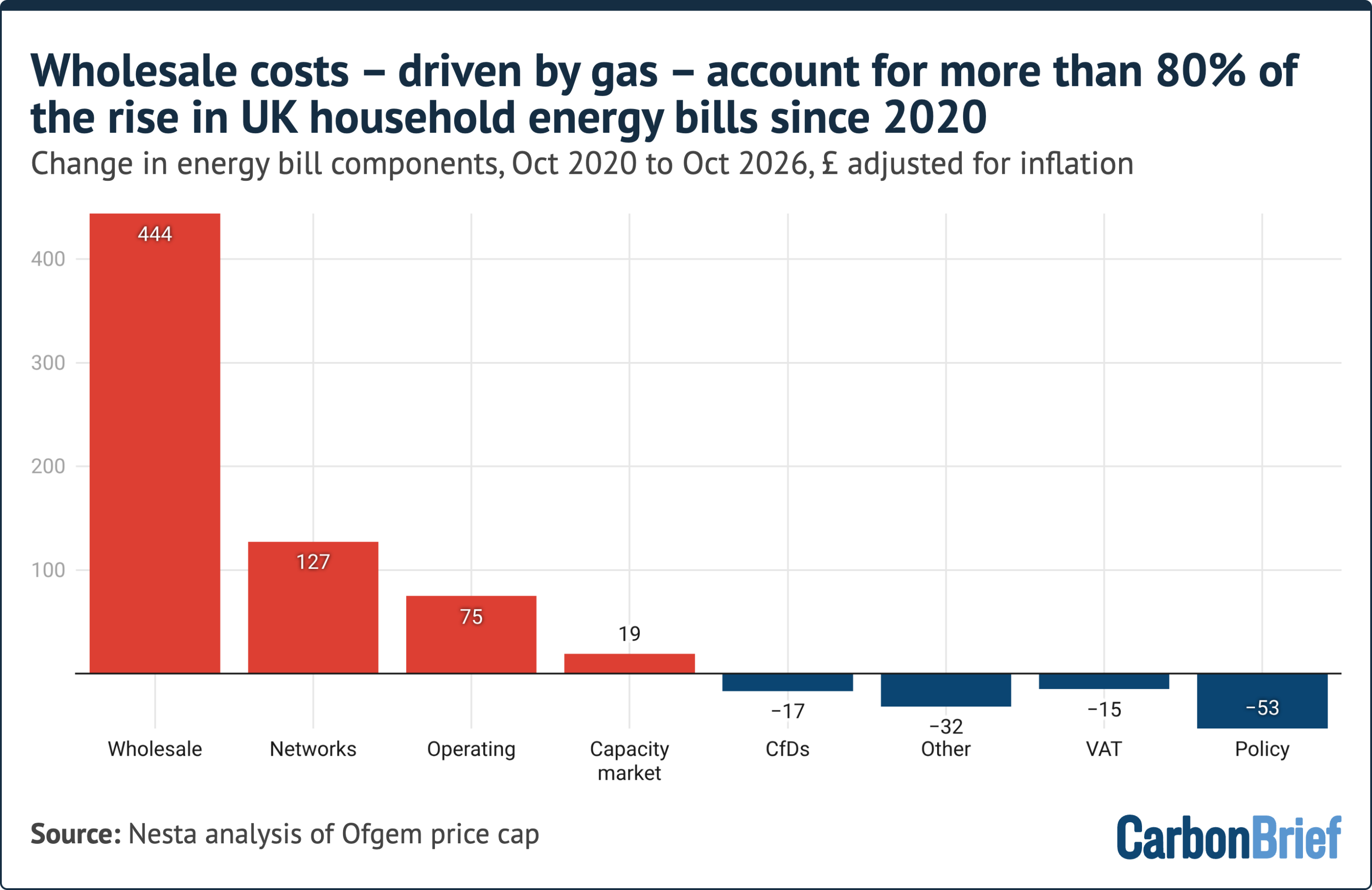
According to the analysis, wholesale gas costs are responsible for nearly 90% of the increase in UK household electricity bills since 2020. Similarly, these same market pressures account for 77% of the rise in gas bills. Far from being the culprit, the UK’s transition toward renewable energy is acting as a vital buffer, shielding consumers from even greater financial exposure to global fossil fuel instability.
The Anatomy of the Price Surge
The figures, shared exclusively with Carbon Brief, dismantle the common political assertion that the "green levy" or net-zero infrastructure investment is the root cause of the current energy burden. Instead, the data highlights a structural dependency on gas that has left the UK uniquely exposed to global market shocks.

Since 2020, the typical UK annual household electricity bill has risen by £180 in real terms. Of this increase, a staggering £161—or 90%—is directly attributable to wholesale costs, which remain tethered to the price of natural gas. Even as the UK expands its wind and solar capacity, the current market mechanism often relies on gas as the "marginal unit," meaning the price of electricity is disproportionately dictated by the most expensive source in the mix.
The Role of Renewables and Policy Costs
Contrary to the perception that green energy is driving up prices, renewable "Contracts for Difference" (CfDs) are actually exerting downward pressure on bills. Nesta’s analysis suggests these contracts are currently reducing household electricity costs by £17 under the existing price cap. Furthermore, the government has successfully shifted 75% of legacy renewable support costs away from consumer bills and onto general taxation, while also eliminating the ECO efficiency scheme and temporarily removing VAT, further insulating the public from "policy-driven" inflation.
A Chronology of the Gas Crisis
To understand why bills remain stubbornly high, one must look back to the onset of the global energy crisis in 2022.
- Pre-2022: The UK energy market operated under a relatively stable price regime, though with a heavy reliance on gas for both heating and power generation.
- 2022 (The Invasion of Ukraine): Russia’s invasion of Ukraine sent global wholesale gas prices into a tailspin, marking the beginning of a sustained period of volatility. In January 2026, Carbon Brief reported that two-thirds of the rise in electricity bills since 2020 was directly linked to this gas price shock.
- Mid-2026 (The Hormuz Crisis): Ongoing conflict in the Middle East has exacerbated these issues. Wholesale gas prices have climbed back to levels not seen since the initial 2022 shock. As of October 19, 2026, prices sat at 220p per therm, surpassing the 2022 average of 210p/therm.
- Late 2026/Early 2027 Outlook: With the January 2027 price cap looming, forecasts suggest another sharp increase, potentially rising by as much as a quarter, as the global market continues to struggle with supply constraints and geopolitical tension.
Supporting Data: Where the Money Goes
The composition of a typical dual-fuel bill provides the clearest evidence of where the money is going. As of October 2026, wholesale costs account for the largest share of the price cap—roughly 44% (£757). Network costs follow at 24% (£417), while supplier operating costs make up 17% (£291).
The increase in network costs, which has added £72 to bills since 2020, is largely a function of necessary infrastructure maintenance. According to the Energy Networks Association, up to 80% of investment in electricity grids is required simply to maintain existing assets, with the remainder dedicated to the expansion necessary for a net-zero future. Notably, "balancing costs"—the frequent subject of media criticism regarding wind farm payments—account for only 4% of a typical £858 annual electricity bill.
The "Decoupling" Effect
Perhaps the most significant finding in the Nesta report is the evidence that the UK is beginning to "break the link" between gas prices and electricity costs. Because of the rapid expansion of clean energy generation, electricity prices have risen far less aggressively than gas prices since the intensification of the Hormuz crisis. This decoupling serves as a proof-of-concept for the government’s energy strategy: the more renewable power is integrated into the grid, the less sensitive the consumer becomes to the geopolitical whims of the global gas market.
Official Responses and Political Narratives
The findings arrive at a critical juncture for the UK government. Despite the evidence that gas, not net-zero, is driving costs, the administration recently granted approval for the development of the Jackdaw gas field in the North Sea. While the government officially stated that the field "would not affect prices," the decision highlights the ongoing tension between short-term fossil fuel extraction and long-term energy security.
Andrew Sissons, director for sustainable future at Nesta, remains firm in his assessment: "Rising gas prices, not net-zero, have driven most of the recent surge in Britain’s energy bills. Britain is particularly exposed, with over 80% of households connected to gas mains, while our electricity system still relies too much on gas as the marginal unit."
Sissons argues that the current political focus on curtailing net-zero is a distraction from the real economic challenge. "Upgrading the grid is not cost-neutral, but that price tag is dwarfed by the impact of rising gas prices," he notes. "In fact, net-zero is helping to shelter Britain from the impact of expensive gas."

Future Implications: The Path to Stability
The upcoming budget on October 28 is expected to feature major interventions to assist households and businesses struggling with energy debt, which has hit £6 billion. However, experts suggest that short-term subsidies, while necessary, do not solve the underlying structural issues.
To truly insulate the British public from the volatility of global fossil fuel markets, the consensus among energy analysts is that the nation must accelerate the transition to electric heating and transport. By replacing gas-dependent boilers with heat pumps and moving away from fossil-fuel-powered vehicles, the UK can shift its energy demand toward a more stable, domestically generated electricity supply.
"Going further will require British households to have clean electricity, electric vehicles, and heat pumps over fossil-fuel cars and boilers," Sissons says. "By focusing on growing electricity demand, the government can spread upgrade costs more widely. This can lock in the consistent investment in electrification that is Britain’s best path to stop global turmoil from showing up on winter energy bills."
Ultimately, the analysis serves as a stark reminder that the cost of inaction is far higher than the cost of transition. As long as the UK remains tethered to the fluctuations of the global gas market, households will remain vulnerable to the next geopolitical crisis. The path to energy independence, and the relief of the financial burden on the average citizen, lies not in abandoning the move to net-zero, but in accelerating it to achieve a more resilient, self-reliant energy future.