By FreightWaves Staff
While the national headline suggests a cooling of the freight market, with tender rejection rates settling at a relatively modest 13.8% over the past two weeks, a closer examination reveals a landscape defined by sharp regional disparities. The American freight economy is currently splitting in two, characterized by localized volatility in the Pacific Northwest and chronic, long-term capacity tightness in the industrial heartland of the Midwest.
This divergence challenges the notion of a monolithic national freight recovery, forcing logistics professionals to rethink their regional strategies as they navigate a market that is simultaneously cooling in some corridors and reaching a boiling point in others.
The State of the Market: A Regional Breakdown
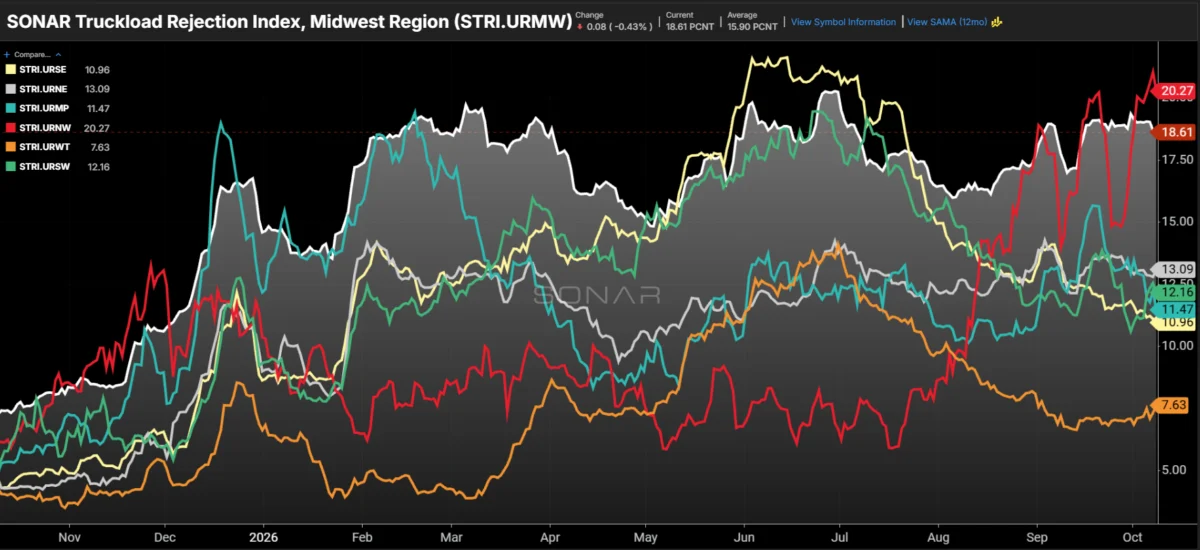
Current data from SONAR indicates that the national average for tender rejections—a key barometer of carrier leverage and capacity tightness—has largely plateaued. However, this average masks extreme regional outliers. As of October 8, 2026, the Northwest region surged to a staggering 20.27% rejection rate, more than triple the 6.2% recorded in the same period last year.
Close behind is the Midwest, maintaining a stubborn 18.61% rejection rate. In stark contrast, other major freight regions, including the Southeast and Southwest, have seen their rejection metrics drift into a more manageable range between 7.6% and 13.1%. The market is no longer moving in unison; it is behaving as a series of fragmented, localized economies, each responding to distinct seasonal, structural, and operational pressures.
Chronology: The Rapid Transformation of the Northwest
The volatility observed in the Northwest is particularly striking due to its suddenness. For the first seven months of 2026, the Northwest was among the "loosest" freight markets in the United States, with rejection rates consistently hovering between 6% and 9%. Shippers enjoyed favorable conditions, and carriers often avoided committing assets to the region due to the relative lack of outbound freight opportunities.
However, the narrative shifted abruptly in August. By the start of the third quarter, the region underwent a transformation that mirrored a classic seasonal supply-demand shock. Within just eight weeks, rejection rates nearly doubled. By early October, the region had surpassed all others in the nation for tender rejections.
This flip is primarily attributed to the intersection of the regional agricultural calendar and a permanently thinner national fleet. As the apple and potato harvests in Washington, Oregon, and Idaho reached their peak, the demand for temperature-controlled (reefer) capacity skyrocketed. Because the Northwest generally lacks consistent outbound freight year-round, national carriers often avoid building long-term contract capacity there. Consequently, when the harvest demand hit, the existing fleet was insufficient to handle the surge, leading to the dramatic spike in rejections.
Supporting Data: Equipment Disparities and Operational Realities
To understand the mechanics of this shift, one must look at the data split by equipment type. The crisis in the Northwest is almost exclusively a reefer-driven phenomenon. In October, Northwest reefer rejection rates averaged 41%, a massive jump from the 17% observed in July and the 16% reported during the same window last year. Conversely, van rejections in the same region remain comfortably under 5%.
The volume data provides the necessary context: reefer tender volumes in the Northwest are up 65% since July and 35% year-over-year. Meanwhile, van volumes have actually contracted by 11% compared to 2025. This suggests that the Northwest’s capacity crunch is not a reflection of a broad industrial boom, but rather a hyper-localized agricultural peak that the current logistics infrastructure is ill-equipped to support.
Interestingly, this is not a result of a record-breaking crop. According to USDA estimates, Washington’s 2026 apple harvest is projected at 176.2 million bushels—a 2% decline from the previous year. Nationally, the crop is down 7%. Therefore, the high rejection rate is not a symptom of "too much cargo," but rather "too little capacity" coupled with the logistical friction of seasonal timing. While the 2025 harvest also caused a spike, it occurred later in the season and peaked at a more modest 13%. This year, the timing of the harvest collided with a tighter national fleet, amplifying the impact significantly.
The Midwest: A Structural Challenge
If the Northwest is a story of seasonal volatility, the Midwest is a story of structural permanence. The region, which serves as the largest freight hub in the country, has maintained a rejection rate at or above 15% since February 2026. This is a stark departure from the 7.6% rejection rate recorded in October of the previous year.
Unlike the Northwest, the Midwest’s tightness is not confined to one equipment type. The region is experiencing across-the-board pressure, with van rejections near 15%—roughly two and a half times the level seen a year ago—and reefer rejections approaching 29%.
The volume data for the Midwest tells a story of sustained growth. Tender volume in the region is up approximately 10% year-over-year, outperforming the national average gain of 8%. This suggests that the Midwest is not merely suffering from a temporary bottleneck; it is the center of a sustained freight demand cycle. Carriers have struggled to maintain tender compliance in the Midwest for nearly a year, indicating that the region’s capacity equilibrium has been fundamentally altered.
Implications for Shippers and Carriers
The implications of this regional divide are significant for both sides of the freight transaction. For shippers in the Northwest, the current high-rejection environment is likely a transient, albeit painful, period. As the harvest winds down throughout the winter months, capacity should normalize. However, these shippers must recognize that their regional "looseness" for the majority of the year makes them vulnerable to any sudden demand spikes. A long-term solution may involve securing more robust regional partnerships that can withstand seasonal volume fluctuations.
For the Midwest, the outlook is different. Because the region is the nation’s primary freight engine, the sustained high rejection rates signal a long-term shift in the carrier-shipper dynamic. The fact that rejection rates remain near their spring and summer highs, despite broader national cooling, suggests that carriers are finding more lucrative or consistent opportunities elsewhere, or that the cost of operating in the Midwest has risen to a level that is no longer being covered by legacy contract rates. Shippers in this region may need to consider aggressive rate adjustments or shift to alternative modes to ensure supply chain continuity.
Meanwhile, other regions—particularly the Southeast and Southwest—are demonstrating how the market naturally corrects when road capacity becomes too expensive. Data shows that domestic intermodal volumes through major hubs like Atlanta and Dallas have spiked by 15% to 20% year-over-year. This shift to intermodal, which began in the summer as regional rejections reached their peak, demonstrates that shippers are actively diversifying their transportation portfolios to bypass the volatility of the spot and contract truckload markets.
Conclusion: A New Normal for Freight Strategy
The 2026 freight market is teaching a valuable lesson in geographic nuance. The "national average" has become a vanity metric that hides the reality of a market defined by local constraints. As the industry looks toward the end of the year, the primary takeaway is that the days of uniform national freight conditions are gone.
The Northwest is currently a cautionary tale of how seasonal cycles can overwhelm a thin fleet, while the Midwest serves as a warning of how structural volume growth can keep a region in a state of permanent tension. For logistics leaders, the path forward requires a shift away from national benchmarking toward hyper-regional monitoring.
As market experts continue to utilize platforms like SONAR to visualize these shifts in real time, the divide between those who can adapt to regional volatility and those who remain tethered to outdated national assumptions will only widen. Whether through the tactical use of intermodal, the restructuring of contract commitments, or a more sophisticated approach to seasonal planning, the winners in the current environment will be those who recognize that when it comes to the American freight economy, geography is, indeed, destiny.
For those interested in deep-diving into these trends and networking with the industry leaders shaping the future of supply chain technology, the upcoming F3: Future of Freight Festival in Chattanooga, Tennessee, promises to provide a comprehensive look at the challenges and opportunities facing the industry. From the Brokerage Compliance Symposium to the FreightTech100 awards, these events are designed to help operators navigate the complexities of a changing, and increasingly fragmented, freight landscape.