In the fast-paced, volatile arena of cryptocurrency, few assets have commanded as much retail attention as Shiba Inu (SHIB). Once celebrated as the quintessential "Dogecoin killer," the token has been a focal point for speculative fervor, community-driven growth, and dramatic market fluctuations. However, the landscape of 2025 has proven to be a period of profound transition. Following a recent market reshuffle, Shiba Inu now finds itself relegated to the 34th position in the global cryptocurrency rankings, a stark reminder of the unforgiving nature of the digital asset markets.
While SHIB managed a modest 8% price increase over the past week, the rally has been lackluster when compared to the broader altcoin market. More alarmingly, the token has officially surrendered its long-held status as the second-largest meme coin by market capitalization. As the market matures and new, agile competitors enter the fray, investors are left questioning whether the "Shiba Army" still possesses the momentum required to regain its former glory.
The New Guard: MemeCore’s Meteoric Ascent
For years, the meme coin hierarchy was simple: Dogecoin (DOGE) occupied the top spot, followed by the formidable Shiba Inu. This dynamic was considered an immovable law of the crypto sector. However, the summer of 2025 served as a turning point, as a new challenger—MemeCore (M)—began its aggressive ascent.
MemeCore has captured the imagination of the retail market, capitalizing on viral trends and a rapidly expanding ecosystem. With a market capitalization now nearing $3.5 billion, driven by a blistering 35% gain over the last month, the asset has successfully leapfrogged Shiba Inu. In contrast, SHIB’s growth has been tepid, struggling to maintain a market cap of approximately $3.37 billion. This shift is not merely numerical; it represents a fundamental change in market sentiment, where investors are increasingly rotating capital away from established "legacy" meme coins toward newer, faster-growing alternatives.
A Historical Perspective on Valuation
To understand the current gravity of the situation, one must look at the historical peaks of Shiba Inu. In the euphoria of 2021, SHIB witnessed an unprecedented explosion, with its market valuation briefly exceeding $40 billion—a feat that cemented its status as a cultural phenomenon. Even as recently as 2024, the token managed to sustain a valuation above $20 billion. The current slide toward the $3 billion range illustrates a significant contraction in the token’s speculative premium. The transition from a multi-billion dollar juggernaut to a mid-cap asset signals that the "hype cycle" that once propelled SHIB to record highs may be reaching a point of exhaustion.

Anatomy of the Decline: Supporting Data
The shift in market hierarchy is supported by several concerning on-chain metrics and behavioral trends that suggest the bears may soon regain total control of the SHIB price action.
The Stagnation of Shibarium
When the Shiba Inu team launched Shibarium, a layer-2 scaling solution designed to reduce transaction costs and increase utility, the community hailed it as the "great equalizer." The goal was to transform SHIB from a mere meme coin into a functional ecosystem capable of hosting decentralized applications (dApps) and NFT platforms.
However, the reality has been underwhelming. While the development team recently implemented a "small but useful" update—refreshing the Remote Procedure Call (RPC) listing within the Ethereum-lists/chains registry to improve Chainlist connectivity—the underlying usage remains stagnant. Despite these technical maintenance efforts, the protocol facilitates a negligible number of daily transactions. A blockchain’s value is fundamentally tied to its network effect; without consistent transaction volume, Shibarium struggles to justify its existence as a core driver for SHIB token burns or ecosystem adoption.
The Exchange Reserve Alarm
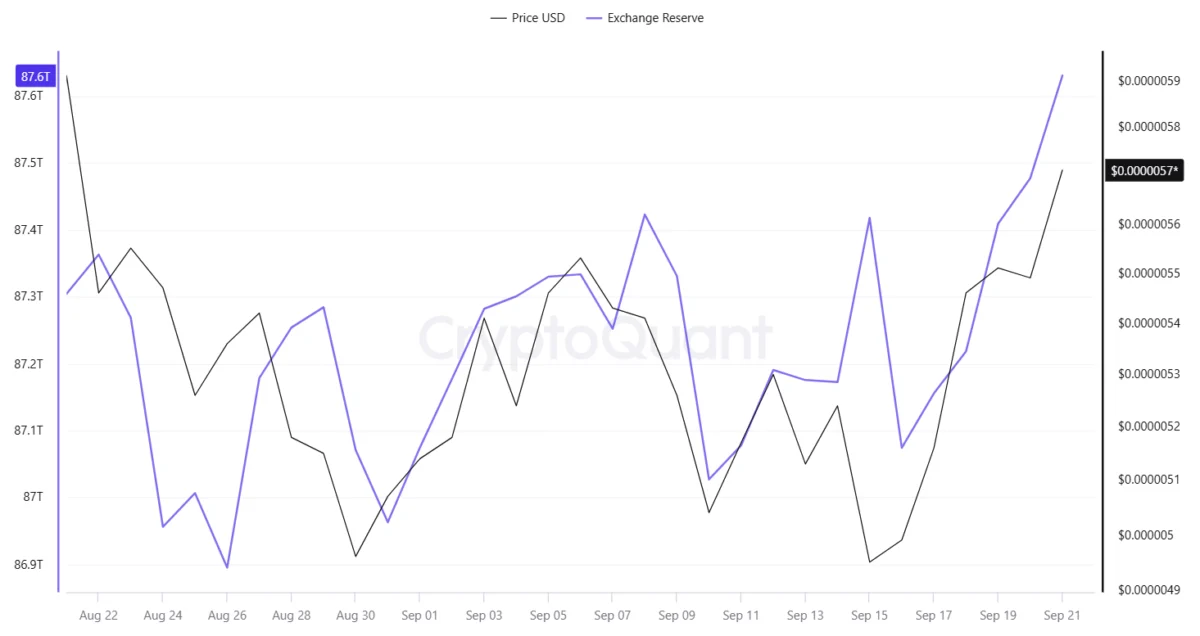
Perhaps the most telling indicator of impending volatility is the behavior of token holders. According to data from the market intelligence firm CryptoQuant, the volume of SHIB tokens currently held on centralized exchange (CEX) wallets has surged to approximately 87.6 trillion. This figure represents the highest concentration of SHIB on exchanges since early August.
In the world of digital asset management, an influx of tokens onto exchanges is widely interpreted as a "sell signal." When investors move assets from cold storage (self-custody) to centralized platforms, it is often because they are preparing for liquidity events—either to trade, swap, or liquidate their positions. The sheer volume of tokens currently sitting on exchange order books suggests a significant increase in immediate selling pressure, which could stifle any attempted bullish recovery.
The "September Curse"
Historical performance also provides a cautionary tale. September has traditionally been a brutal month for the broader crypto market, but for Shiba Inu specifically, it has been a period of consistent underperformance. Over the past five years, the token has finished in the red in three out of five instances during this month. Analysts often point to seasonal liquidity cycles and the "back-to-work" effect in traditional finance, which frequently leads to risk-off behavior in speculative asset classes like meme coins.
Official Responses and Strategic Pivot
The Shiba Inu core team, led by the enigmatic figurehead Shytoshi Kusama, has maintained a stance of cautious optimism. In recent communications, representatives have emphasized that the current price action is secondary to the long-term architectural goals of the ecosystem.
"We are building for the next decade, not for the next market cycle," a spokesperson stated in a recent community update. The team argues that the recent update to Shibarium, while technically minor, is part of a broader roadmap to ensure that the infrastructure remains robust for future mass adoption. They point to the ongoing integration with decentralized finance (DeFi) protocols and the expansion of the "Shiboshi" NFT line as evidence that the ecosystem is far from dormant.
However, institutional observers note a disconnect between the development team’s narrative and the market’s reception. While the developers focus on technical stability, the market is demanding innovation that drives genuine buy-side demand. The silence regarding a major, high-impact catalyst has left the "Shiba Army" increasingly divided, with a segment of the community calling for more aggressive marketing and token-burning strategies to counteract the current supply-side pressure.
Implications for the Future of Meme Coins
The displacement of SHIB by MemeCore and the ongoing struggle for market relevance have profound implications for the meme coin sector.
1. The Death of the "First-Mover" Advantage
For years, being the "second-largest" meme coin was a defensive moat for SHIB. It provided a sense of legitimacy and safety for retail investors. The success of MemeCore proves that this moat is evaporating. Investors are no longer tethered to legacy brands; they are increasingly performance-driven, willing to pivot to assets that offer fresher narratives and more aggressive growth potential.
2. The Shift Toward Utility
The struggle of Shibarium highlights a critical lesson: in the current cycle, "meme status" is no longer enough. Investors are beginning to demand tangible utility. Assets that cannot demonstrate a clear, high-traffic use case—whether through DeFi, gaming, or decentralized infrastructure—are increasingly likely to see their valuations drift toward zero as the speculative excitement wanes.
3. Increased Volatility and Risk
With the increase in exchange reserves, the short-term outlook for SHIB is one of heightened volatility. Should the 87.6 trillion tokens on exchanges begin to hit the market in a cascading fashion, the price could experience significant downside deviation. Conversely, if the broader market experiences a macro-driven rally, SHIB may benefit, but it will likely do so as a "beta" play—underperforming the assets that have now established themselves as the new leaders of the pack.
Conclusion: A Crossroads for the Shiba Army
Shiba Inu stands at a critical juncture. It has evolved from a simple joke into an expansive ecosystem, yet it now faces the existential threat of obsolescence in an industry that moves with dizzying speed. The loss of its second-place ranking is not just a statistical change; it is a signal that the market’s appetite for the "Dogecoin killer" has changed.
Whether SHIB can reclaim its former status depends on two factors: the ability of the development team to catalyze real-world usage on the Shibarium network, and the resilience of the community in the face of mounting selling pressure. For now, the charts and the data suggest a period of consolidation—or perhaps further decline—is on the horizon. For the investors who have stuck with the token through its historic 2021 highs and its current stagnation, the months ahead will be a test of conviction. In the volatile world of meme coins, the only certainty is that the market rarely looks back, and yesterday’s heroes must fight harder than ever to remain relevant in tomorrow’s economy.