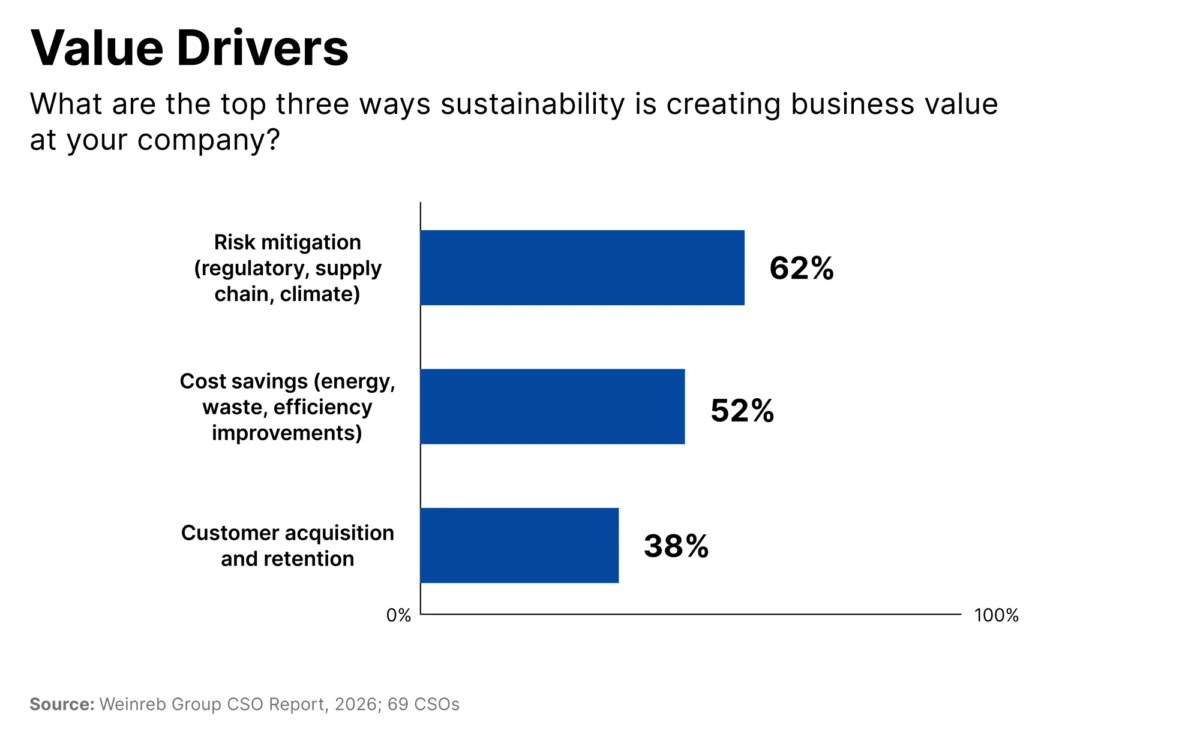
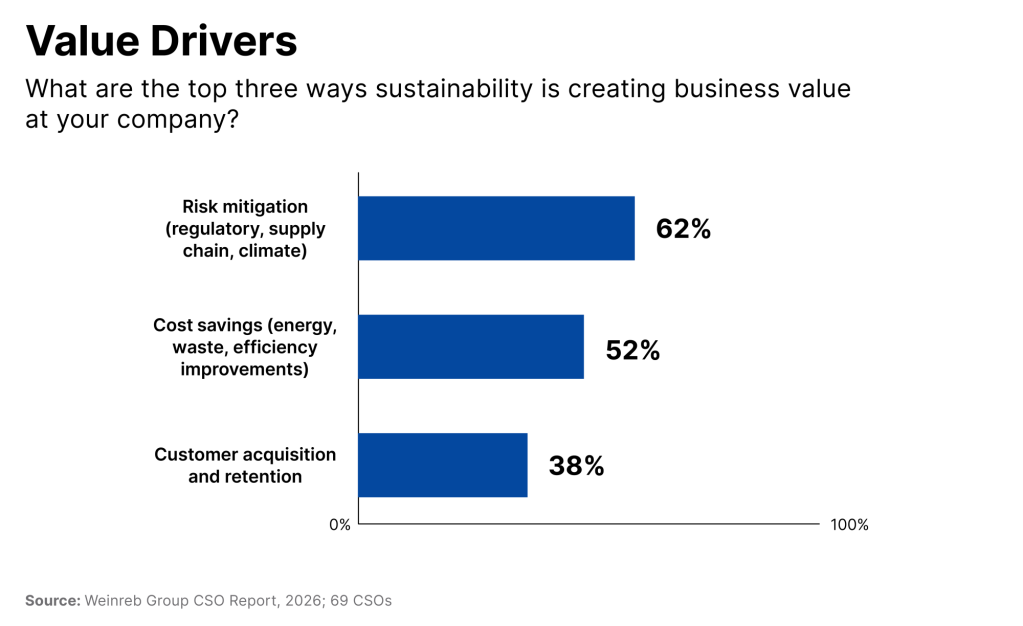
The role of the Chief Sustainability Officer (CSO) is undergoing a profound transformation. Once viewed primarily through the lens of operational efficiency and cost-cutting—often focused on energy reduction and waste management—the position has matured into a strategic pillar of enterprise risk management. According to the 8th biennial survey of CSOs at publicly traded U.S. companies by the Weinreb Group, risk mitigation has officially eclipsed cost savings as the primary driver of value creation for sustainability teams.
As global markets face unprecedented volatility, the mandate of the CSO has expanded from "doing good" to "ensuring resilience." This shift signals a departure from the peripheral corporate social responsibility (CSR) initiatives of the past toward a model where sustainability is inextricably linked to the survival and profitability of the modern enterprise.
The Paradigm Shift: Risk as the New North Star
The Weinreb Group’s survey, which canvassed 69 CSOs—roughly one-third of the 193 executives holding the title at U.S. public companies as of July 1—reveals a clear consensus: the C-suite is no longer satisfied with sustainability teams that only report on carbon footprints. Instead, they demand insights that protect the bottom line.
More than 62 percent of respondents identified the ability to address regulatory, supply chain, and climate risks as their most significant contribution to the business. This finding marks a turning point in corporate governance. When sustainability is framed as risk management, it gains the attention of boardrooms and CFOs who might otherwise view environmental initiatives as secondary to core business functions.
The Suntory Blueprint: A Case Study in Integration
The practical application of this shift is best exemplified by Suntory. In January 2025, the spirits giant took the bold step of appointing Kim Marotta, their CSO, to lead the company’s entire risk management function. Marotta’s dual mandate is a harbinger of how the role is likely to evolve across other sectors.

"What enterprise risk management has given me is the opportunity to see the big picture," Marotta explained in a recent interview. "Instead of just having environmental risks, they’re business risks." By breaking down the silos between sustainability and corporate risk, companies like Suntory are ensuring that climate-related threats—ranging from water scarcity in production regions to shifting agricultural yields—are evaluated with the same rigor as currency fluctuations or geopolitical instability.
Chronology of a Maturing Profession
To understand where the CSO role is heading, it is necessary to examine how it has arrived at this juncture.
- The Early 2000s (The Compliance Phase): Sustainability leaders were often buried within HR or Communications departments, tasked primarily with reporting and reputation management.
- The 2010s (The Efficiency Phase): As energy prices rose and technology matured, the CSO mandate shifted toward "green" cost savings—retrofitting buildings, optimizing logistics, and reducing landfill waste.
- 2020–2024 (The ESG Integration Phase): The explosion of ESG (Environmental, Social, and Governance) reporting requirements necessitated a move toward formalizing data gathering and regulatory compliance.
- 2025–Present (The Resilience Phase): The current era is defined by the integration of sustainability into core business strategy. As the Weinreb Group report indicates, the total number of individuals holding the title "CSO" at U.S. public companies has shifted from 216 in 2025 to 193 in 2026, reflecting a period of consolidation and professionalization rather than a decline in relevance.
Supporting Data: The Drivers and Challenges
The survey data paints a vivid picture of the modern corporate landscape. While risk mitigation is the primary value driver, the forces pushing this agenda are multifaceted.
External Pressures
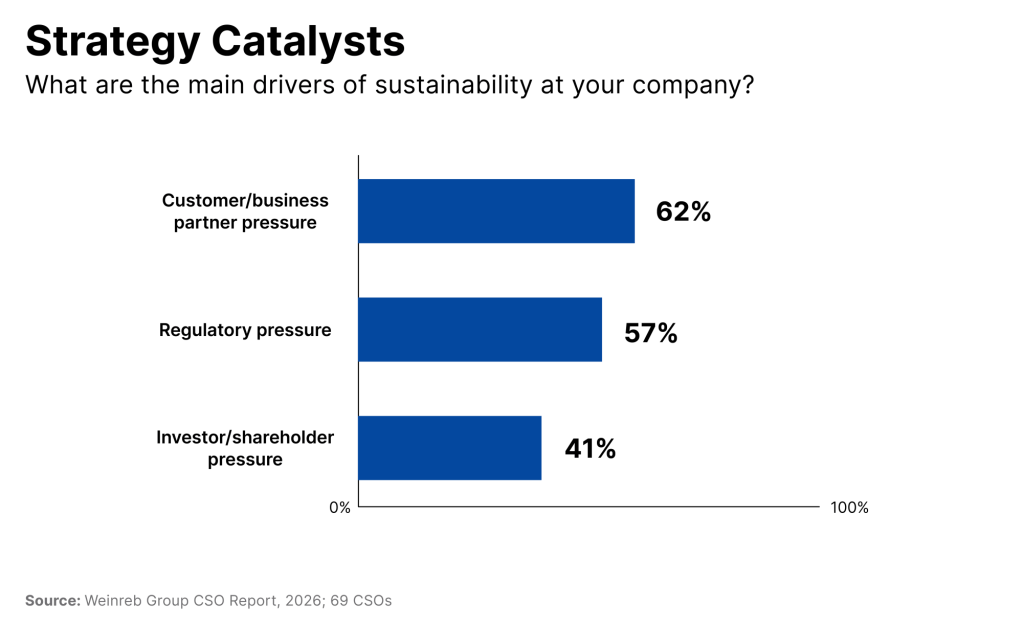
Sustainability strategy is currently driven by three primary external forces:
- Customer and Business Partner Pressure (62%): Corporations are finding that their own sustainability credentials are being scrutinized by their clients and partners, creating a ripple effect through the entire supply chain.
- Regulatory Pressure (57%): With the rise of mandatory climate disclosures, sustainability teams are increasingly acting as the compliance backbone for the organization.
- Investor and Shareholder Pressure (41%): Capital markets are increasingly incorporating climate risk into their valuation models, forcing CSOs to articulate how their programs protect long-term shareholder value.
The Obstacles Ahead
Despite the increased influence of CSOs, the path forward is not without friction. The top challenges cited by respondents include:
- Market and Economic Uncertainty (62%): A volatile macro environment makes long-term sustainability investments harder to justify in the face of short-term quarterly targets.
- Regulatory Complexity (57%): Navigating a patchwork of global, federal, and state-level requirements remains a daunting task for even the most sophisticated teams.
Official Responses and Strategic Realignment
The shift in the CSO role is not merely theoretical; it is manifesting in organizational structures. A notable trend is the decentralization of sustainability talent. Approximately 42 percent of survey respondents noted that sustainability headcount is increasingly moving out of the central "sustainability office" and into core business units like finance, supply chain, and procurement.
The Changing Reporting Line
Perhaps the most telling indicator of the profession’s evolution is the shift in reporting lines. According to the Weinreb Group, only 14 percent of CSOs now report directly to the CEO, a significant drop from the 33 percent reported just 18 months ago. Instead, a growing number of CSOs are reporting to the legal department or risk officers.
While some might interpret this as a "downgrade," experts argue it represents the institutionalization of the role. When a CSO reports to legal or risk, it implies that sustainability has moved from the "PR and Marketing" bucket to the "Governance and Compliance" bucket. It is a sign that the organization views sustainability as a legal and operational necessity rather than a branding exercise.
"We are reaching a tipping point where ‘sustainable business’ is simply ‘smart business,’" noted one anonymous survey respondent. This sentiment was echoed by Sophie Beckham, CSO at International Paper, who described the CSO as the "futurist" of the organization. "My mandate is to see around corners, build resilience into our business model, and create value that will help my company not just navigate but thrive when facing emerging risks and opportunities."
Implications for the Future of Business
The data provided by the 8th biennial CSO insights report offers several critical takeaways for the future of the corporate landscape.
1. The Death of the "Sustainability Silo"
The most successful companies of the next decade will be those that fully integrate sustainability into their operational DNA. As sustainability teams distribute their expertise across departments, the CSO role will increasingly become one of a "strategic facilitator" rather than a standalone functional leader.
2. The Rise of the "Resilience Officer"
As climate change accelerates, the definition of risk is broadening. CSOs are now at the center of discussions regarding infrastructure hardening, resource security, and long-term asset valuation. The transition from cost-savings to risk mitigation is, in essence, a transition toward corporate survivalism.
3. A Focus on Professional Resilience
Ellen Weinreb, CEO of the Weinreb Group, highlighted the grit required of those in the position. "There’s rarely a playbook for what they do, yet they negotiate every new challenge with grace and determination." As the role evolves, the need for CSOs to possess both deep technical knowledge and high-level change management skills will only increase.
Conclusion
The 8th biennial survey from the Weinreb Group confirms that the era of "voluntary" or "performative" sustainability is rapidly closing. The modern CSO is now a critical architect of business continuity, tasked with navigating an increasingly volatile global landscape. By centering their efforts on risk mitigation, sustainability leaders are demonstrating that their work is not a drain on corporate resources, but a vital investment in the organization’s long-term viability.
As we look toward the latter half of the decade, the companies that thrive will be those that have successfully empowered their CSOs to look around those corners, identify the risks that others ignore, and build a business model that is as resilient as it is profitable. The title may be changing, the reporting lines may be shifting, but the importance of the sustainability function has never been more clear. Sustainability is no longer a department—it is the lens through which the future of business must be viewed.