In a striking example of how numerical errors can cascade through the policy-making ecosystem, the UK’s opposition Conservative Party has anchored its recent "common sense" platform on a fundamental miscalculation. A key economic claim regarding the "cost of net-zero" in their recent policy booklet, The Right Way, appears to be the result of a simple but catastrophic spreadsheet error—a mistake that has been amplified by think tanks and political commentators for nearly a year.
The document, which emphasizes the necessity for government competence, asserts that the Climate Change Committee (CCC)—the government’s official independent adviser—estimated the cost of the UK’s path to net-zero at approximately £1 trillion. Specifically, the booklet claims: "In 2020, the CCC estimated that its route to net-zero would cost £957bn."
This figure is factually incorrect. In reality, the CCC’s 2020 estimate was exactly half that amount: £478 billion. The discrepancy highlights a dangerous trend in modern political discourse: the uncritical propagation of "data" that serves a narrative, without verifying the underlying source material.
The Genesis of the Error: A Spreadsheet Misstep
To understand how the figure of £957 billion entered the mainstream, one must look at the source material provided by the Climate Change Committee in 2020. As part of its advice on the Sixth Carbon Budget, the CCC published a technical spreadsheet detailing the capital expenditure (CAPEX) and operational expenditure (OPEX) required to transition to a net-zero economy by 2050.
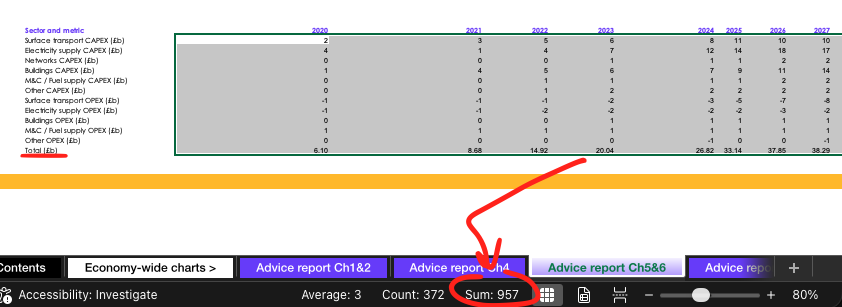
The spreadsheet contains rows of sectoral data covering everything from wind and solar generation to the installation of heat pumps and the transition to electric vehicles. In the original data, the total additional investment (CAPEX) required over the 30-year period from 2020 to 2050 is listed alongside the projected operational savings (OPEX).
When these figures are summed correctly, the net cost is £478 billion. However, the spreadsheet also included a summary line that aggregated the totals for each individual year. It appears that an analyst, in attempting to calculate the total cost, added the yearly summary totals in addition to the individual sectoral components already accounted for. This effectively double-counted the entire cost of the transition.
The resulting figure—£957 billion—became a convenient, albeit imaginary, metric for those seeking to cast doubt on the economic viability of the UK’s climate commitments.
Chronology of a Misconception
The journey of the £957 billion figure from a technical miscalculation to an official opposition policy document is a case study in the rapid spread of misinformation.
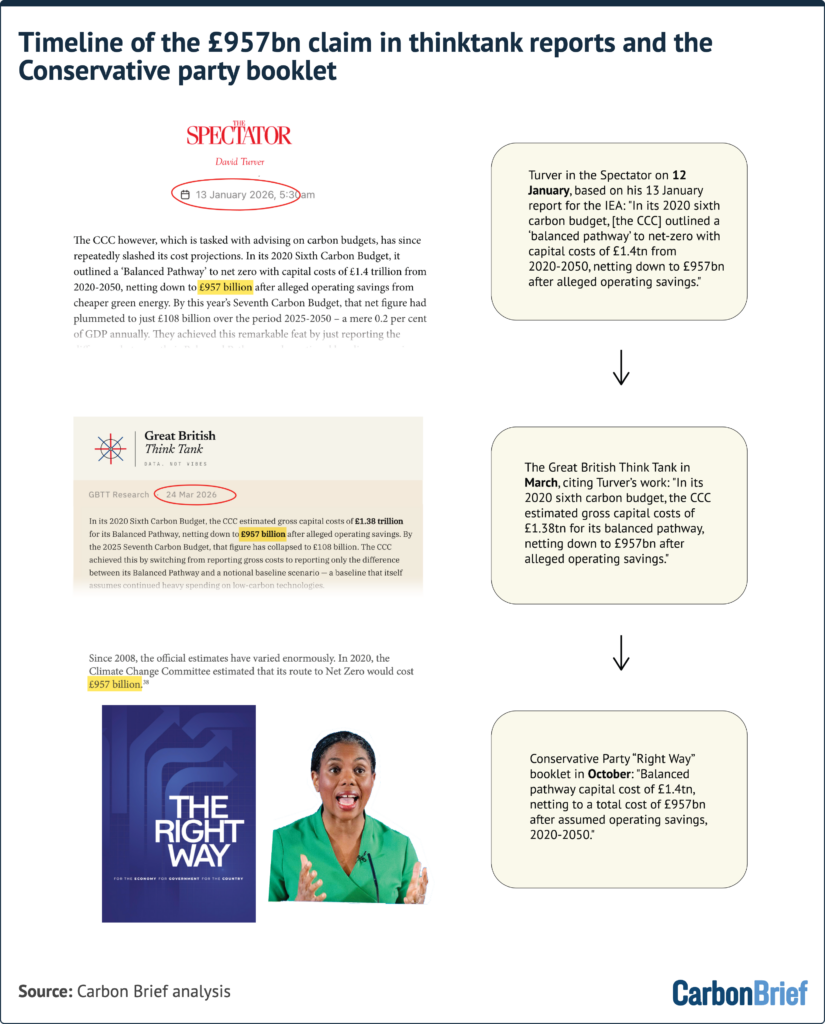
January 2026: The "Accidental Analyst"
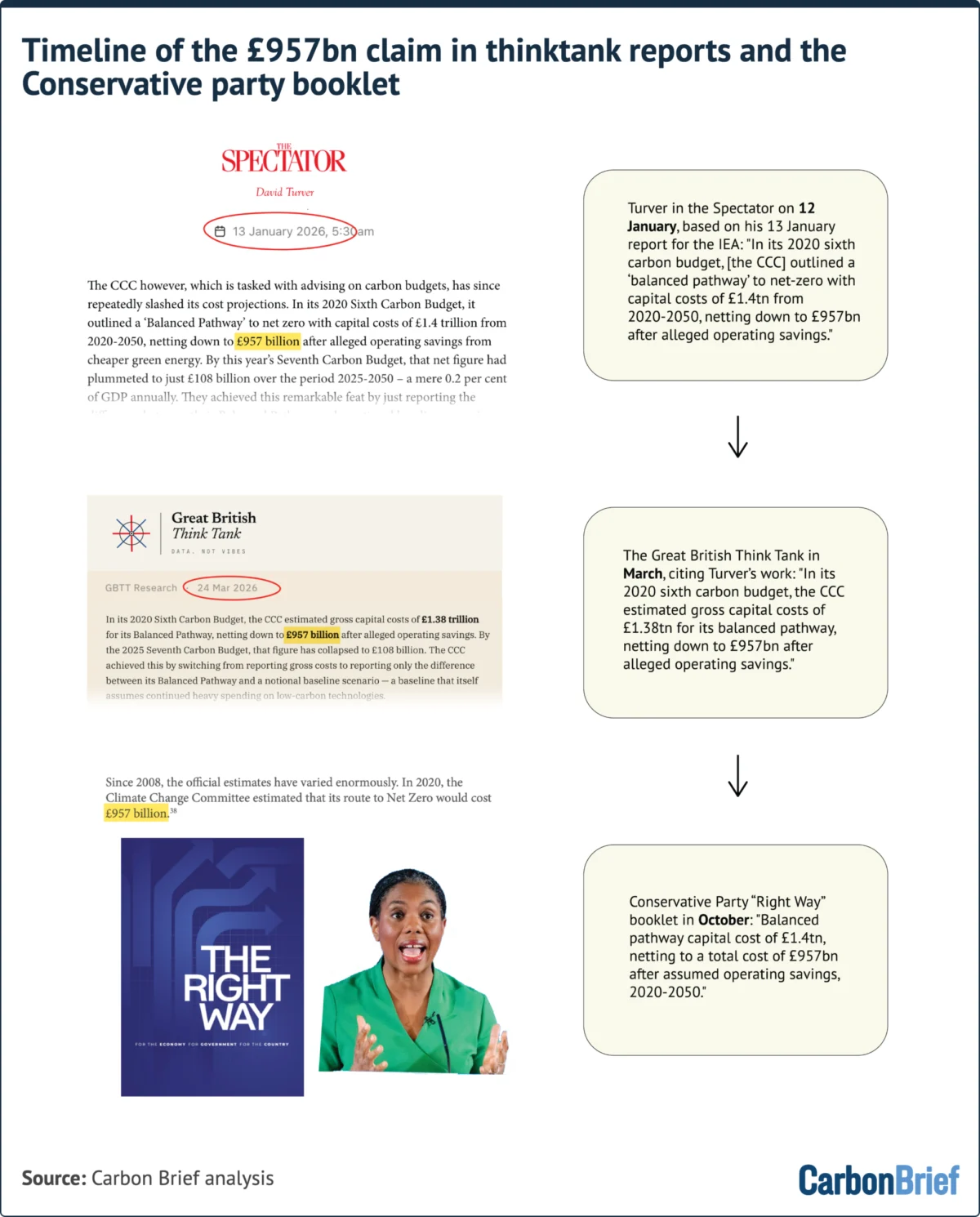
The earliest online appearance of the £957 billion figure identified by researchers was in an article published on January 12, 2026, in The Spectator. The author, David Turver, a retired engineer who describes himself as an "accidental energy analyst," cited the CCC’s 2020 spreadsheet as his primary source.
January 2026: Institutional Legitimacy
The error gained further traction just one day later when Turver published a formal report for the Institute of Economic Affairs (IEA). By presenting the figure within a report for a prominent free-market think tank, the erroneous calculation was imbued with a veneer of academic rigor. The IEA report explicitly pointed to Figure 5.3 of the CCC’s 2020 advice, failing to notice that the source data only totaled half of what they were claiming.
March 2026: The "Data, Not Vibes" Paradox
By spring, the figure had migrated to the "Great British Think Tank," an organization that ironically uses the tagline "data, not vibes." Despite their stated commitment to sourcing figures exclusively from official public bodies, they repeated the £957 billion claim as established fact.
October 2026: Policy Adoption
The final stage of this process occurred in October 2026, when the Conservative Party incorporated the figure into The Right Way. By including it in a high-level policy document, the party elevated a simple arithmetic mistake to the status of official party platform, using it to disparage the "sophisticated modelling" of experts in favor of their own flawed "political judgement."
The Reality of Net-Zero Costs
The actual economic picture of the UK’s net-zero transition is significantly more nuanced—and far less daunting—than the figure cited in the Conservative document.
When the CCC published its 2020 advice, it emphasized that the net cost of £478 billion represented less than 1% of GDP spread over three decades. Furthermore, the committee projected that this investment would stimulate the economy, ultimately boosting GDP by approximately 2% by 2050 due to the transition away from volatile, imported fossil fuels.
Since 2020, the economic landscape has changed drastically, largely due to the precipitous decline in the cost of clean technologies. In 2025, the CCC revised its estimates downward. The new figures put the total investment cost at £670 billion and operating savings at £562 billion, resulting in a net total of just £108 billion over 25 years. This revised total represents less than 0.2% of GDP.
As the committee noted earlier this year, the total cost of reaching net-zero is now lower than the cost of a single fossil-fuel price shock. The transition is not merely a "cost" to be borne, but a strategy for economic insulation against global market volatility.

Implications for Public Policy
The inclusion of the £957 billion figure in the Conservative Party’s literature is not merely an embarrassing clerical error; it has profound implications for the quality of democratic debate.
The Erosion of Expertise
The document explicitly attacks "sophisticated modelling" as a substitute for "political judgement." This rhetoric seeks to delegitimize the role of independent, evidence-based advisory bodies like the CCC. When political parties choose to ignore the technical expertise of statutory bodies in favor of figures pulled from biased or poorly researched reports, the basis for rational policy-making is undermined.
The "Fossil Fuel Free" Myth
The error is compounded by the fact that many of the reports that popularized the £957 billion figure also relied on the implicit assumption that current fossil-fuel-based systems—such as existing petrol cars, gas boilers, and coal power plants—would have zero cost to maintain or replace if the UK did not transition to net-zero. By ignoring the "counterfactual" cost of inaction (the cost of replacing like-for-like in a fossil-fuel-dependent economy), these reports present a skewed picture that misleads the public.
Accountability and Correction
To date, there has been no formal correction from the Conservative Party regarding the claim in The Right Way. In a healthy political environment, a demonstrable, source-traceable error of this magnitude should trigger a retraction. However, the persistence of the figure across various platforms suggests a "zombie statistic"—a piece of misinformation that, once released into the wild, becomes difficult to eradicate regardless of the evidence presented against it.
Conclusion: Data, Vibes, and the Path Forward
The "spreadsheet error" story serves as a warning to voters and policymakers alike. In an era where think tanks and political parties are increasingly competing for attention, the demand for "common sense" and "simplicity" can often act as a veil for a lack of diligence.
The £957 billion figure is a testament to the dangers of confirmation bias. Because the figure supported a pre-existing narrative that net-zero is prohibitively expensive, it was accepted without scrutiny by those who were ideologically inclined to believe it.
As the UK navigates the complex economic and environmental realities of the coming decades, the quality of our policy debate will depend on our ability to distinguish between rigorous analysis and the accidental products of a misaligned spreadsheet. If the goal of the Conservative Party is, as they state, to prove they are "competent enough to solve the problems for which it takes responsibility," the first step must be to align their policy documents with the objective reality of the data.
Until such corrections are made, the £957 billion figure remains a glaring example of how, in the absence of rigorous verification, political rhetoric can easily drift into the realm of fiction.