
In the high-stakes world of cybersecurity, data is not merely information; it is ammunition. For threat intelligence firms, antivirus developers, and AI researchers, the ability to train detection models depends entirely on the breadth and depth of their malware repositories. Recently, a casual social media exchange between two prominent entities in the field—the research collective vx-underground and VirusTotal founder Bernardo Quintero—offered a rare, tangible glimpse into just how massive these digital arsenals have become.
While the figures—terabytes and petabytes—are often tossed around in technical briefings, they remain abstract to the average reader. To put these numbers into perspective, we must bridge the gap between digital storage and physical reality, transforming abstract bytes into a literal monument of hardware.
The Scale of the Archives: Key Facts
The conversation began when vx-underground, widely recognized for maintaining one of the world’s largest collections of malware source code, announced on X (formerly Twitter) that their archive had reached approximately 30 terabytes (TB) of data.
In a rapid follow-up, Bernardo Quintero, the founder of VirusTotal—the industry-standard service that aggregates malware scans from dozens of antivirus engines—revealed the sheer disparity in scale. VirusTotal, which serves as a global clearinghouse for malicious files submitted by security researchers and automated systems alike, holds roughly 31 petabytes (PB) of malware samples.
To grasp the magnitude of this difference, one must understand the hierarchy of storage. A petabyte consists of 1,024 terabytes. Therefore, VirusTotal’s archive is more than 1,000 times larger than that of vx-underground. While 30 TB is enough to fill the hard drives of several hundred consumer-grade laptops, 31 PB is a massive, enterprise-grade data lake, equivalent to roughly 31,000 terabytes.
Chronology of the Disclosure
The discourse began on May 13, when vx-underground shared an update regarding the expansion of their repository. The group has long been a go-to resource for researchers looking to analyze the evolution of viruses, ransomware, and wiper malware. By keeping a historical record of source code, they provide an invaluable service for "blue teamers" (defenders) trying to understand how threat actors have refined their code over the last several decades.
Shortly thereafter, Quintero joined the conversation. His disclosure was not merely a "brag" about data volume; it highlighted the fundamental difference between a specialized research repository and a global, crowdsourced detection engine. VirusTotal’s growth is fueled by constant daily submissions from users worldwide, allowing it to capture everything from the most sophisticated state-sponsored APT (Advanced Persistent Threat) tools to the most mundane "script kiddie" malware.
This public exchange prompted an immediate curiosity in the cybersecurity community: If these bytes were converted into physical hardware, how would they look? Could we measure the danger of these digital threats by their physical height?
The Physics of Data: A Back-of-the-Napkin Calculation
To visualize these datasets, we performed a thought experiment. We assumed the use of standard 3.5-inch internal hard drives. While solid-state drives (SSDs) are becoming the norm, the traditional spinning-platter hard drive remains the standard for massive, high-capacity cold storage in data centers.
A standard 3.5-inch internal hard drive is approximately 1 inch (2.54 cm) thick. For our calculation, we assumed a capacity of 1 TB per drive. While real-world usable capacity is often lower due to formatting and overhead, using a flat 1 TB metric provides a clean, baseline mathematical model.
1. The vx-underground Stack
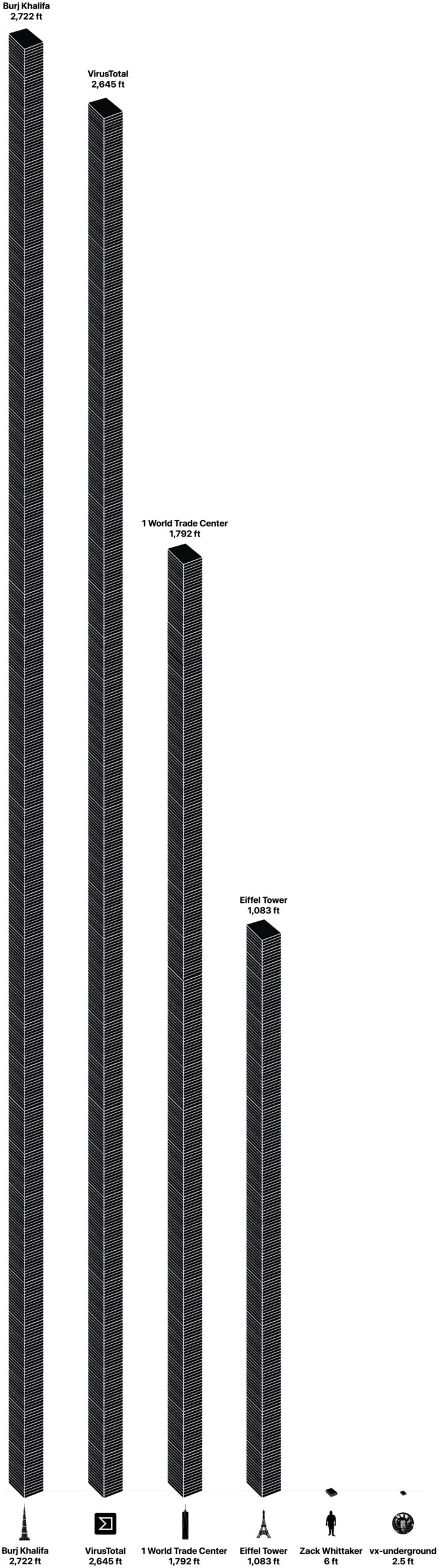
With 30 TB of data, the vx-underground archive would require 30 hard drives. When stacked perfectly vertically, this column of hardware would reach 30 inches, or 2.5 feet. This is roughly the height of a small nightstand or a stack of roughly three dozen hardcover books. While significant for an individual researcher, it is a manageable "mountain" of hardware.

2. The VirusTotal Stack
The calculation for VirusTotal’s 31 petabytes is far more staggering. At 1 TB per drive, we are looking at 31,744 drives. Stacking these one on top of the other at 1 inch per unit yields a total height of 31,744 inches, or approximately 2,645 feet.
To put that height into perspective, the Burj Khalifa in Dubai—the world’s tallest building—stands at 2,722 feet. The VirusTotal malware archive, if converted to physical drives, would nearly scrape the top of the Burj Khalifa. It would tower over the Eiffel Tower (1,083 feet) two-and-a-half times over, and it would dwarf the One World Trade Center (1,792 feet) by a margin of nearly 850 feet.
Implications: Why These Archives Matter
These repositories are not just collections of "junk files." They are the backbone of modern digital defense. The implications of maintaining such massive datasets are profound:
Training AI Detection Models
Modern cybersecurity is increasingly reliant on machine learning. To train an AI to recognize a "zero-day" threat—a vulnerability that has never been seen before—the system must be fed millions of examples of known malicious code. The sheer volume held by VirusTotal allows researchers to create neural networks that can identify patterns in code structure that are invisible to the human eye.
Understanding the Evolution of Attacks
By maintaining historical data, firms like vx-underground allow researchers to perform "archaeology" on malware. Understanding the lineage of a piece of ransomware—how it evolved from a primitive 1990s virus into a sophisticated, encrypted extortion tool—is crucial for predicting where threat actors will go next.
Operational Security and "Data Fatigue"
The size of these repositories presents a challenge known as "data fatigue." When a security analyst is presented with 31 petabytes of samples, the challenge is no longer about finding the data—it is about finding the right data. This is why metadata tagging, automated classification, and threat intelligence feeds are so critical. Without sophisticated indexing, a 31-petabyte haystack makes finding the "malware needle" nearly impossible.
The Role of AI in Misinformation
Interestingly, our newsroom’s initial attempt to calculate these heights using a standard AI chatbot yielded wildly inaccurate results. The chatbot struggled with the conversion of petabytes to terabytes and failed to account for the physical dimensions of standard hardware. This serves as a pertinent reminder: in the world of cybersecurity, where precision is paramount, AI should be treated as a tool for acceleration, not a final arbiter of truth. "Rough math" must be verified by human oversight, especially when the subject matter involves critical infrastructure or technical capacity.
Conclusion: A Monument to Digital Conflict
The contrast between the 2.5-foot stack of vx-underground and the 2,645-foot tower of VirusTotal is a perfect metaphor for the current state of cybersecurity.
The smaller, curated archives represent the artisanal, deep-dive research that defines the "hacker" ethos—focused, specific, and technically dense. The massive, cloud-based repositories represent the industrial-scale war against global cybercrime, where every single suspicious file from every corner of the planet is ingested, cataloged, and studied.
As we move toward an era of increasingly automated and AI-driven cyber warfare, these repositories will only continue to grow. We may soon see the "VirusTotal Tower" surpass the height of the Burj Khalifa. And while that height represents a frightening volume of malicious code, it also represents our best hope for safety: the more we collect, the more we learn, and the better we can defend the digital world from those who seek to tear it down.
Zack Whittaker is the security editor at TechCrunch and author of the weekly newsletter "This Week in Security." For those interested in secure communication, he can be reached via Signal at zackwhittaker.1337 or via professional email at [email protected].