The case of Ervin Hoskins is a quintessential portrait of the modern information crisis. A seemingly credentialed geopolitical commentator, Hoskins authored insightful op-eds on the Iran-Iraq conflict that managed to bypass the editorial filters of a regional Florida newspaper. There was only one catch: Ervin Hoskins did not exist.
Last week, OpenAI confirmed that Hoskins was merely one of seven synthetic personas generated by an Iranian influence operation. These digital ghosts utilized ChatGPT to polish their prose, lending a veneer of intellectual authority to state-sponsored disinformation. While the Hoskins case is a glaring example of AI-assisted deception, it is merely the tip of a rapidly expanding iceberg. From deepfake video conferencing fraud to automated job application bots, the architecture of trust on the internet is undergoing a stress test of unprecedented proportions.
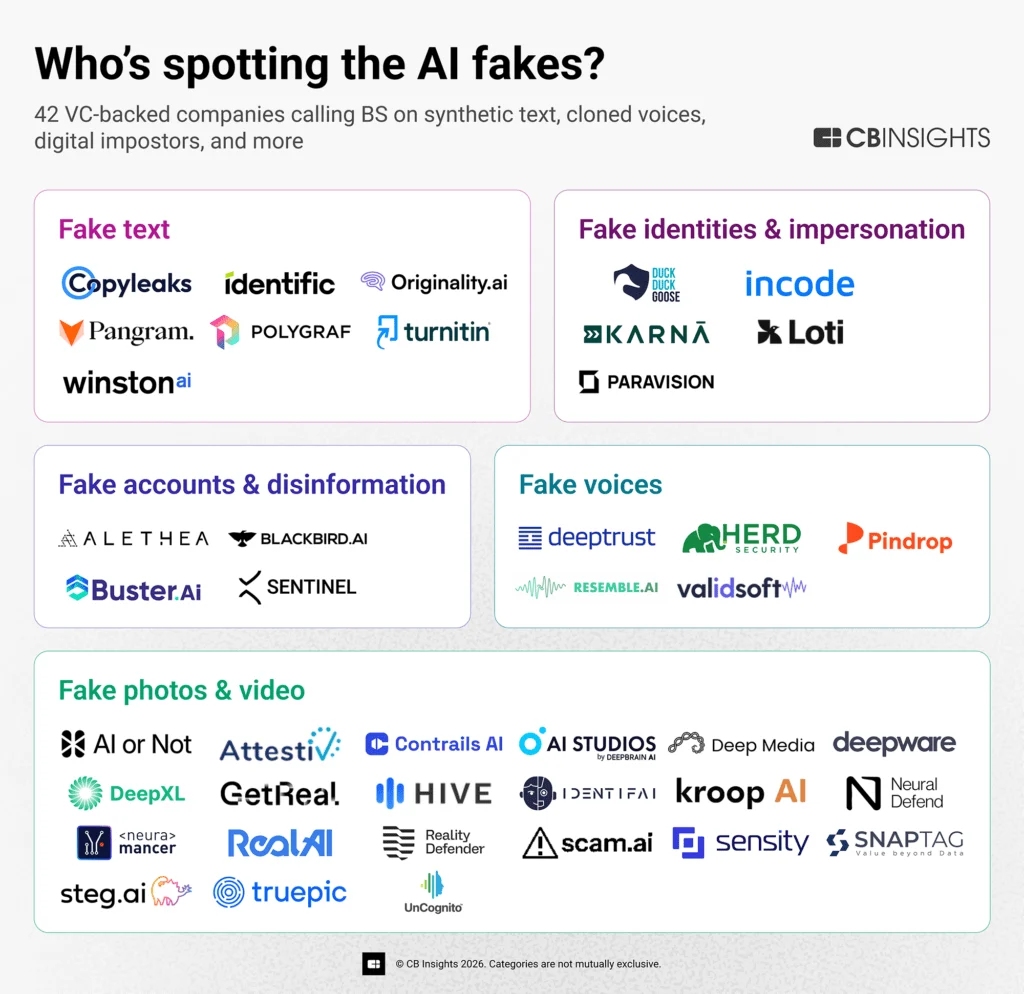
As the line between synthetic and organic content blurs, a new industry has emerged to restore the boundaries of reality. We have identified 42 VC-backed startups currently operating in the AI "fake-catching" ecosystem. This report maps the state of this nascent market, analyzing how capital, technology, and corporate strategy are converging to combat the proliferation of the digital mirage.
The Chronology of Deception: From Chatbots to Deepfakes
The evolution of synthetic media has moved with terrifying velocity.
- 2022–2023: The Generative Dawn: The widespread release of accessible LLMs (Large Language Models) democratized the creation of high-quality, persuasive text. Fraudsters began using these tools to automate phishing campaigns and generate fake personas for social engineering.
- 2024: The Visual Turning Point: The maturity of image and voice-cloning technologies brought the "deepfake" out of the realm of fringe internet subcultures and into the corporate boardroom. Real-time voice cloning began causing disruptions in financial services and executive communications.
- 2025: The Institutional Response: Recognizing the systemic risk to financial integrity, major institutions began formalizing investments in detection technologies. Banks, in particular, became the primary adopters, integrating "reality verification" tools into their security stacks.
- 2026: The Maturity of the Detection Market: Today, the industry has shifted from experimental pilots to a structured market, characterized by specialized startups, venture capital funding, and strategic acquisitions by data giants like Equifax.
Supporting Data: The Capital Flow of Truth
Since January 2025, the 42 companies mapped in our research have secured approximately $125 million across 26 distinct funding rounds. This influx of capital highlights a growing investor consensus: as synthetic content becomes cheaper to produce, the cost of verifying truth will become a permanent, non-negotiable tax on the global economy.
The Breakdown of Investment
The data reveals a clear preference among venture capitalists for companies tackling "identity-critical" fraud.
- Identity and Voice Detection: These sectors claimed $74 million of the total $125 million raised.
- Market Leader: Incode, a prominent player in the identity verification space, secured the largest individual round at $37 million, signaling the market’s prioritization of "hard" biometric verification over "soft" content analysis.
- Corporate Backing: The financial sector is no longer just a customer; it is an active participant. Capital One’s investment in GetReal and BNY’s backing of Reality Defender demonstrate that legacy financial institutions view deepfake detection as a foundational component of modern risk management.
Strategic Implications: Why the "Fake-Catching" Market is Maturing
Four distinct trends define the current landscape of the AI detection market.
1. The Integration of Detection into Existing Workflows
Rather than creating new platforms that customers must log into, successful detection startups are embedding their technology into existing identity-verification ecosystems. Companies that already manage KYC (Know Your Customer) and anti-money laundering (AML) processes are increasingly licensing third-party detection software to add a layer of "synthetic intelligence" to their current suites.
2. The Rise of the Specialized Founder
There is a notable shift in the leadership profiles of these startups. Of the 11 companies founded since 2023, seven focus exclusively on high-stakes sectors like banking and insurance. Interestingly, few of these founders come from traditional fraud-prevention backgrounds.
Instead, the sector is being led by professionals with deep technical roots in cybersecurity and infrastructure. For instance, the founder of IdentifAI previously spent nine years leading the Italian cybersecurity firm Yoroi, while the CEO of DeepXL transitioned from a legal role at major Nordic banks. This fusion of legal/regulatory expertise and engineering prowess is vital, as these companies must navigate not only the technical challenges of detection but also the stringent compliance requirements of the financial sector.
3. The "Platform" Pivot
Software companies are increasingly building detection as an API-first service. By partnering with existing enterprise software, these firms are ensuring that their detection capabilities are "always on." This move minimizes the friction for end-users, effectively turning the detection of deepfakes into a background utility rather than a manual audit process.
4. The M&A Cycle: The Predators and the Prey
The market is bracing for a wave of consolidation. Equifax serves as the primary case study here; by integrating Incode’s technology into its Kount fraud platform, the company has signaled a broader strategy. During their July earnings call, Equifax explicitly identified identity and fraud detection as one of its four core acquisition lanes.
On the other side of the ledger, several smaller, boutique detection firms are currently in "funding windows," making them prime targets for acquisition. As the cost of maintaining high-accuracy detection models rises, smaller startups will likely find it difficult to scale independently, leading to an inevitable absorption by larger data conglomerates.
The Dystopian Reality: The Human Cost
The implications of this technology extend far beyond corporate balance sheets. When a persona like Ervin Hoskins can infiltrate a legitimate publication, it erodes the foundational trust in the fourth estate.
For the average consumer, the "dystopian" aspect of this reality is the constant requirement for skepticism. We are entering an era where the burden of proof has shifted. Previously, a video or an article was considered authentic until proven otherwise. Today, the default assumption for any digital asset must be one of suspicion.
The security industry calls this the "Zero Trust" model applied to media. In this environment, the startups listed in our map are the new gatekeepers. They are attempting to build a "digital immune system" that can distinguish between a human voice and a synthetic clone, or between a real job candidate and an automated bot.
Official Responses and Ethical Considerations
The rapid deployment of detection tools is not without controversy. Privacy advocates argue that the surveillance required to detect AI fraud—such as constant biometric monitoring and behavioral analysis—could lead to a "panopticon" effect.
"We are building a world where, in order to be trusted, you must be constantly surveilled," notes one cybersecurity analyst. The balance between maintaining institutional security and protecting individual privacy remains the industry’s greatest, and perhaps most difficult, challenge.
Furthermore, the "cat-and-mouse" game between synthetic generators and detection software creates a permanent state of technological escalation. As detectors improve, generative models are trained to bypass them. This cycle ensures that there will never be a "final" solution to AI deception. Instead, companies and governments are committing to a perpetual cycle of technological investment, where the cost of verification becomes a permanent fixture of digital life.
Conclusion: The Market’s Next Move
As of late 2026, the AI fake-catching market is transitioning from a niche security concern to a critical infrastructure requirement. The $125 million invested over the last 20 months is merely the beginning of a much larger shift.
For now, the Ervin Hoskinss of the world remain a nuisance—cheap to produce and difficult to monetize. But as the underlying models for voice, image, and text generation continue to improve, the sophistication of these fakes will increase in tandem.
For investors, the opportunity lies in identifying companies that can provide "high-fidelity" detection—those that can move beyond simple pattern matching to understand the context and intent behind content. For the public, the reality is more sobering: we are all now required to be amateur forensic experts in our own lives, navigating a world where the most authentic-looking information may be the most manufactured.
The "fake-catching" industry is not just selling software; it is selling the ability to believe what we see. And in a digital landscape crowded with synthetic ghosts, that is becoming the most valuable commodity of all.