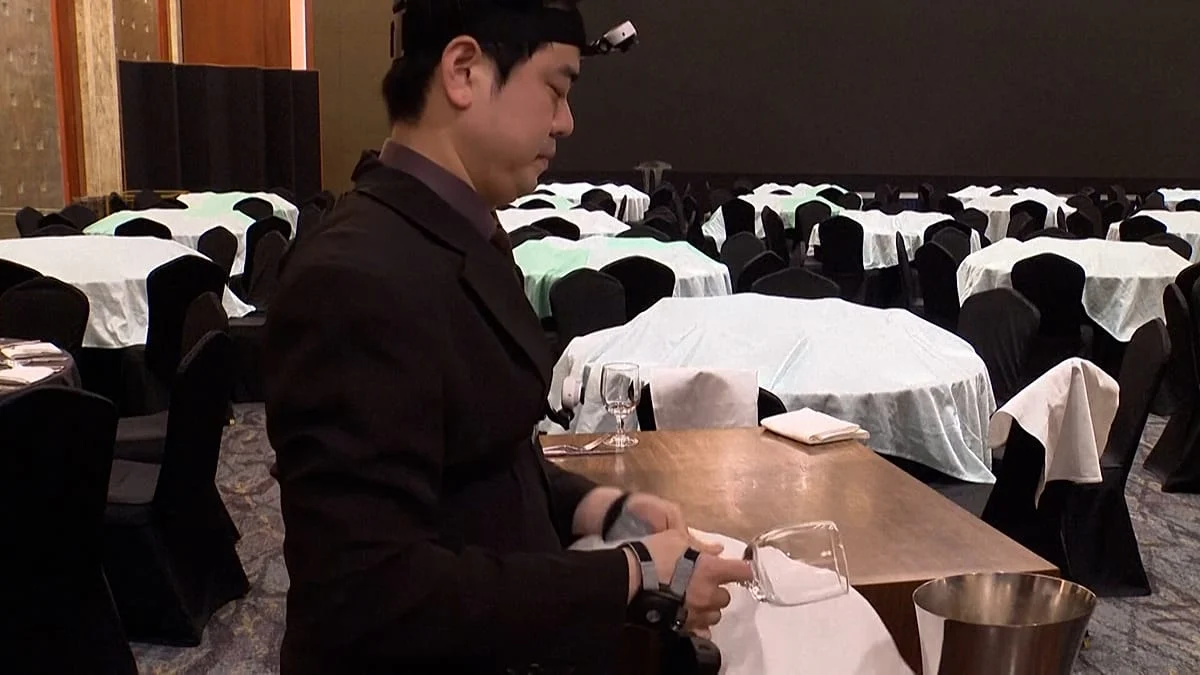
In the gleaming, high-end corridors of a Seoul hotel, the future of labor is being meticulously recorded. David Park, a seasoned hospitality professional with nine years of experience, performs his daily routine—folding crisp linen napkins, polishing glassware to a streak-free shine, and setting tables with surgical precision. Yet, he is not merely preparing a ballroom for guests; he is acting as a "human teacher" for a new generation of artificial intelligence. Strapped with motion-tracking cameras on his head, chest, and hands, every nuance of his physical labor is being digitized to train humanoid robots to mirror the delicate dexterity of human touch.
This initiative, spearheaded by the South Korean AI firm RLWRLD, represents a pivotal shift in the global robotics landscape. By capturing the minute data of human movement—joint angles, finger pressure, and spatial awareness—the company aims to transition robots from clumsy, stiff-limbed machines into fluid, human-like assistants capable of navigating the complex, unpredictable environments of hotels, factories, and warehouses.
The Mechanics of "Physical AI"
The technological ambition behind RLWRLD’s project is to bridge the gap between digital intelligence and physical execution, a field increasingly referred to as "Physical AI." While large language models like ChatGPT have mastered the synthesis of text and logic, Physical AI requires a different kind of data: the "instinctive know-how" of human muscle memory.
At the core of this research is the development of five-finger robotic hands. Traditional industrial grippers are designed for repetitive, high-force tasks, such as welding or lifting heavy metal components. However, they lack the sensitivity required for hospitality or retail. As Hyemin Cho, a business and strategy executive at RLWRLD, explains, standard robotic grippers cannot achieve the "crisp, precise folds" required for five-star service. To replicate the finesse of a human concierge or a warehouse packer, the AI must learn the physics of soft materials and the subtle adjustments made in real-time.
The training process is exhaustive. Each recording session captures gigabytes of telemetry data. When a human worker like Park folds a napkin, the system records not just the final shape, but the trajectory of his wrists, the precise tension in his fingertips, and the varying force applied as the cloth transitions from a flat surface to a geometric fold. This data is then fed into neural networks that power robots equipped with onboard cameras, allowing them to "see" and "feel" their way through tasks that were previously impossible for machines to automate.
A Chronology of the Humanoid Leap
The trajectory of South Korea’s investment in robotics has been accelerating over the past decade, moving from basic automation to advanced human-centric design:
- 2015–2020: Focus on traditional industrial automation. South Korea solidified its position as a global leader in manufacturing density, integrating robots into the automotive and semiconductor sectors.
- 2022–2023: The "Generative AI Boom" forces a rethink of robotics. Researchers realize that while robots are efficient, they lack the adaptability to work alongside humans in unstructured environments.
- 2024: RLWRLD launches its data-capture program, partnering with high-end hospitality brands like Lotte Hotel and logistics giants like CJ Group.
- 2025–2026: The South Korean government announces a $33 million national project aimed specifically at digitizing the skills of veteran technicians, essentially creating a "library of human movement."
- 2028 (Projected): Industry leaders, including Hyundai Motor and Samsung, aim to begin the large-scale deployment of humanoid robots in commercial factories and service environments.
Supporting Data: The Efficiency Gap
While the progress is rapid, the current state of robotics serves as a sobering reminder of the complexity of human movement. Demonstrations of RLWRLD’s prototypes reveal a significant gap in performance. A humanoid robot currently takes several hours to clean a hotel room that a human professional can prepare in approximately 40 minutes.
Despite this, the trajectory is exponential. Developers note that as AI software matures, the "learning curve" for robots is flattening. By utilizing vast datasets from various industries—ranging from food display arrangements at Lawson convenience stores in Japan to heavy-duty logistics at CJ Group warehouses—the AI is becoming generalized. The goal is a "universal controller" for robotic hands that can be deployed across disparate sectors without requiring a complete rewrite of the software code.
Official Responses and Strategic Vision
The South Korean government views the rise of humanoid robotics as a matter of national security and economic survival. In the shadow of the ongoing technological rivalry between the United States and China, Seoul is positioning itself as the "factory of the future."
Government officials argue that South Korea possesses a unique "unfair advantage": a highly skilled workforce and a mature manufacturing base. By capturing the expertise of these workers before they retire, the nation hopes to codify its industrial knowledge into AI systems. This is not viewed as a replacement of labor, but as a preservation of expertise.
"We are building the infrastructure for the next industrial revolution," says a spokesperson for the Ministry of Trade, Industry and Energy. "Our goal is to ensure that the skills honed by our workers over decades are not lost, but are instead amplified through robotic hardware."
Major corporations are placing massive bets on this vision. Hyundai Motor’s acquisition of Boston Dynamics is the cornerstone of its strategy to automate assembly lines by 2028. Meanwhile, Samsung Electronics has declared an ambitious goal to transform all its global manufacturing facilities into "AI-driven factories" by 2030, utilizing a fleet of humanoids to handle both delicate assembly and heavy lifting.
Implications: The Future of Work
The prospect of humanoid robots entering the workforce naturally invites scrutiny regarding labor rights and employment security. Labor unions have raised alarms about the potential for mass displacement in sectors like retail and logistics.
However, the perspective from the ground—from the workers being "recorded"—is more nuanced. David Park, who has spent nearly a decade in the hospitality industry, views the development as a collaborative evolution rather than an existential threat.
"If you look at the entire process of preparing for an event in the back-of-house space, we think humanoids might be able to take over about 30% to 40% of that workload," Park explains. "The repetitive, physically taxing tasks—the heavy lifting, the constant bending—those are perfect for robots. But the remaining 60% or 70% of the work involves the ‘human-to-human’ interaction, the empathy, and the ability to read a guest’s needs. That is where we remain indispensable."
This assessment aligns with current industry trends, which emphasize "cobots" (collaborative robots) designed to work alongside humans rather than in isolation. The integration of Physical AI is expected to alleviate labor shortages in aging societies like South Korea, where the declining workforce is a primary economic concern.
As the technology moves from the research lab to the hotel ballroom, the line between human and machine performance continues to blur. While the robot may one day fold a napkin as perfectly as David Park, the true test of this technology will be its ability to handle the chaotic, unscripted reality of human life. For now, the cameras keep rolling, the AI continues to learn, and the human hands of Seoul continue to teach the machines how to exist in our world.