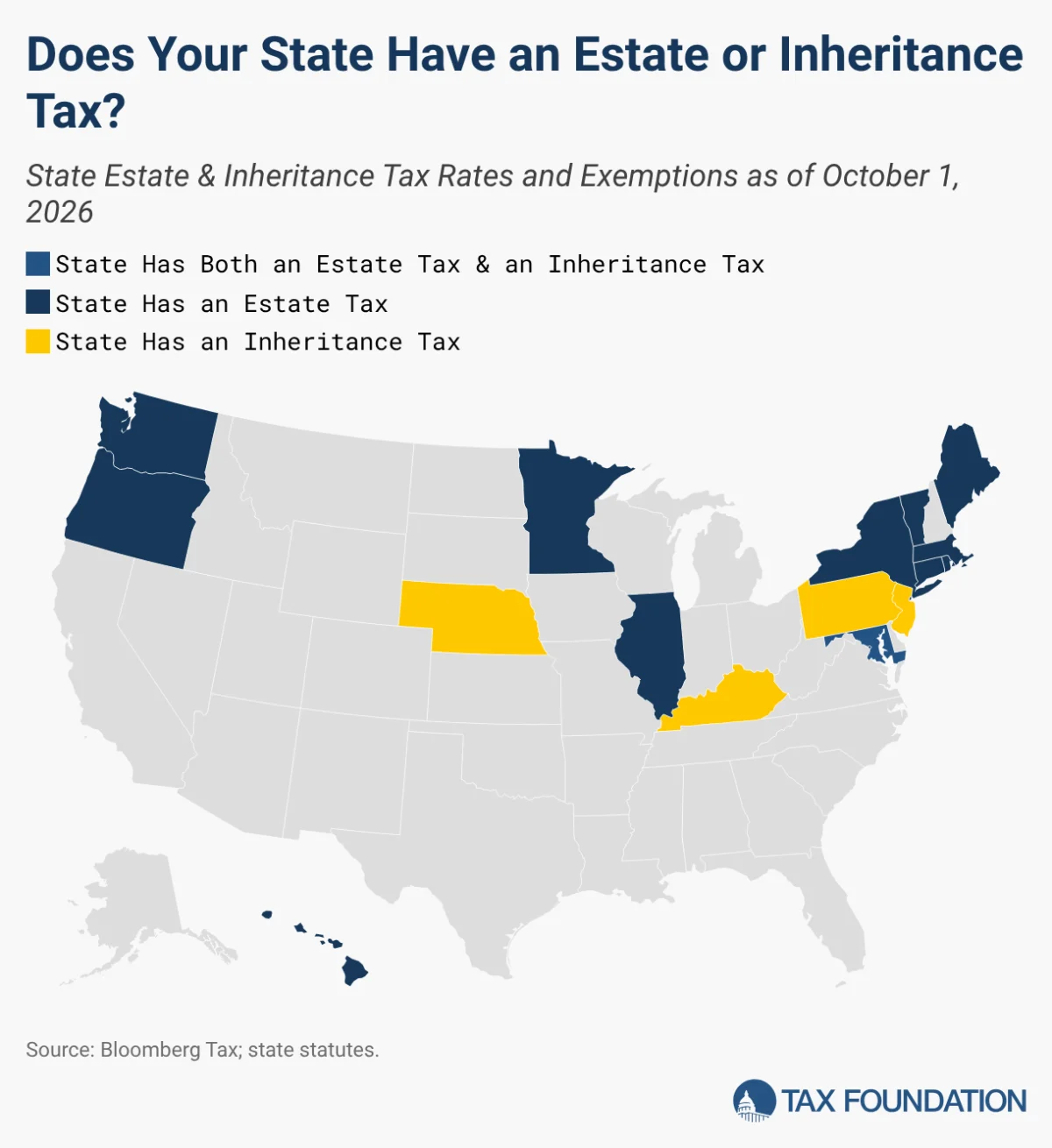
As the United States enters a new fiscal landscape following the implementation of the 2025 One Big Beautiful Bill Act (OBBBA), the debate surrounding the taxation of wealth at the point of death has moved to the forefront of state-level policy discussions. While federal tax law has shifted to accommodate higher thresholds for generational wealth transfers, a patchwork of state-level estate and inheritance taxes continues to create significant economic friction. For families, small business owners, and estate planners, navigating this complex web of state regulations has become increasingly precarious.
The Mechanics of Death Taxes: Estate vs. Inheritance
To understand the current landscape, one must first distinguish between the two primary forms of death taxation: the estate tax and the inheritance tax.
An estate tax is levied on the total net value of a decedent’s estate before any assets are distributed to heirs. It is, in essence, a tax on the privilege of transferring wealth, paid by the estate itself. Conversely, an inheritance tax is a levy on the value of the assets received by an individual beneficiary. While the estate tax is determined by the size of the total fortune, the inheritance tax is determined by the size of the bequest and, frequently, the relationship between the beneficiary and the deceased.
Currently, the federal estate tax maintains a top marginal rate of 40 percent. However, at the state level, 12 states and the District of Columbia impose their own estate taxes, while five states—Kentucky, Maryland, Nebraska, New Jersey, and Pennsylvania—levy inheritance taxes. Maryland occupies a unique and often criticized position as the only jurisdiction in the nation to impose both.
Chronology of Reform: From Federal Credit to State Repeal
The history of state-level death taxes is inextricably linked to federal policy. Prior to 2005, the federal government offered a "state death tax credit." This mechanism essentially allowed states to claim a portion of the federal estate tax revenue at no additional cost to the taxpayer; if a state imposed an estate tax, the taxpayer’s federal liability decreased by the amount paid to the state. This created a powerful incentive for states to maintain their own levies.
When the federal government phased out this credit in 2005, the landscape shifted dramatically. States that had "pick-up" taxes—laws that automatically triggered a state tax to match the federal credit—saw their revenue streams evaporate overnight unless they moved to decouple their tax code from federal provisions.
In the two decades since, a wave of reform has swept across the country. States began to recognize that death taxes were not merely revenue tools, but economic deterrents. Notable milestones include:
- 2018: Delaware repealed its estate tax, while New Jersey completed a multi-year phase-out of its estate tax, though it retained its inheritance tax.
- 2021: Vermont significantly expanded its economic competitiveness by nearly doubling its estate tax exemption to $5 million.
- 2023: Connecticut finalized a six-year transition, aligning its estate tax exemption with federal levels and moving toward a flat tax rate structure. Nebraska implemented significant legislative relief by reducing inheritance tax rates and increasing exemptions.
- 2025: Iowa achieved a major policy victory by fully repealing its inheritance tax.
Data and Comparative Analysis
The burden of these taxes is dictated by two primary factors: the exemption threshold and the marginal rate.
The Exemption Gap
The federal exemption threshold, following the OBBBA, now stands at $15 million and is indexed for inflation starting in 2027. This represents a significant move toward shielding middle-class families and smaller business enterprises from federal taxation. However, state exemptions are frequently far lower, creating a "bracket creep" scenario where estates are exempt from federal tax but subject to state-level confiscation.
Connecticut stands alone as the only state that currently conforms its exemption threshold to the federal standard. At the other end of the spectrum, states like Oregon ($1 million) and Rhode Island ($1.8 million) maintain some of the most restrictive thresholds in the country, ensnaring modest estates that were never the intended targets of such policies.
Marginal Rates and Structural Burdens
Hawaii and Washington currently share the highest top marginal estate tax rate in the nation at 20 percent. While Hawaii’s rate applies to estates exceeding $10 million, Washington’s tax is widely considered more burdensome. With a lower exemption of $3 million and a steeper marginal rate progression, Washington’s system creates a more aggressive tax environment for high-net-worth residents.
In the realm of inheritance taxes, the structure is often tied to the "closeness" of the heir. Kentucky and New Jersey impose the highest top marginal rates at 16 percent. These states use a tiered system: lineal heirs (spouses, children, grandchildren) often pay lower rates or are exempt entirely, while more distant relatives or non-related beneficiaries face the full, punitive weight of the 16 percent tax.
Implications: The "Asset Rich, Cash Poor" Dilemma
The most profound implication of these taxes is the impact on family-owned businesses and agricultural operations. A common characteristic of such enterprises is that they are "asset rich but cash poor." A family farm may have a valuation of $10 million based on the market value of the land, yet the operation may generate very little liquid cash.
When a death occurs, the estate tax bill is often due in a short window. If the estate lacks sufficient liquidity to cover the tax liability, heirs are frequently forced to liquidate assets—such as selling off portions of the farm or the business itself—to satisfy the government. This does not just reduce the wealth of the family; it destroys the continuity of the business, leading to job losses and diminished economic activity in the local community.
Furthermore, the administrative cost of compliance is significant. Wealthy individuals often engage in complex, inefficient tax-avoidance strategies, such as creating trusts or gifting assets prematurely, simply to mitigate the impact of death taxes. This "deadweight loss"—the expenditure of time and money on tax avoidance rather than productive investment—acts as a drag on the national economy.
Official Responses and Future Policy Outlook
During the 2025-2026 legislative sessions, the push for reform was visible in the halls of state capitols from Maryland to Oregon. Lawmakers in these states introduced bills aimed at raising exemptions or repealing the taxes entirely. While many of these proposals failed to clear their respective legislatures, the mere act of their introduction signifies a growing consensus among policymakers: the current death tax structure is increasingly viewed as an impediment to economic mobility.
The Tax Foundation and other economic policy advocates argue that the 16 states and the District of Columbia still clinging to these levies are at a competitive disadvantage. In an era of high geographic mobility, high-net-worth individuals are increasingly choosing to establish their domicile in states without death taxes—such as Florida or Texas—to ensure that their lifetime of labor is not diluted upon their passing.
Conclusion: A Case for Sunset
The existence of estate and inheritance taxes in the modern fiscal environment is increasingly difficult to justify. As the federal government moves to protect estates up to $15 million, the state-level persistence of low-exemption, high-rate death taxes creates an uneven playing field that penalizes families for their success.
The economic evidence is clear: death taxes discourage in-state investment, trigger the flight of capital, and force the dissolution of family enterprises. For states looking to boost their economic competitiveness and provide stability for their residents, the path forward is clear. By following the examples of Iowa and Delaware, or by at least aligning with the federal exemption levels as Connecticut has done, states can foster an environment that rewards industry and preserves the generational legacy of their citizens. The "death tax" is not just a tax on the deceased; it is a tax on the future of the state’s economy.