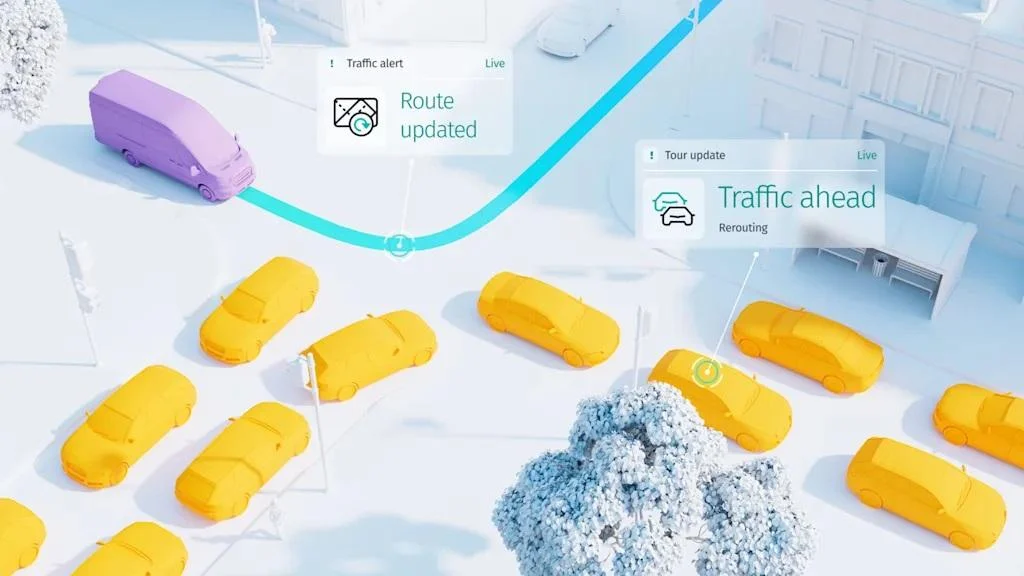
In the high-stakes world of fleet management and last-mile logistics, there is a pervasive, cynical adage: "A dispatch plan is only as good as the moment it hits the screen at 6 a.m." By 9 a.m., the reality of urban congestion, a driver calling in sick, or a sudden change in delivery priority often renders that masterfully crafted route obsolete.
For decades, the logistics industry has treated this "plan-versus-reality" gap as an inevitable tax on efficiency. However, HERE Technologies is now challenging the status quo. Instead of attempting to build a "perfect" static plan, the company is pivoting toward a dynamic, learning-based architecture that evolves in real-time. By integrating field data with advanced AI reasoning, HERE aims to transform dispatch from a rigid administrative task into a fluid, adaptive process.
The Core Philosophy: Closing the "Plan-Reality" Gap
Bart Coppelmans, a key voice at HERE Technologies, recently detailed the company’s strategic roadmap at Home Delivery World. The vision is simple yet radical: move away from command-and-control logistics and toward a system that observes, learns, and corrects.
The problem, as Coppelmans notes, is rooted in the inherent unpredictability of modern transit. A plan built in the quiet of an office cannot possibly account for the micro-fluctuations of a city’s pulse. "If you have a perfect plan by six in the morning, by nine it can already be different because of unexpected events—a driver getting sick, a carrier going dark, or last-minute order changes," Coppelmans explains. "You need to be really dynamic and flexible, taking that into account."
A Chronology of Innovation
- The Decade of Development: HERE’s core tour planning engine is a ten-year labor of love. While it started as a standard optimization solver, recent updates have catapulted its adoption, shifting it from a utility to a mission-critical engine.
- The "Last Meter" Shift (Recent): Recognizing that the "last mile" is often a "last meter" problem, HERE introduced its Last Meter Guidance tool to capture the nuances of where a vehicle actually stops versus where a map claims a front door exists.
- The Agentic Future (Upcoming): Later this year, the company plans to move its prototype "cognitive reasoning layer"—an AI agent designed to explain and refine dispatch decisions—into closed beta.
Technical Enhancements: Solving for Human Behavior
The latest iteration of HERE’s tour planning engine goes beyond basic shortest-path algorithms. It incorporates "time-dependent optimization," a sophisticated mechanism that acknowledges that traffic is not a static variable.
"At nine o’clock in the morning, you can deliver fewer orders than at one o’clock in the afternoon because of traffic jams," says Coppelmans. By baking these temporal shifts into the solver, HERE allows dispatchers to manage capacity as a variable that breathes throughout the day.
Precision at the Curb
Perhaps the most granular innovation is "walk clustering." Drivers often waste significant time repositioning their vehicles for multiple stops in dense urban environments. HERE’s system now identifies clusters where a driver should park once and complete several deliveries on foot. This is not merely about finding a parking spot; it is about reconfiguring the entire physical workflow of the driver to minimize the friction of constant vehicle ingress and egress.
Last Meter Guidance: Closing the Feedback Loop
One of the most persistent frustrations for drivers is the "map-to-reality" disconnect—the discrepancy between a GPS point and the actual entrance to a secure building or a complex loading dock.
HERE’s Last Meter Guidance acts as a bridge. By leveraging a proprietary positioning stack and collecting sensor data from handheld devices, the system captures the "traces" of actual, successful deliveries.
- Data Collection: The system tracks where the vehicle actually parked, the specific path the driver took to the building, and the exact coordinates of the final drop-off point.
- Dynamic Feedback: This data flows back to dispatch, refining delivery windows, and forward to the next driver, providing precise guidance on where to park and how to access the building.
"There’s no disconnect anymore," says Coppelmans. "Drivers are more comfortable trusting what is being planned because the data reflects the reality they see on the ground."
The Cognitive Layer: Why AI Must Explain Itself
Perhaps the most ambitious aspect of HERE’s roadmap is the introduction of an AI-driven "reasoning layer." In the current logistics landscape, many black-box algorithms provide a route without explanation, leaving dispatchers to guess why a specific decision was made.
The new reasoning layer changes this paradigm. If an order is left unassigned, or if two trucks are routed to the same street, the system provides a rationale. It doesn’t just show the result; it explains the constraints—be it driver skill levels, vehicle capacity, or specific delivery priorities.
Proactive Remediation
The system goes a step further by acting as a digital veteran dispatcher. It can suggest structural fixes:
- "Should we loosen the time constraints?"
- "Can we shift these three orders to tomorrow’s manifest?"
- "Does adding a vehicle to this specific sector resolve the backlog?"
Coppelmans likens this to the evolution of telematics. Just as generative AI has enabled fleet managers to ask, "Why is this tire losing pressure?" instead of staring at raw sensor data, the dispatch reasoning layer allows managers to focus on high-level strategy while the AI handles the granular troubleshooting.
The Challenge of Hallucination: Grounding Location AI
As the industry rushes to integrate Large Language Models (LLMs) into operations, a significant danger has emerged: "geospatial hallucination." A standard LLM might confidently direct a truck to a location that looks correct on a map but is physically inaccessible or non-existent in the real world.
To combat this, HERE has launched a "Location Reasoning" layer. This acts as a grounding mechanism, providing a spatial "sanity check" for AI agents. When a user asks an AI to find a restaurant halfway along a route, the Location Reasoning layer ensures the agent understands the actual road geometry and the physical boundary of the route, rather than relying on the imprecise probabilistic guesses common in general-purpose models.
"You can get fooled easily," Coppelmans warns. "These LLMs hallucinate based on geo-location queries. We’re feeding them a correspondent layer so they can really understand the context of location and ground it."
Implications: A Network of Agents
Looking toward the horizon, Coppelmans envisions a shift from monolithic software suites to a decentralized, "agent-to-agent" ecosystem. He posits that no single model can encompass the unique service-level agreements (SLAs) and operational KPIs of every carrier.
Instead, the future lies in an interoperable network. A carrier’s internal operations agent might "consult" with a HERE routing agent, much like a dispatcher would consult with a peer.
The Path Forward
The implications for the industry are profound:
- Reduced Siloing: By allowing agents to query one another, companies can break down the walls that currently prevent data from being shared across the supply chain.
- Institutional Memory: The system effectively builds a digital library of "what works" based on real-world driver traces, ensuring that the knowledge of a veteran driver is baked into the system for the next generation.
- Efficiency Gains: By moving from rigid, manual oversight to proactive, AI-assisted management, carriers can drastically reduce the cost of last-mile delivery.
While the "agent-to-agent" communications model is still in its infancy, the technological foundation—the data collection, the reasoning layers, and the grounding of LLMs—is already being laid.
For the logistics industry, the message is clear: the era of the static, 6 a.m. plan is fading. In its place, a more resilient, communicative, and "intelligent" era of logistics is beginning to take shape. For HERE Technologies, the goal is not to eliminate the human dispatcher, but to provide them with a digital teammate that finally understands the difference between a map and the street.