In the high-stakes arena of artificial intelligence, where trillion-dollar valuations and existential technological leaps have become the new baseline, one company is quietly—yet rapidly—stealing the spotlight. Anthropic, the AI research powerhouse, is currently navigating a year of unprecedented growth. As the industry watches, the firm is reportedly eyeing a massive funding round that could push its valuation toward the $950 billion mark, positioning it to potentially eclipse the market cap of its most formidable rival, OpenAI.
This surge is not merely a product of investor enthusiasm; it is grounded in a shifting tide of enterprise adoption. Business customers, once firmly tethered to the OpenAI ecosystem, are increasingly pivoting toward Claude. Recent data from Ramp reveals that Anthropic has successfully quadrupled its market share among corporate clients since May 2025, a performance metric that signals a decisive shift in the "AI arms race."
The Architecture of Success: The "Batman and Robin" Duo
At the heart of this operational momentum is a strategic pivot that moved Claude from a static, informational chatbot to a dynamic, functional coding tool. Much of this evolution can be traced back to the arrival of Cat Wu, Anthropic’s head of product for Claude Code and Cowork.
Joining the company in August 2024, Wu brought a clinical, product-first focus to the organization. Her partnership with Boris Cherny, a pillar of Anthropic’s technical staff and the architect behind the company’s proprietary Claude Code, has become legendary within Silicon Valley circles. Industry observers have dubbed the pair "Batman and Robin," a nod to their complementary skill sets—Wu’s strategic product vision and Cherny’s technical execution—which have effectively turned the Claude ecosystem into a powerhouse for developers and enterprises alike.
Chronology: From Research Lab to Market Titan
To understand Anthropic’s current trajectory, one must look at the rapid-fire succession of developments that have defined the last 18 months.
- Mid-2024: The company accelerates its recruitment of top-tier product leadership, including Cat Wu, signaling a shift from pure research toward high-utility product deployment.
- Late 2024: Anthropic begins the transition from a single-model approach to a "fleet" of models, diversifying its offerings to suit specific enterprise needs.
- April 2026: The launch of "Glasswing," a guarded initiative involving a consortium of tech giants including Amazon, Apple, and Microsoft. This marked a shift toward high-security, closed-access AI, specifically through the debut of the cybersecurity model, Mythos.
- May 2026: Reports emerge regarding a potential $950 billion valuation round, positioning Anthropic to surpass OpenAI’s $854 billion milestone reached in March.
- Present Day: Anthropic solidifies its position as the preferred partner for business-critical AI infrastructure, outpacing its rivals in total enterprise customer count.
Supporting Data: Why Businesses Are Migrating
The flight to Anthropic is not a matter of brand loyalty, but of tangible utility. According to industry data, the competitive advantage currently enjoyed by Anthropic lies in its reliability and specific feature sets tailored for the modern enterprise.
The transition from a "chat-first" interface to one defined by "coding and coworker" capabilities has allowed businesses to integrate AI directly into their technical workflows. Unlike general-purpose models that may struggle with hallucination or inconsistency in complex software environments, Anthropic’s model architecture—driven by the continuous iteration seen in the release of six models in a single year—provides a level of precision that professional developers now prioritize.
Furthermore, the company’s decision to adopt a tiered release strategy—ranging from widely available models to the restricted, high-security Mythos—demonstrates a maturity that enterprise risk managers value. By restricting access to Mythos, Anthropic has effectively signaled that it is a responsible steward of powerful technology, rather than a reckless disruptor.
Official Perspectives: Navigating the Frontier
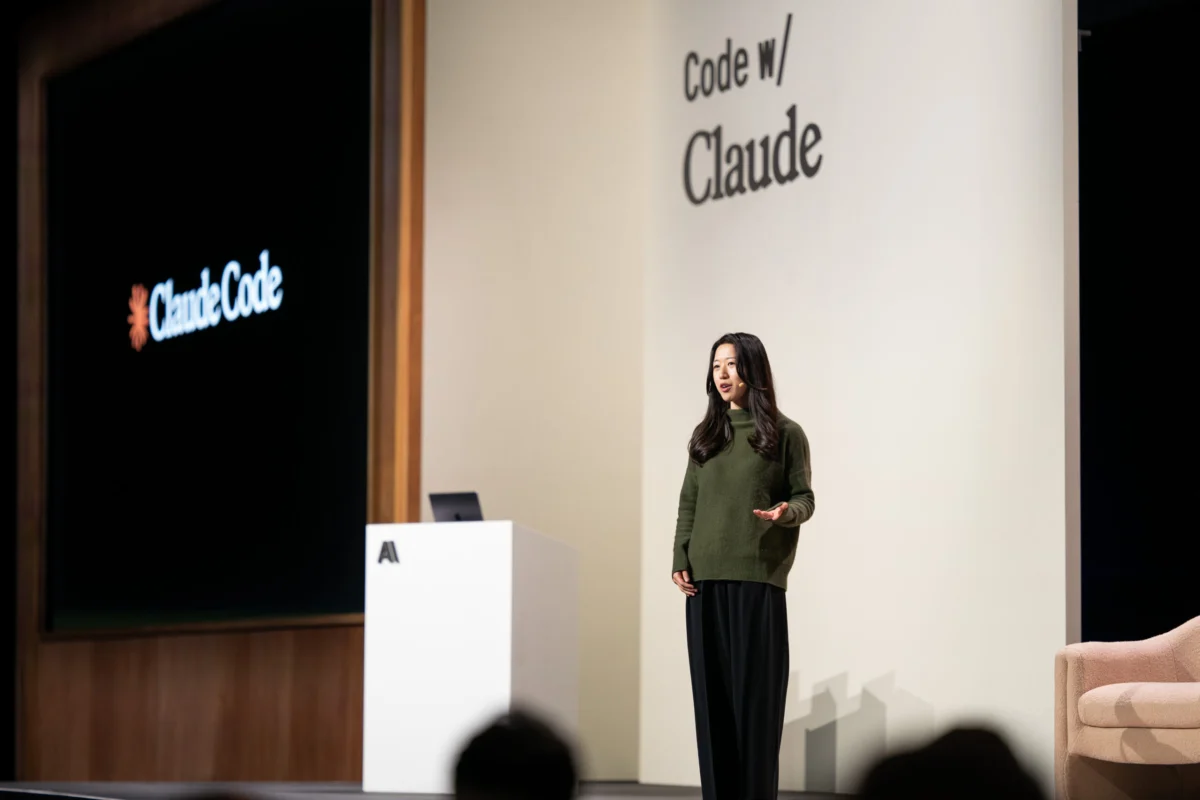
At the second annual "Code with Claude" conference in San Francisco, Cat Wu provided insight into the philosophy that prevents Anthropic from falling into the "reactive trap" that plagues many of its competitors.
"The main thing that we design for is staying on the exponential," Wu noted. "Across our team, we instill the lesson that AI will continue to get better. For us, we just need to stay at this frontier. We don’t think about competitors. If you think about competitors, you end up being perpetually two weeks, or a month, behind how fast you can execute."
When questioned about the aggressive pace of model deployment—releasing nearly a dozen models in less than two years—Wu remained steadfast. She emphasized that the goal is not to launch for the sake of headlines, but to solve human bottlenecks. "As much as possible, we want this intelligence to benefit as many people as possible, and it has to be handled in a very safe way."
This safety-first approach is best exemplified by the aforementioned Mythos initiative. By creating a controlled environment for a specialized cybersecurity model, Anthropic is actively avoiding the "black box" risks that have haunted other AI developers.
The Future of Work: Managing the Fleet
Perhaps the most significant portion of the discourse surrounding Anthropic involves the future of human labor. As the company rolls out tools that allow AI to act as autonomous coworkers, the question of human obsolescence inevitably arises. Wu, however, frames the shift as a move toward a new type of management.
"I think it is extremely hard to manage agents if you can’t do the job yourself," Wu explained. "The managers still need to be experts in their domain. It’s a new skill set… managing agents is actually very similar to being a manager of people. You have to understand why the agent made a mistake. Did it misinterpret the instruction? Was the request under-specified? You have to have the ability to debug it."
Rather than viewing the technology as a replacement for human staff, Wu argues that Anthropic is focused on removing the "tedious" friction from daily operations. "My hope is that AI does the boring stuff—like responding to emails—and then everyone has the bandwidth to build the things they actually want to build."
Implications for the Tech Ecosystem
The implications of Anthropic’s rise are profound. As the company moves toward proactive AI—systems that anticipate needs rather than waiting for prompts—the entire software industry is bracing for a paradigm shift.
- The End of Synchronous Work: The shift from "chatting" with an AI to having an AI handle routine tasks autonomously means the speed of business is set to accelerate exponentially.
- Valuation Wars: With Anthropic nearing the $1 trillion club, the capital intensity of the AI sector has hit a new peak. This will likely force a consolidation in the market, where only the most well-funded and technically proficient firms survive.
- Security as a Product: By demonstrating that a model can be both powerful and restricted, Anthropic has set a new gold standard for AI governance. Other players will likely be forced to adopt similar "closed-consortium" models for their more potent technologies.
As Anthropic continues its meteoric climb, the message to the industry is clear: the era of the chatbot is ending, and the era of the agentic, proactive, and enterprise-integrated AI has begun. Under the guidance of leaders like Wu and technical innovators like Cherny, Anthropic is not just competing for market share—it is drafting the blueprint for the next century of human-machine collaboration.