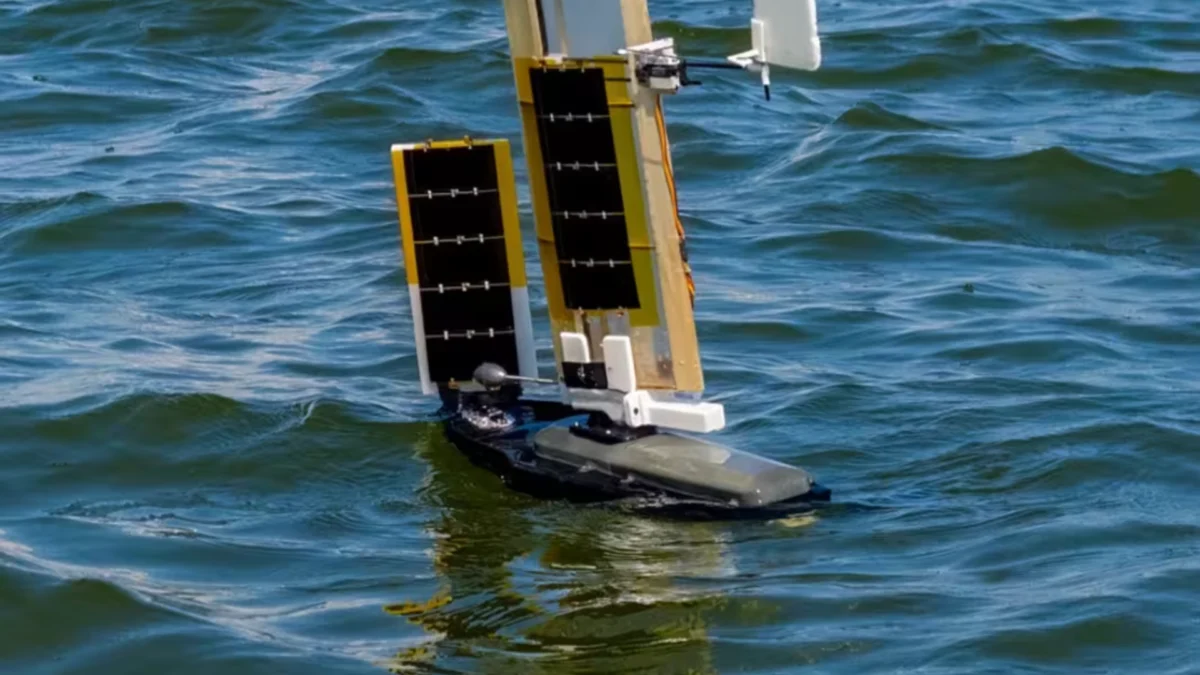
In the rapidly evolving landscape of autonomous robotics, a team of seven researchers from the Singapore University of Technology and Design (SUTD) has unveiled a breakthrough that blurs the lines between aviation and maritime exploration. The project, dubbed "ALBATROSS," introduces a lightweight, hybrid drone capable of being deployed from the sky to perform long-range oceanic sensing without the need for complex landing gear or fuel-heavy propulsion systems.
By leveraging the physics of autorotation and the efficiency of wind-powered sailing, the ALBATROSS prototype represents a fundamental departure from traditional hybrid systems. It is not merely a drone; it is a passive, smart-design vessel that treats the air-to-water transition not as a mechanical challenge to be overcome with motors, but as a flight phase to be harnessed.
Main Facts: The Anatomy of a Hybrid Pioneer
The ALBATROSS is a testament to the power of minimalist engineering. Weighing in at a mere 1.107 kg, the craft is designed for rapid aerial deployment. Unlike traditional UAVs that require a runway or vertical take-off/landing (VTOL) rotors, the ALBATROSS is designed to be dropped from a parent aircraft or high-altitude drone.
Key Technical Specifications:
- Mass: 1.107 kg (prototype).
- Deployment: Aerial release from a host platform.
- Descent Mechanism: Autorotation via rigid wingsails.
- Marine Propulsion: Passive wind-propulsion (sailing).
- Steering Mechanism: A fish-tail-inspired rudder system utilizing lateral motion.
- Control Architecture: Three primary sensors and three control actuators.
- Operational Range: Estimated to exceed 100 km.
The most striking feature of the ALBATROSS is its lack of landing gear. Instead, the craft utilizes its rigid wingsails to enter an autorotation state during its descent. This spinning motion acts as a natural braking system, slowing the drone’s descent speed and mitigating the impact forces upon water entry. Once it touches down, the vehicle is engineered to automatically self-right, transitioning from a falling projectile into a wind-propelled vessel capable of navigating vast stretches of open ocean.
Chronology: The Development Path
The evolution of the ALBATROSS was driven by a specific engineering goal: overcoming the "last mile" problem of maritime sensing. While large-scale sailing drones exist, they are often bulky, expensive to deploy, and reliant on mother ships for logistics.
Phase 1: Conceptualization and Design
The SUTD team began by identifying the failure points of previous hybrid systems. Most marine-aerial drones rely on heavy propellers or complex mechanical actuators to survive water entry. The team pivoted toward a design that requires no external energy for the transition. By focusing on passive stability, they drafted a geometry that allows the drone to remain stable in both air and water.
Phase 2: The Autorotation Prototype
Early testing focused on the descent mechanism. Engineers discovered that by utilizing the rigid sails as airfoils, they could induce a controlled, spiraling descent. This was the turning point; it allowed the craft to drop from significant altitudes without incurring structural damage upon impact.
Phase 3: Transition and Self-Righting
The most recent stage of development involved optimizing the craft’s center of gravity. The team refined the design to ensure that, upon hitting the water, the craft would naturally flip upright. This "passive self-righting" is the backbone of the ALBATROSS’s efficiency, as it eliminates the need for battery-consuming motors that would otherwise be required to orient the craft after a landing.
Supporting Data: Why ALBATROSS Outperforms Predecessors
To understand the significance of the ALBATROSS, one must look at the current state of autonomous marine exploration. Existing platforms like SailMAV have set benchmarks for performance, yet the SUTD team has managed to push these boundaries significantly.
Comparative Range Analysis
The SailMAV system, a notable predecessor, reports a operational range of approximately 7 km. In contrast, the ALBATROSS is projected to exceed 100 km. This order-of-magnitude increase is primarily attributed to the elimination of aerial propulsion systems. By relying on air-drop deployment and wind-based surface propulsion, the ALBATROSS consumes virtually zero energy during the deployment phase, leaving its onboard power reserves strictly for data collection and communication.
The Efficiency of Passive Design
The SUTD team’s approach prioritizes "mechanical simplicity." By removing complex landing hardware and reconfiguration motors, they have created a vessel that is not only lighter but significantly more resilient.
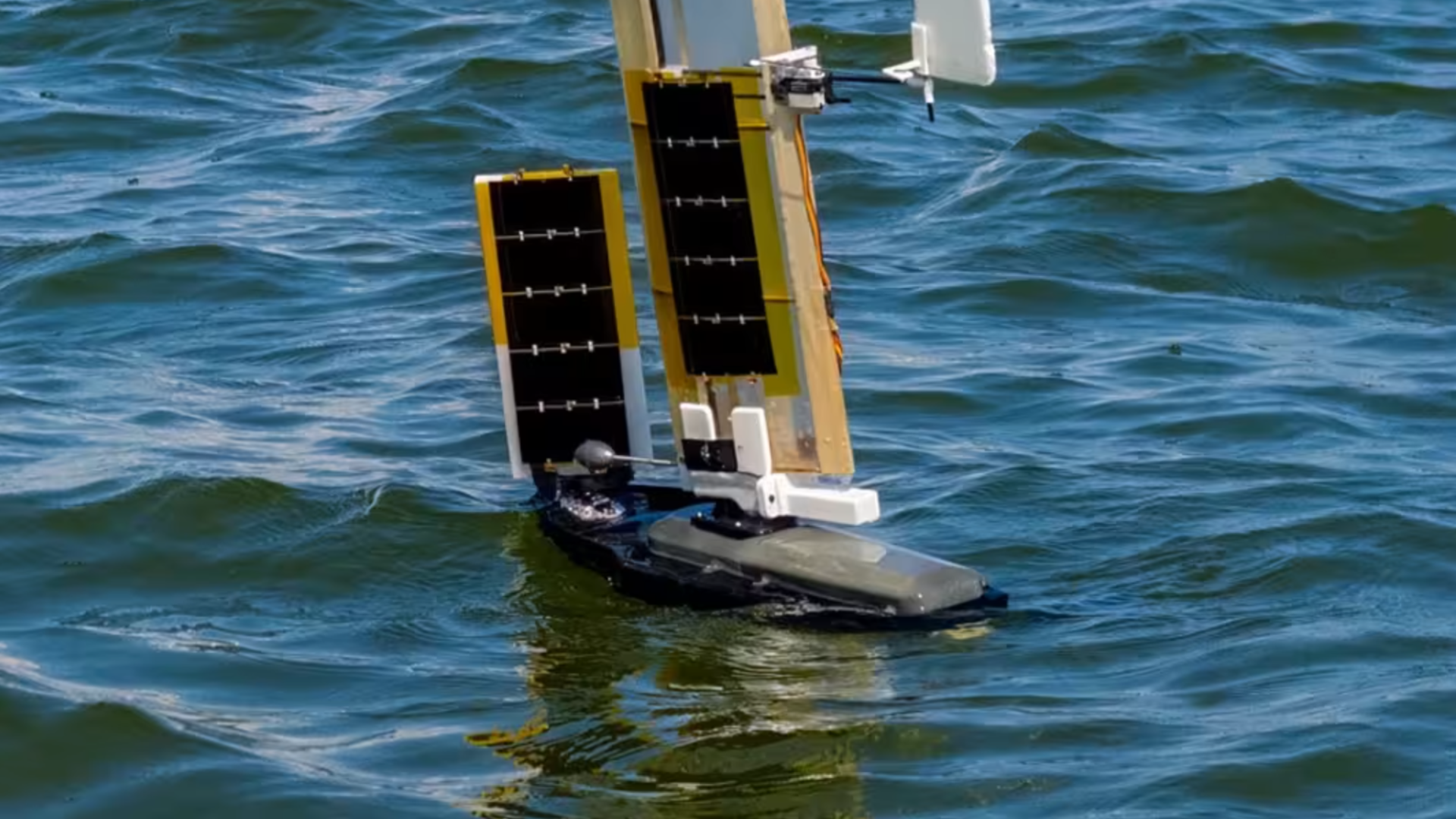
- Energy Savings: Because the craft does not require motors to "land" or "take off" from the water, the entirety of its battery life is dedicated to its mission—be it monitoring sea temperatures, tracking oil spills, or collecting salinity data.
- Deployment Velocity: The ability to be dropped from high altitudes allows for the rapid deployment of a fleet of these drones in response to sudden environmental events, such as hurricanes or maritime disasters.
Official Responses and Engineering Philosophy
The research team at SUTD has been vocal about the philosophy behind their design. In a recent statement, they emphasized that the primary hurdle in hybrid systems is usually the "reconfiguration" stage—the moment a drone tries to change its physical shape to accommodate a new medium.
"Unlike many hybrid aerial-marine systems, ALBATROSS eliminates the need for aerial propulsion, complex mechanical reconfiguration, or active stabilization during the air-water transition," the team explained. "It is designed to be released from an aircraft or UAV, passively enter autorotation for a controlled, low-impact water landing, and self-right without actuation."
By removing these "active" points of failure, the engineers have created a system that is inherently more reliable. If a motor fails, a drone falls; if an actuator jams, a hybrid system sinks. By moving the intelligence of the craft into its passive geometry, the SUTD team has created a machine that "wants" to be in the water.
Implications: The Future of Autonomous Maritime Sensing
The success of the ALBATROSS prototype carries profound implications for multiple sectors, including climate science, defense, and environmental conservation.
1. Climate and Environmental Monitoring
Oceanic data is notoriously difficult to collect in real-time. Satellite imagery can see the surface, and research vessels are slow and costly. A swarm of ALBATROSS-class drones could be released into a remote oceanic region to form a distributed sensor network, providing granular data on changing currents, water acidity, and plastic pollution.
2. Defense and Security
The ability to deploy low-cost, silent surveillance units from the air offers a new tactical advantage. Because the ALBATROSS does not have a heavy thermal or acoustic signature from engines, it is ideally suited for clandestine environmental monitoring or long-term maritime domain awareness.
3. Logistical Independence
Unlike larger sailing drones—such as the industry-standard Saildrone—which often require dedicated shore support and specialized launch facilities, the ALBATROSS is "logistically light." It can be carried in the cargo bay of a standard commercial or military aircraft, effectively turning any plane into a deployment platform for marine research.
Critical Challenges
Despite the optimism surrounding the project, the researchers acknowledge that moving from a prototype to a real-world, long-term operational tool involves significant hurdles. The "wild" ocean is an unpredictable environment. Whether the ALBATROSS can maintain its self-righting capability in high-sea states, or whether its steering mechanism (the fish-tail rudder) can handle extreme currents, remains to be seen.
The next steps for the SUTD team will involve long-endurance sea trials. These trials will test the limits of the craft’s endurance and its ability to autonomously navigate back to shore—a capability the team claims is achievable at the end of a mission.
Conclusion: A New Wave of Innovation
The ALBATROSS project is a compelling reminder that in engineering, sometimes the best solution is the one that works with nature rather than fighting it. By embracing the passive physics of autorotation and wind-based propulsion, the SUTD team has effectively turned the ocean’s surface into a vast, navigable frontier for small-scale robotics.
If the ALBATROSS proves to be as reliable in the field as it is in the lab, it could democratize ocean exploration. It shifts the burden of maritime research from heavy-duty, expensive vessels to a fleet of "smart" drones that can be dropped anywhere, at any time, to observe the pulse of our planet’s oceans. As we continue to face the challenges of a rapidly changing climate, the ability to deploy such low-impact, high-efficiency tools will prove to be an indispensable asset for the global scientific community.