Computer vision (CV) has transcended the narrow confines of basic object detection and image classification. As we head into 2026, the field has evolved into a high-stakes engineering discipline that sits at the volatile intersection of foundation models, spatial computing, and high-performance embedded hardware. Today’s CV engineers are no longer just tuning hyper-parameters; they are architects of systems that must perceive, reason, and act within the physical world in real time.
Whether powering autonomous delivery drones, optimizing robotic warehouse efficiency, or enabling complex medical imaging diagnostics, the modern CV engineer must master a full-stack journey that spans from the mathematical essence of a camera sensor to the aggressive optimization required for edge-based production.
The Evolution of the CV Landscape
The demand for "full-stack" vision engineers has never been higher. Industry requirements have shifted away from siloed research towards integrated systems. Organizations are increasingly looking for professionals who understand the entire pipeline: sensor calibration, model architecture selection, and deployment-grade inference optimization.
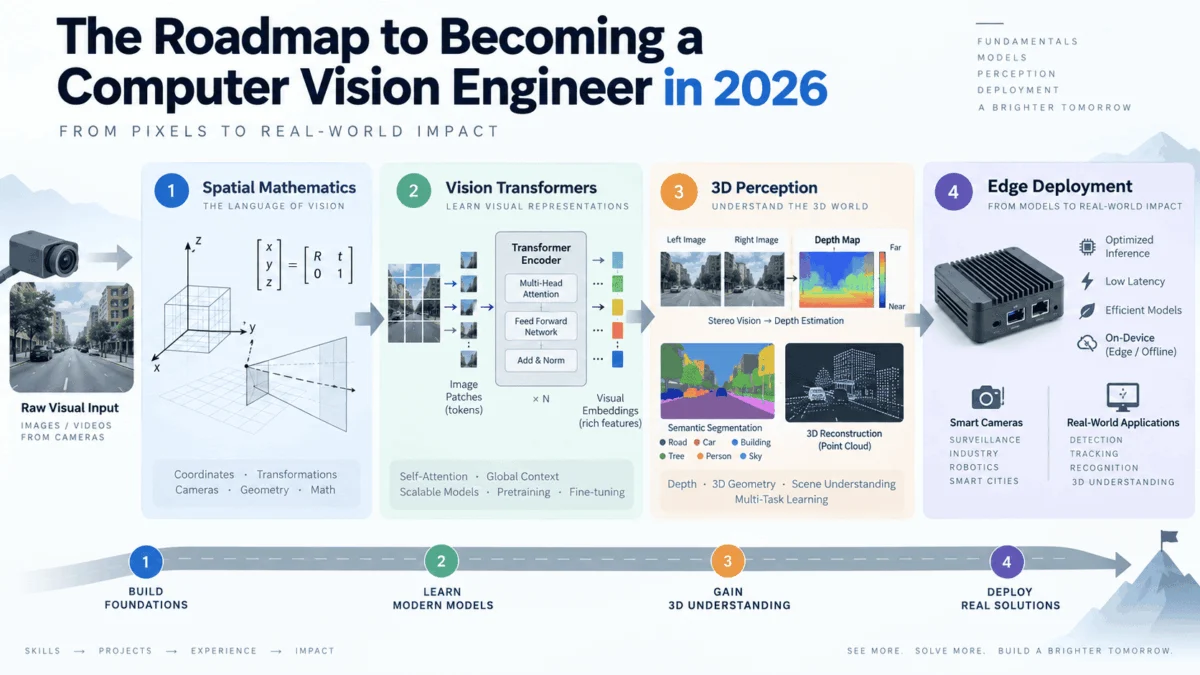
The following four-stage roadmap serves as a comprehensive guide for navigating this complex landscape, ensuring that practitioners move from theoretical understanding to tangible, production-ready capabilities.
Stage 1: The Mathematical Foundation and Vision Primitives
Every sophisticated computer vision system is, at its core, a engine for spatial reasoning. Before one can leverage modern transformer-based architectures, a rigorous grasp of the underlying geometry is mandatory.
Core Mathematical Principles
The foundational layer of CV involves matrix transformations, coordinate frame management, and projective geometry. Engineers must understand how a 3D environment is projected onto a 2D sensor plane—a process that dictates how cameras perceive depth and perspective. Furthermore, mastery of multi-view geometry is essential for tasks like stereo vision and sensor fusion, where data from multiple camera rigs must be synchronized into a single, cohesive spatial coordinate system.
Implementation and Frameworks
Proficiency in PyTorch remains the industry gold standard for both research and production environments. To complement this, engineers must master synthetic data augmentation pipelines. Libraries like Albumentations provide the necessary toolkit to simulate real-world conditions—lighting shifts, geometric distortions, and occlusions—allowing models to generalize without the massive overhead of collecting new training data.
Feature Representation
The final component of this stage is understanding feature representation. Practitioners must distinguish between traditional convolutional backbones (e.g., ResNet, EfficientNet) and modern attention-based architectures. Furthermore, contrastive representation learning—a technique where models learn by comparing similar and dissimilar data points—has become a cornerstone for generating robust embeddings before fine-tuning for downstream tasks.
Portfolio Exercise: Construct a stereo depth estimation pipeline using two calibrated images. By visualizing the disparity map and documenting the points of failure, an engineer can internalize the limitations of geometric reasoning in real-world scenarios.
Stage 2: Vision Transformers and the Rise of Multimodal Models
The transition from Convolutional Neural Networks (CNNs) to transformer-based architectures has fundamentally altered the CV toolkit. Vision Transformers (ViTs) treat images as sequences of patches, applying global self-attention rather than localized filters, which allows for a more holistic understanding of image context.
The Era of Vision-Language Models (VLMs)
Perhaps the most significant development in recent years is the emergence of models like CLIP and SigLIP. By learning joint embeddings across image and text modalities, these models allow for "open-vocabulary" understanding. Instead of being restricted to a fixed set of class labels, systems can now interpret visual scenes through natural language queries.
Advanced Segmentation and Detection
Techniques such as Grounding DINO and Meta’s SAM 2 (Segment Anything Model 2) have democratized complex tasks. SAM 2, in particular, offers promptable, zero-shot segmentation for both static images and video streams. By providing a point, bounding box, or text prompt, an engineer can generate high-quality masks without requiring specialized, task-specific retraining.
Portfolio Exercise: Develop a zero-shot object detection demo using Grounding DINO. By testing the model across disparate domains—such as industrial environments, medical imaging, and standard indoor scenes—engineers can pinpoint exactly where open-vocabulary approaches encounter domain shift and fine-grained classification errors.
Stage 3: 3D Vision, Neural Rendering, and Spatial Perception
As systems move from passive observation to active spatial reasoning, the necessity for 3D understanding becomes paramount. This stage marks the transition from flat pixel analysis to true volumetric awareness.
Representing the 3D World
Engineers must become fluent in various 3D representations:
- Point Clouds: The standard output for LiDAR sensors and Structure-from-Motion (SfM) pipelines.
- Voxel Grids: Provide a structured, volumetric approach, though often at a high memory cost.
- Signed Distance Fields (SDFs): Enable differentiable rendering by representing geometry as continuous mathematical functions.
The Shift Toward Neural Rendering
Traditional rendering has been revolutionized by Neural Radiance Fields (NeRFs) and the even more efficient 3D Gaussian Splatting. These techniques allow for interactive, novel view synthesis, enabling systems to "hallucinate" or reconstruct unseen angles of a scene with remarkable fidelity, even on consumer-grade hardware.
Simultaneous Localization and Mapping (SLAM)
For robotics and autonomous navigation, Visual Odometry (VO) and SLAM are critical. These techniques enable a system to estimate its own position while incrementally building a map of its environment. Mastering these tools is the final hurdle in moving from "seeing" to "navigating."
Portfolio Exercise: Utilize Depth Anything v2 to generate depth maps from a video feed. Convert these maps into a sequential point cloud to visualize a 3D reconstruction, providing a practical lesson in temporal consistency and spatial mapping.
Stage 4: Inference Optimization and Edge Deployment
The final, and perhaps most challenging, stage of the 2026 roadmap is systems engineering. A model that achieves state-of-the-art accuracy on a high-end workstation is useless if it cannot function on constrained edge hardware.
Techniques for Model Compression
To deploy models effectively, engineers must utilize:
- Quantization: Reducing the precision of model weights (e.g., from FP32 to INT8) to decrease memory footprint and accelerate inference.
- Pruning: Removing redundant connections in the neural network to increase computational efficiency.
- Knowledge Distillation: Training a smaller "student" model to replicate the performance of a larger, more complex "teacher" model.
Hardware Execution and Pipeline Engineering
Tools like NVIDIA TensorRT, ONNX Runtime, and Intel OpenVINO are essential for bridging the gap between framework code and hardware execution. On the embedded side, familiarity with the NVIDIA Jetson ecosystem or Apple Silicon’s Neural Engine is required to manage real-time inference tasks.
Managing high-throughput, multi-camera streaming—maintaining 30+ FPS while performing complex analytics—requires sophisticated pipeline engineering. NVIDIA DeepStream remains the industry standard for these high-performance video analytics pipelines.
Portfolio Exercise: Export a pretrained model (like YOLOv8) to ONNX, quantize it using TensorRT, and perform a benchmark study on accuracy versus latency. This exercise provides the definitive proof of the trade-offs required to bring AI into the physical world.
Implications for the Future Workforce
The 2026 computer vision engineer is a polymath. The field is no longer just about model architecture; it is about the integration of mathematics, software engineering, and hardware constraints. As foundation models continue to lower the barrier to entry for basic tasks, the value of the engineer will increasingly lie in their ability to optimize these models for the edge and ensure their reliability in unpredictable, real-world environments.
By mastering this four-stage progression, professionals can move fluidly between levels of abstraction—from the geometric nuances of camera sensors to the low-level instruction sets of neural processing units. The path to becoming an elite CV engineer is not a sprint, but a systematic, layered discipline that rewards those who build, measure, and iterate on real-world projects.
Summary of Key Resources
- Mathematical Foundations: Multiple View Geometry (Hartley & Zisserman); Stanford CS231n.
- Foundation Models: Hugging Face Transformers documentation; Meta AI’s SAM 2 research repository.
- 3D Vision: Open3D library; nerfstudio for neural rendering experiments.
- Deployment: TensorRT Developer Guide; NVIDIA Jetson Developer Kits.
Vinod Chugani is an AI and data science educator specialized in bridging the gap between cutting-edge research and industrial application. His work focuses on empowering technical teams to navigate the rapidly evolving AI landscape through actionable, hands-on strategies.