The global cryptocurrency landscape has once again reminded investors of its inherent volatility. After a sustained period of optimistic momentum throughout late August and September—a period that saw Bitcoin (BTC) flirt with record-breaking price levels—the market has experienced a sharp, multi-day correction. While the broader market cap has shed over $150 billion in value, the institutional narrative remains paradoxically bullish, highlighted by aggressive accumulation strategies from major corporate players like Metaplanet and MicroStrategy.
The Chronology of a Correction: From Resistance to Retracement
The narrative of the past week is one of "so close, yet so far." Entering the week, the atmosphere in the digital asset space was electric. Bitcoin was trading near $86,000, buoyed by favorable macroeconomic indicators, including cooling Personal Consumption Expenditures (PCE) data and steady employment reports.
However, the momentum proved fragile. By late Friday, the first cracks appeared as the asset slipped below the $84,000 support level. Despite a resilient attempt to reclaim $85,000 over the weekend and a bold challenge of the stubborn $87,000 resistance on Monday morning, the bulls lacked the necessary conviction to sustain the breakout.
The ensuing sell-off was swift and decisive. Following the failed attempt at $87,000, Bitcoin experienced a cascading decline, dipping to $85,000 before a momentary "fake-out" rebound to $86,600. When that recovery failed, the market succumbed to a significant correction, pushing the price below $80,400—marking its most volatile drop since mid-August.
Analysts point to a confluence of factors for this retreat, ranging from institutional profit-taking and exchange-traded fund (ETF) outflows to jitters surrounding US government wallet transfers. As of today, the market is attempting a consolidation phase, with Bitcoin clawing back above the $83,000 threshold. Whether this represents a "dead-cat bounce" or the foundation of a new upward trajectory remains the primary debate among traders.
Supporting Data: A Market in Flux
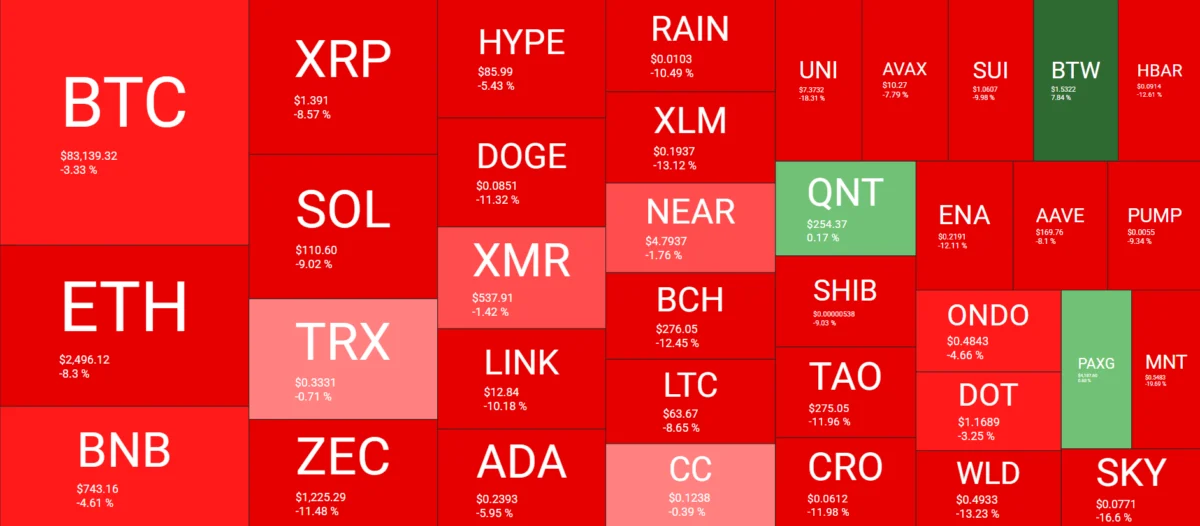
The scale of the recent market downturn is visible across all major metrics. On a weekly basis, the market is firmly in the red. Bitcoin has faced a decline of over 3%, but the pain has been more acute for altcoins. Ethereum (ETH) has slumped by more than 8%, while Ripple (XRP) has endured a contraction of 8.6%. Even more severe, assets such as ZEC, DOGE, LINK, and BCH have recorded double-digit percentage losses.
Current market data as of the most recent reporting cycle paints a sobering picture:
- Total Market Capitalization: $3.050 Trillion
- 24-Hour Trading Volume: $113 Billion
- Bitcoin Dominance: 56.6%
The volatility is expected to persist, if not intensify, as market participants turn their attention to the upcoming September Consumer Price Index (CPI) report, scheduled for release this Wednesday. Inflation data remains the primary driver of Federal Reserve policy, and any deviation from expectations could trigger further seismic shifts in risk-on assets.
Corporate Strategy: The Institutional "Buy the Dip" Mentality
While retail traders may be shaken by the double-digit percentage drops in altcoins, institutional heavyweights are treating the current market environment as a strategic opportunity.
Metaplanet’s Treasury Rebalancing
One of the most intriguing developments in Q3 comes from Metaplanet, the largest Asian corporate holder of Bitcoin. In a move that initially confused market observers, the company disclosed that it had sold 10,000 BTC during the third quarter. However, the move was not an exit strategy but a treasury liquidity exercise. The firm immediately repurchased 11,000 BTC, albeit at slightly higher prices. According to management, the maneuver was designed to demonstrate that their corporate treasury could be efficiently converted into fiat and back into digital assets, reinforcing the liquidity of their holdings.

MicroStrategy’s Unrelenting Accumulation
Contrasting with the occasional rebalancing seen elsewhere, MicroStrategy has doubled down on its "buy and hold" strategy. The firm recently announced its third consecutive purchase of Bitcoin, bringing its total holdings to a staggering 848,000 BTC. By continuing to accumulate at the current price levels, MicroStrategy is signaling a long-term conviction that transcends short-term price fluctuations.
Industry Headlines: Key Developments Shaping the Landscape
Beyond the price action, the crypto ecosystem is buzzing with significant technological and regulatory developments that will define the coming months.
The Midterm Election Outlook
As the US midterm elections approach, historical data suggests that Bitcoin often overperforms in the 12 months following such cycles. However, analysts at XWIN Japan have offered a note of caution, warning that historical patterns are not guarantees of future performance, particularly given the current intersection of crypto-policy and fiscal volatility.
Technical Debates: Lattice vs. Hash-Based Cryptography
A heated discourse has emerged between industry titans regarding the future of security. Cardano founder Charles Hoskinson recently challenged Vitalik Buterin’s warnings regarding lattice-based cryptography. Hoskinson argued that there is no credible evidence of a successful attack against lattice structures, pushing back against the notion that hash-based alternatives are inherently superior.
Regulatory Divergence: US vs. Russia
The geopolitical landscape for crypto is shifting rapidly. While the US continues to struggle with the stagnation of the CLARITY Act, Russia has taken a proactive regulatory step by officially registering its first digital asset operators. This move suggests a formal, central-bank-led transition toward a structured digital asset market in the region, standing in stark contrast to the regulatory uncertainty currently plaguing the US.
Arthur Hayes on the AI-Bitcoin Nexus
Former BitMEX CEO Arthur Hayes continues to advance a provocative theory: the AI industry is currently overbuilt. Hayes posits that the inevitable crash in data center demand will drive capital toward the most liquid, scarce asset available—Bitcoin. He suggests that as AI projects fail to meet the astronomical capital expenditures poured into them, the "digital gold" narrative of BTC will only strengthen.
Implications for the Future
The current market correction serves as a vital stress test for the maturation of the cryptocurrency sector. While the decline from $87,000 has been painful for speculative traders, the underlying infrastructure continues to grow.
The core takeaway from the past week is the growing disconnect between short-term price volatility and long-term institutional commitment. While retail sentiment fluctuates with each headline, companies like Metaplanet and MicroStrategy are actively managing their balance sheets with the expectation of a multi-year bull cycle.
Investors should approach the coming week with caution. The combination of the upcoming CPI release and the lingering uncertainty of the recent crash suggests that the market is currently in a "price discovery" phase. As we move into the final quarter of the year, the stability of the $80,000 support level will be the most critical indicator of whether the bull market remains intact or if a deeper period of consolidation is required.
Disclaimer: The information provided in this article is for educational and informational purposes only and does not constitute financial, investment, or legal advice. CryptoPotato and its contributors are not responsible for any financial losses. Always conduct your own research before making investment decisions.