The digital asset market remains hyper-focused on the recent price movements of Hyperliquid [HYPE], as the token faces renewed selling pressure following significant on-chain activity. A notable whale transaction involving a $2.03 million deposit onto the KuCoin exchange has ignited concerns regarding potential supply dilution. This development comes at a critical juncture for HYPE, which has been struggling to find stable ground after a period of broader market decline. As exchange-bound supply increases, market participants are weighing the implications of this transfer against a backdrop of cooling retail interest and precarious technical indicators.
Main Facts: The Whale’s Market Move
The primary catalyst for the current market sentiment is a substantial transfer detected on-chain. A single wallet, acting as a "whale," deposited 37,390 HYPE tokens—valued at approximately $2.03 million—into the KuCoin exchange. This transaction, executed six hours prior to the latest market analysis, is significant because it directly expands the immediately tradable supply on a major centralized platform.
While the same wallet also moved 290,750 USDC (worth roughly $290,650) to Kraken, the HYPE transaction holds far greater weight for the token’s price action. In the world of decentralized finance and crypto-trading, exchange-bound transfers are often interpreted as a precursor to liquidation. While such a deposit does not definitively confirm that a sale has occurred, it signals a shift in the whale’s strategy from holding to liquidity provision or potential divestment. When combined with broader on-chain data, this move has reinforced bearish sentiment among traders who fear that the market may soon need to absorb a significant influx of sell-side pressure.
Chronology of the Shift
To understand the current state of HYPE, one must look at the recent timeline of exchange flows. For much of July, HYPE saw a trend characterized by heavy outflows. During this period, tokens were being moved off-exchange to private wallets, effectively reducing the available circulating supply on exchanges and providing a cushion for price stability.
However, the tide began to turn in early August. The transition from a "withdrawal-heavy" environment to one of "inflow-dominance" marks a distinct shift in market behavior.

- Late July: HYPE experienced pronounced negative netflows, suggesting strong accumulation or long-term holding patterns.
- Six Hours Prior to Press Time: The whale initiated the $2.03 million deposit of HYPE to KuCoin, marking a pivot toward supply-side expansion.
- One Hour Prior to Press Time: The same entity transferred nearly $300k in stablecoins to Kraken, indicating a diversification or potential preparation for off-ramping assets.
This shift in momentum is not an isolated incident but part of a broader trend where netflows have turned positive, currently hovering around $1.24 million. This indicates that more HYPE is entering exchange order books than leaving them, placing an increased burden on the buy-side to maintain current price levels.
Supporting Data: Analyzing Market Dynamics
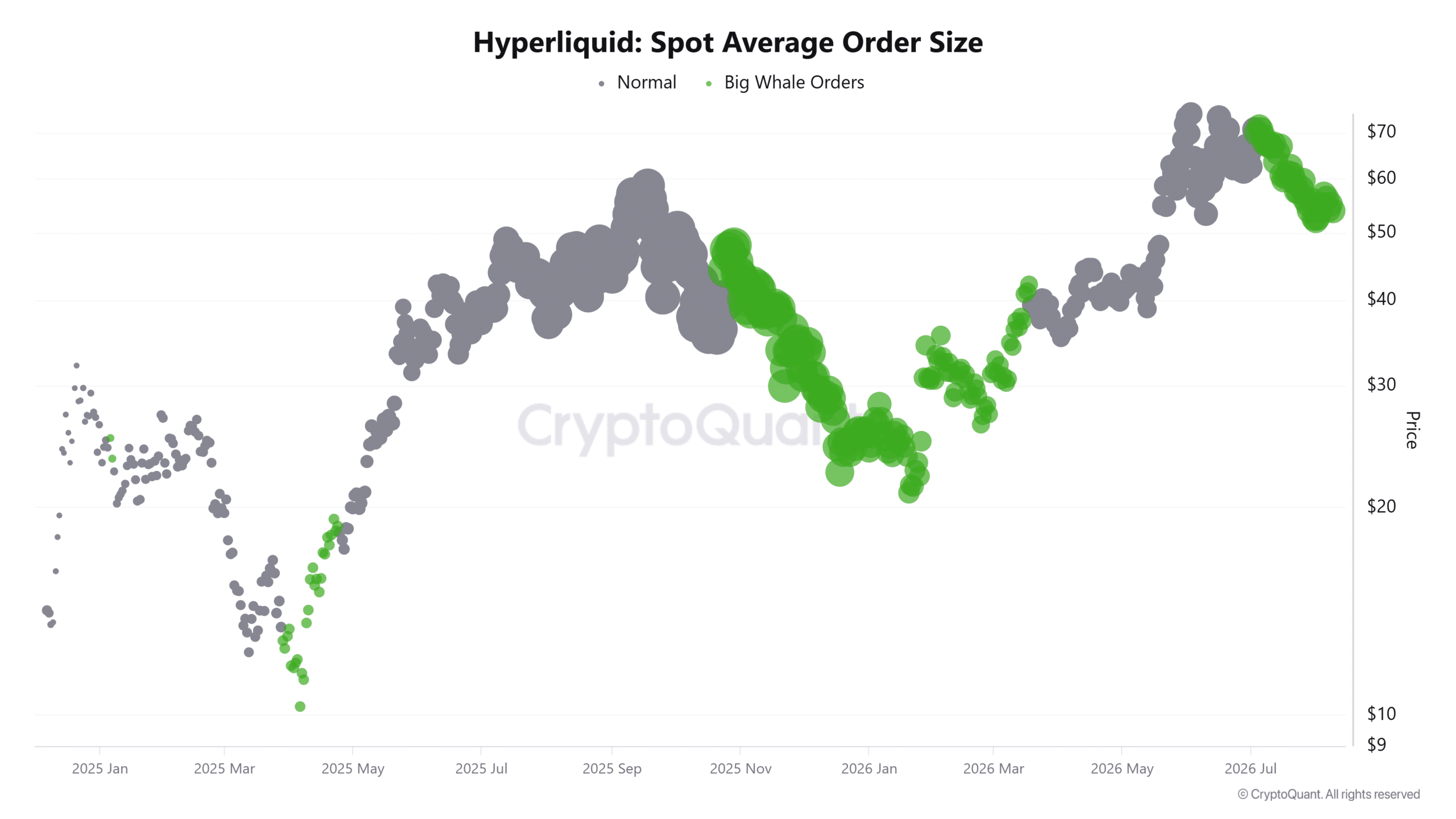
The impact of this whale movement is magnified by the current state of retail participation. Data from the Spot Volume Bubble Map suggests that retail interest is cooling, leaving a void that is increasingly being filled by the influence of large-scale traders.
Divergence Between Whales and Retail
The market is currently experiencing a divergence. While "Big Whale Orders" are frequently registered in the Spot Average Order Size metrics, the wider spot volume is trending downward. This means that as retail participation fades, the market is becoming thinner and more susceptible to the whims of a few large holders. When a whale moves millions in assets, their influence on the order book is disproportionately high because there is less "noise" from smaller traders to counterbalance these massive shifts.
Technical Indicators: A Fragile Technical Setup
From a technical analysis perspective, HYPE is caught in a tug-of-war. The token has successfully defended a key support level at $53.67, preventing a further slide. However, the path to recovery is obstructed by a descending trendline that continues to act as a ceiling, capping upside potential near $57.10.
- MACD (Moving Average Convergence Divergence): There is a glimmer of hope. The MACD line has recently moved to -1.93, positioning itself above the -2.23 signal line. This, accompanied by a positive histogram of 0.30, suggests that the selling momentum may be decelerating slightly. Yet, as both lines remain in negative territory, this recovery remains purely speculative and not yet confirmed by a shift into bullish territory.
- RSI (Relative Strength Index): Currently sitting at 43.42, the RSI is showing signs of life as it trades above its average of 39.57. Despite this, it remains below the neutral 50 threshold, confirming that the token is currently trapped in a "neutral-to-bearish" zone.
Official Responses and Market Sentiment
While there have been no direct statements from the Hyperliquid core development team regarding this specific whale deposit, the community sentiment on social platforms and decentralized finance forums remains cautious. Analysts note that the lack of institutional buying to offset this whale-driven supply is a point of concern.
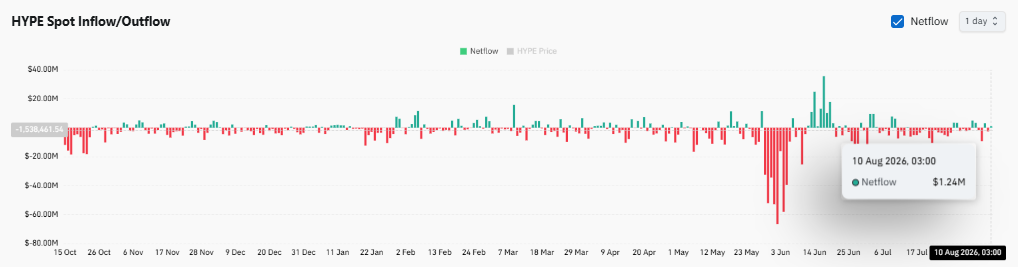
The prevailing sentiment among market observers is that the current price action is highly sensitive to further on-chain movements. If the current whale continues to deposit, or if other large holders follow suit, the $53.67 support level will likely be tested again. Conversely, a reversal of these flows—where we see a return to net outflows—would be the primary indicator that the market is ready to break through the $57.10 resistance barrier and potentially target the $62.48 level.
Implications: The Road Ahead
The implications for HYPE holders are clear: the market is currently entering a phase of supply-side testing. The ability of the HYPE ecosystem to absorb this influx will determine its short-term trajectory.
1. The Burden of Proof
The primary implication of recent exchange inflows is that the burden of proof has shifted to the buyers. To invalidate the bearish narrative created by the whale’s $2.03 million deposit, we would need to see a sustained increase in trading volume and a corresponding rise in price that effectively clears the sell orders being placed.
2. Risk of Further Liquidation
If the positive netflows continue, the risk of a breakdown increases. A failure to hold the $53.67 support could trigger stop-loss orders from retail traders, potentially accelerating a move toward the next major support zone at $51.09.
3. The Need for Catalysts
For HYPE to sustain a recovery, the current technical improvement in the MACD and RSI needs to be supported by a fundamental catalyst. Without new demand-side triggers—such as increased adoption of the Hyperliquid protocol, new partnerships, or a broader recovery in the altcoin sector—the whale’s influence is likely to keep the token suppressed in the near term.
Summary of Market Outlook
As it stands, Hyperliquid [HYPE] is at a crossroads. The combination of cooling retail participation and an increase in exchange-bound supply has created a challenging environment for bulls. While the defense of the $53.67 level demonstrates some resilience, the bearish pressure from whales is a reality that cannot be ignored. Investors and traders should remain vigilant, watching for shifts in exchange netflows as the most critical indicator of whether the current selling pressure is merely a temporary fluctuation or the start of a more sustained trend.
The coming days will be vital. If the market can consolidate above its current levels despite the increase in supply, it may signal that the worst of the sell-side pressure has been absorbed. However, if the current positive netflow trend persists, the outlook remains cautious, with the probability of a retest of lower support levels remaining elevated.