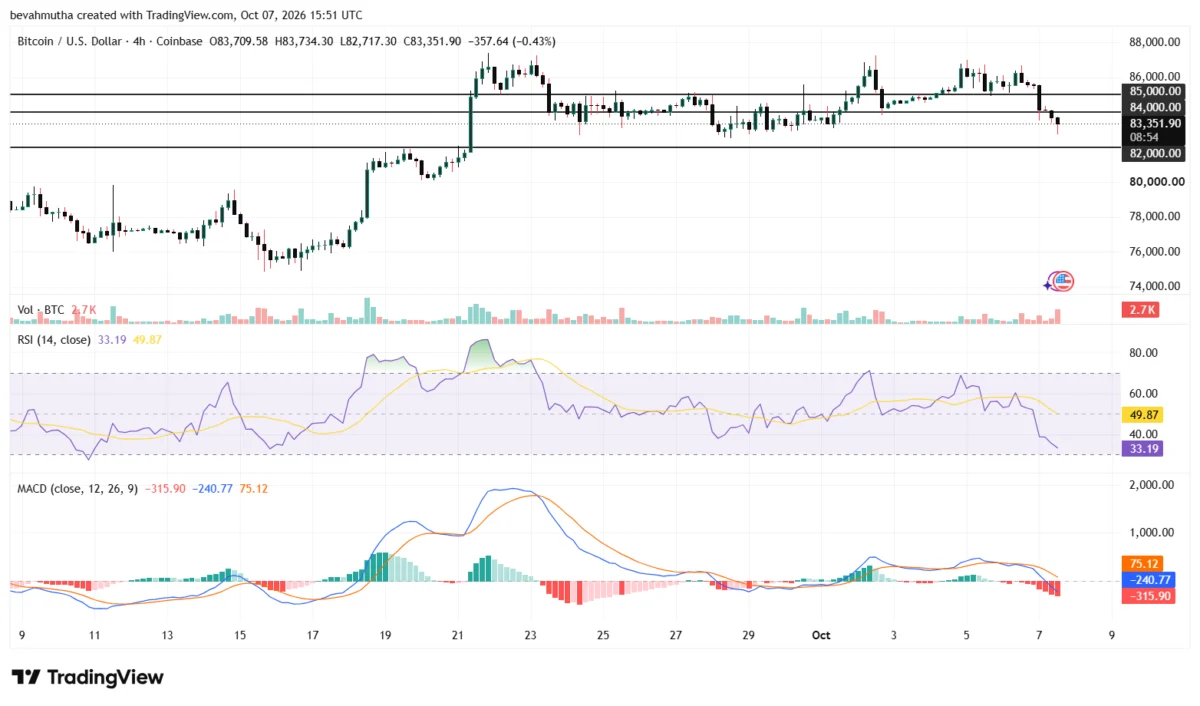
The global financial landscape is currently grappling with a period of extreme volatility, characterized by a synchronized retreat across both traditional and digital asset classes. Bitcoin, the world’s leading cryptocurrency, has faced significant downward pressure, sliding 3.72% over the last 24 hours to trade at approximately $82,911. This decline marks a sharp reversal from the optimistic sentiment that dominated the market earlier this month, as leveraged positions unwound and investors braced for a more hawkish macroeconomic environment.
The downturn in crypto assets has not occurred in a vacuum. It is deeply intertwined with a broader "risk-off" sentiment triggered by surging oil prices, soaring Treasury yields, and a dramatic, high-speed sell-off in precious metals. As capital flees to safety and liquidity dries up in risk-sensitive sectors, market participants are now shifting their undivided attention toward the impending release of the Federal Reserve’s latest meeting minutes, seeking clues on the future trajectory of monetary policy.
The Chronology of the Correction
The current market instability reached a fever pitch over the last 48 hours. Bitcoin, which had been attempting to establish a firm foothold above the $86,000 threshold, saw its momentum systematically dismantled.

The Failure at $87,000
For weeks, $87,000 acted as a psychological and technical ceiling for Bitcoin. Since September 23, the asset made three distinct attempts to break through this resistance level, each time failing to sustain the necessary volume to flip it into support. This repeated rejection created a "triple-top" formation, which is often interpreted by technical analysts as a precursor to a significant price correction. As the price failed to clear the hurdle, bearish sentiment began to solidify, leading to the overnight retreat to the $83,000 zone.
The Precious Metals Flash Crash
While crypto markets were reeling, a parallel disaster unfolded in the commodities sector. Reports surfaced—and were amplified by market monitors—suggesting that an estimated $400 billion in combined market valuation was wiped out from gold and silver in a blistering ten-minute window. While analysts caution that this figure reflects valuation shifts rather than confirmed capital withdrawals, the sheer speed of the move sent shockwaves through global trading desks. The simultaneous crash in gold, silver, and Bitcoin suggests that institutional investors were forced to liquidate across the board to cover margin calls, likely prompted by the sudden spike in the U.S. 10-year Treasury yield.
Supporting Data: A Market Under Duress
The scale of the carnage is best reflected in the raw data emerging from the derivatives and bond markets.

The Liquidation Cascade
According to data provided by CoinGlass, the crypto market witnessed approximately $697.02 million in liquidations within a 24-hour window. Crucially, $644.52 million of this total involved long positions. This indicates that a vast number of traders had over-leveraged themselves, betting on a breakout that never arrived. When the price dipped below critical support levels, these positions were automatically liquidated, creating a feedback loop of selling that further depressed the price.
Total Market Capitalization
The broader crypto ecosystem, which had been approaching the $3 trillion milestone, has seen its total capitalization contract by 3.85%, or roughly $113 billion, in a single day. Major altcoins—including Ethereum, Solana, Dogecoin, and XRP—have mirrored Bitcoin’s downward trajectory, confirming that the current sell-off is a systemic event rather than an asset-specific correction.
Yields and Energy Prices
The macroeconomic backdrop is equally unforgiving. Brent crude oil has surged past the $101 per barrel mark, fanning the flames of inflation. Simultaneously, the U.S. 10-year Treasury yield climbed to 5.35%, its highest level in 24 years. This movement in bond yields is particularly damaging to non-yielding assets like gold and Bitcoin. When government debt offers a risk-free return of over 5%, the opportunity cost of holding speculative or non-interest-bearing assets becomes significantly higher, prompting a rotation of capital out of "risky" assets and back into the safety of the dollar and Treasury notes.

Macroeconomic Context: Awaiting the Fed’s Hand
All eyes are now fixed on the release of the Federal Reserve’s September meeting minutes, scheduled for October 7. The context for this release is a complex one: last month, the Fed raised benchmark rates by 25 basis points, bringing the range to 3.75%–4.00%.
The market is looking for evidence of "higher-for-longer" rhetoric. With energy costs rising due to supply concerns in the Middle East and the labor market showing resilience, investors are concerned that the Fed may be forced to maintain, or even increase, interest rates to cool an economy that refuses to slow down. If the minutes suggest that committee members are worried about stickier-than-expected inflation, we could see another wave of selling across all risk assets. Conversely, any hint of a "dovish pivot" or an acknowledgment that current rates are restrictive enough could provide the necessary catalyst for a market rebound.
Technical Implications: Can $82,000 Hold?
From a technical analysis perspective, Bitcoin is currently hovering in a "no-man’s land" where the next 24 to 48 hours are critical.

Support and Resistance Levels
- Support: The immediate floor is the $82,000 mark. Should this fail to hold, the $81,000 level becomes the next line of defense. A confirmed four-hour close below $81,000 would likely expose the $80,000 support, which previously served as a major consolidation area. If the bleeding continues, the $78,000 level remains the primary downside target.
- Resistance: On the flip side, any attempt at a recovery will face significant resistance at $84,000. Should buyers manage to overcome that, the $85,000 level stands as the secondary hurdle. Reclaiming these levels is essential for bulls to re-enter the $86,000–$87,000 zone, where the recent downtrend originated.
Oscillator Analysis
The Relative Strength Index (RSI) is currently hovering at 33. This places the asset in a "neutral-to-oversold" territory, dangerously close to the 30-level, which is traditionally viewed as a sign that an asset is oversold and potentially due for a bounce. However, the Moving Average Convergence Divergence (MACD) tells a more bearish story. With the MACD line sitting at -280.33 and significantly below the signal line, the histogram indicates that the downward momentum is still accelerating. Until the histogram begins to flatten or the MACD lines cross back over, the path of least resistance remains to the downside.
Implications for the Broader Economy
The current market climate highlights the increasing interconnectedness of crypto and traditional finance. No longer a fringe asset class, Bitcoin is now reacting to the same inputs—interest rates, oil prices, and geopolitical tension—as gold and tech stocks.
- The End of the "Safe Haven" Narrative: For some time, crypto proponents argued that Bitcoin would act as an inflation hedge. However, the recent price action suggests that in times of extreme liquidity stress, Bitcoin behaves more like a "risk-on" growth asset, suffering alongside stocks when the cost of borrowing rises.
- Institutional Maturity or Vulnerability? The fact that over $600 million in long positions were liquidated in 24 hours underscores that the crypto market is now dominated by high-leverage institutional players. While this brings more capital into the space, it also makes the market more prone to "flash crashes" when those institutions are forced to de-risk.
- The Road Ahead: The coming weeks will be a litmus test for market maturity. If Bitcoin can defend its $80,000 floor despite a surge in Treasury yields and oil prices, it may finally prove that it has a loyal investor base capable of weathering a high-rate environment. If it fails, we may see a prolonged period of consolidation that could last through the end of the quarter.
As the financial world awaits the Federal Reserve’s minutes, the sentiment is clear: caution is the order of the day. Investors are advised to monitor the $82,000 support level closely, as its integrity will likely dictate the market’s tone for the remainder of October. The current volatility, while painful for leveraged traders, serves as a stark reminder that in the face of global macroeconomic shifts, no asset is immune to the tides of the broader market.