
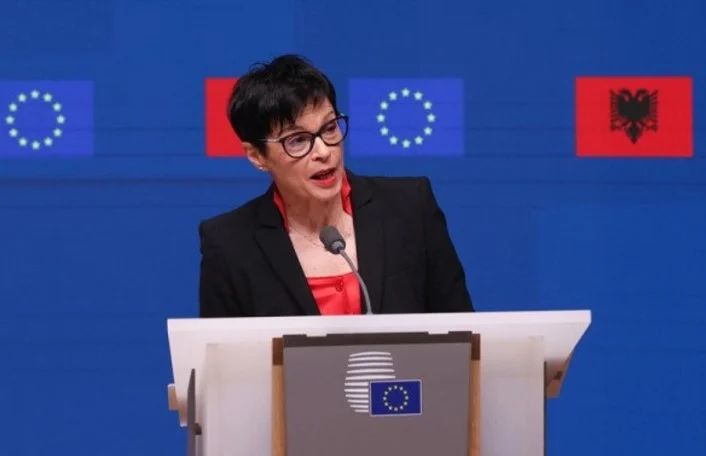
Pristina, Kosovo – May 13, 2024 – In a significant diplomatic engagement, European Union Commissioner for Enlargement, Marta Kos, is scheduled to arrive in Pristina tomorrow, May 14, directly from London. This visit marks Commissioner Kos’s inaugural official trip to Kosovo since assuming her pivotal role in 2024, underscoring the European Union’s sustained focus on the Western Balkans amidst a period of political transition in the young republic.
Commissioner Kos’s tightly packed agenda in the Kosovar capital includes three high-level meetings. She is slated to hold discussions with the acting President, Albulena Haxhiu, and the acting Prime Minister, Albin Kurti. Notably, her third scheduled engagement is not with opposition representatives but with key figures from Kosovo’s vibrant civil society sector, a decision that highlights the EU’s emphasis on democratic principles, transparency, and grassroots reform efforts.
The timing of this visit, occurring just three weeks before Kosovo’s snap general elections on June 7, adds an additional layer of geopolitical and domestic political significance. It serves as a powerful signal of the EU’s unwavering commitment to Kosovo’s European path, even as the country navigates a delicate pre-election period. The Commissioner’s presence is expected to reiterate the EU’s expectations for a fair and democratic electoral process, followed by the swift formation of a stable and reform-oriented government.
This highly anticipated visit comes after a previously scheduled trip by Commissioner Kos to Kosovo on March 12 was cancelled due to the rapid unfolding of political events in Pristina, which ultimately led to the dissolution of parliament and the call for early elections. The rescheduled visit, therefore, not only fulfils a prior commitment but also reinforces the EU’s dedication to engaging with Kosovo’s leadership at a critical juncture.
Chronology of Engagement and Political Flux
The path to Commissioner Kos’s maiden visit to Pristina has been marked by both steady EU commitment and significant domestic political turbulence in Kosovo. Understanding this chronology is crucial to grasping the full weight of her upcoming engagements.
The Path to Pristina: A Delayed Debut
Commissioner Kos’s planned visit on March 12 was abruptly called off in the wake of a rapidly escalating political crisis in Kosovo. The preceding days had been fraught with uncertainty following the failure of the Kosovar Assembly to elect a new president by the constitutional deadline of March 5. This constitutional impasse triggered an immediate political deadlock, culminating in a decisive move by President Vjosa Osmani. On March 6, President Osmani issued a decree to dissolve the Assembly, paving the way for snap elections.
The inability to elect a head of state, a critical function for any parliamentary democracy, plunged Kosovo into a period of provisional governance. The acting President and acting Prime Minister, therefore, represent the continuity of state institutions during this interim phase. The cancellation of Kos’s initial visit underscored the EU’s recognition of the gravity of the political situation and the need to allow domestic processes to unfold. Her rescheduled visit now takes place as the country gears up for what promises to be a highly contested electoral battle, making her presence even more pertinent.
Kosovo’s European Aspirations: A Historical Overview
Kosovo’s journey towards European integration began almost immediately after its declaration of independence in 2008. The European Union has been a central pillar in Kosovo’s state-building process, providing significant financial, technical, and political support. The Stabilisation and Association Agreement (SAA), which entered into force in April 2016, represents the most comprehensive framework for relations between the EU and Kosovo, outlining a clear path for political, economic, and institutional reforms.
However, Kosovo’s path to full EU membership has been fraught with challenges. Issues such as the lack of full recognition by five EU member states (Cyprus, Greece, Romania, Slovakia, and Spain), the ongoing dialogue for the normalization of relations with Serbia, and internal challenges related to the rule of law, the fight against corruption, and economic development have complicated its progress. Despite these hurdles, the EU remains Kosovo’s largest trading partner, investor, and donor, profoundly shaping its socio-economic and political landscape. The EU Office in Kosovo plays a vital role in monitoring reforms, coordinating assistance, and facilitating the integration process.
For years, visa liberalization for Kosovar citizens has been a highly sensitive issue, often seen as a tangible benefit of the European path. While the EU Commission has repeatedly confirmed Kosovo’s fulfilment of all technical benchmarks, the final decision has faced delays within the Council of the EU. (As of early 2024, visa liberalization for Kosovo citizens has come into effect, removing a significant point of frustration and demonstrating concrete progress in EU-Kosovo relations.)
The Enlargement Portfolio: Marta Kos’s Mandate
Marta Kos assumed the crucial portfolio of Commissioner for Enlargement in 2024, inheriting a complex and evolving policy landscape. The role of the Commissioner for Enlargement is multifaceted, encompassing the monitoring of candidate and potential candidate countries’ progress in adopting and implementing the EU acquis, facilitating the accession process, and promoting regional stability and cooperation in the Western Balkans.
The EU’s enlargement policy has seen renewed impetus in recent years, driven by geopolitical considerations and the recognition of the strategic importance of a stable and prosperous Western Balkans. Commissioner Kos’s mandate involves working closely with governments in the region to encourage necessary reforms, uphold democratic values, and foster good neighbourly relations. Her visit to Kosovo, therefore, is not merely a courtesy call but an integral part of her broader mission to advance the EU’s strategic objectives in the region, ensuring that enlargement remains a credible and merit-based process. Her experience and diplomatic skills will be crucial in navigating the intricate political dynamics of the Western Balkans.
Supporting Data and Contextual Insights
The specific configuration of Commissioner Kos’s meetings and the broader regional context provide valuable insights into the EU’s strategy and priorities for Kosovo.
The Importance of Civil Society Engagement
The decision to allocate one of the three crucial meetings to civil society representatives, rather than opposition leaders, is a deliberate and significant choice. It underscores the EU’s long-standing commitment to fostering a robust and independent civil society in accession countries. Civil society organizations (CSOs) are viewed as essential partners in the reform process, playing a critical role in:
- Monitoring Governance: Providing independent oversight of government actions, scrutinizing policy decisions, and advocating for accountability and transparency.
- Promoting Human Rights and Democracy: Working to protect fundamental freedoms, promote inclusivity, and strengthen democratic institutions.
- Advocating for EU Standards: Raising public awareness about EU values, standards, and the benefits of integration, while also pushing for their adoption and implementation at the domestic level.
- Grassroots Engagement: Representing diverse voices and concerns from across society, ensuring that reforms are not just top-down but also responsive to citizens’ needs.
By engaging directly with civil society, Commissioner Kos is sending a clear message that the EU values a multi-stakeholder approach to governance and that the success of Kosovo’s European journey depends not only on political leadership but also on the active participation and vigilance of its citizens and their representative organizations. It also avoids any perception of interference in the pre-election political contest by not meeting with specific opposition parties.
Kosovo’s Reform Agenda: Challenges and Progress
Kosovo’s reform agenda, as outlined in the SAA and the annual EU progress reports, covers a wide array of areas critical for aligning with EU standards. Key reform priorities include:
- Rule of Law: Strengthening the independence and efficiency of the judiciary, combating corruption and organized crime, and ensuring robust law enforcement. This remains a cornerstone of the EU’s conditionality.
- Public Administration Reform: Professionalizing the civil service, enhancing transparency, and improving service delivery to citizens.
- Economic Development: Fostering a competitive market economy, attracting foreign investment, and tackling high unemployment rates, particularly among youth.
- Protection of Minority Rights: Ensuring the full implementation of constitutional and legal provisions for the protection of all minority communities, including Serbs, Roma, Ashkali, and Egyptians, and promoting inter-ethnic harmony.
- Environmental Protection: Aligning with EU environmental standards and promoting sustainable development.
While Kosovo has made some progress in these areas, particularly in legislative reforms, the implementation often lags due to political instability, capacity constraints, and at times, a lack of sustained political will. The frequent electoral cycles and changes in government have historically hampered the continuity and effectiveness of reform efforts. Commissioner Kos’s visit will undoubtedly serve as an opportunity to assess the current state of these reforms and to re-emphasize the EU’s expectations for tangible progress.
The Western Balkans Perspective: A Unique Focus
Commissioner Kos’s decision to make Kosovo her sole stop in the region for this specific visit is noteworthy. Typically, EU Commissioners for Enlargement undertake broader tours of the Western Balkans, engaging with multiple capitals to reinforce a regional approach to integration. This focused attention on Pristina suggests a particular emphasis on Kosovo’s unique circumstances and the urgency of its current political trajectory.
It could be interpreted as a signal that the EU recognizes the critical nature of Kosovo’s upcoming elections and the need for a strong, direct message to its political actors and citizens. It might also reflect the specific challenges inherent in Kosovo’s statehood and its ongoing dialogue with Serbia, which remains a central preoccupation for the EU in the region. By concentrating her efforts on Kosovo, Commissioner Kos can delve deeper into the specific issues facing the country, providing tailored messages and demonstrating a targeted commitment that might not be possible during a multi-country tour. This focused engagement is particularly relevant given the complex geopolitical landscape and the renewed global attention on the stability of Europe’s neighbourhood.
Expected Dialogue and Official Positions
The meetings scheduled for Commissioner Kos in Pristina will undoubtedly feature a rigorous exchange of views, with both sides articulating their positions and expectations regarding Kosovo’s European future.
From Pristina: Aspirations and Commitments
Acting President Albulena Haxhiu and acting Prime Minister Albin Kurti are expected to convey Kosovo’s unwavering commitment to its European integration path. Their message will likely focus on:
- Continued Dedication to Reforms: Reassuring the Commissioner of Kosovo’s dedication to implementing the necessary reforms in the rule of law, public administration, and economic sectors, despite the current political transition.
- Electoral Integrity: Stressing the government’s commitment to ensuring free, fair, and transparent elections on June 7, which are crucial for the legitimacy of the incoming government.
- Dialogue with Serbia: Reaffirming Kosovo’s constructive approach to the EU-facilitated dialogue for the normalization of relations with Serbia, while also emphasizing its positions on key issues, particularly mutual recognition and the rights of Kosovar Serbs.
- Sovereignty and Territorial Integrity: Reiterating Kosovo’s commitment to its sovereignty and territorial integrity as an independent state.
- Regional Cooperation: Expressing a willingness to enhance regional cooperation initiatives that contribute to stability and economic development in the Western Balkans.
The Kosovar leaders will likely seek continued EU support for their state-building efforts and express gratitude for the EU’s consistent engagement. They might also highlight the challenges faced, such as the need for further economic investment and the ongoing struggle against illicit activities.
From Brussels: Expectations and Conditionalities
Commissioner Marta Kos will, in turn, articulate the EU’s consistent expectations and conditionalities for Kosovo’s progress towards membership. Her message will likely underscore:
- Rule of Law as a Priority: Emphasizing that concrete and irreversible progress in strengthening the rule of law, combating corruption, and fighting organized crime remains the absolute cornerstone of the enlargement process.
- Good Governance: Stressing the importance of transparent, accountable, and efficient public administration, free from political interference.
- Regional Cooperation and Good Neighbourly Relations: Highlighting the imperative for Kosovo to actively engage in regional cooperation and to make tangible progress in the dialogue with Serbia, leading to a comprehensive, legally binding agreement.
- Respect for Democratic Principles: Reinforcing the need for a peaceful and democratic electoral process, the swift formation of a stable government post-elections, and respect for institutional continuity.
- Implementation of Reforms: Insisting on the effective implementation of existing legislation and commitments, rather than merely adopting new laws.
- Importance of Civil Society: Acknowledging the vital role of civil society in driving reforms and holding institutions accountable.
The EU’s position has always been clear: the pace of integration is directly linked to the pace and quality of reforms undertaken by the aspiring country. Commissioner Kos will likely reiterate that the EU stands ready to support Kosovo, but the primary responsibility for progress lies with its own leadership and institutions.
The Role of International Partners
Beyond the EU, other international actors, notably the United States and the United Nations, continue to play significant roles in supporting Kosovo’s stability, democratic development, and its path towards full international recognition. The EU’s engagement in Kosovo is often coordinated with these partners, ensuring a coherent approach to promoting peace, security, and prosperity in the Western Balkans. The outcomes of Commissioner Kos’s meetings will undoubtedly be closely observed by these partners, as they collectively work towards a stable and European future for Kosovo.
Implications of the Visit
Commissioner Kos’s maiden visit to Kosovo carries significant implications, both for Kosovo’s internal political dynamics and for the broader EU enlargement agenda.
For Kosovo’s Political Landscape
The timing of this visit, just weeks before snap elections, means it carries substantial weight for Kosovo’s political landscape.
- Signaling Continued Engagement: The visit sends an unequivocal message that the EU remains deeply invested in Kosovo’s future, irrespective of the current political flux. This can reassure citizens and political actors that the European path remains open and supported.
- A Message to Political Parties: The Commissioner’s engagements, particularly her emphasis on reform, rule of law, and democratic processes, will serve as a strong message to all political parties contesting the upcoming elections. It underscores the importance of forming a stable, pro-European, and reform-oriented government post-elections. Any future government will be expected to prioritize these EU-mandated reforms.
- Potential Influence on Pre-Election Discourse: While the EU aims to remain neutral in electoral contests, the Commissioner’s statements about the importance of good governance, anti-corruption efforts, and the dialogue with Serbia could subtly influence the pre-election discourse, pushing candidates to articulate clearer positions on these critical issues.
- Legitimacy and Stability: A successful and democratically sound electoral process, followed by the formation of a stable government, is crucial for Kosovo to regain momentum on its reform agenda. The EU’s presence implicitly supports this objective.
For EU-Kosovo Relations
This visit is a pivotal moment for EU-Kosovo relations, particularly under the tenure of the new Commissioner.
- Reinforcing Commitment: It strongly reinforces the EU’s long-term commitment to Kosovo’s European future, providing a tangible sign of support after a period of political uncertainty.
- Setting the Stage for Renewed Dialogue: By engaging with the current acting leadership, Commissioner Kos is laying the groundwork for renewed and intensified dialogue with the incoming government. This proactive engagement aims to ensure a smooth transition and continuous progress on the SAA implementation.
- Symbolic Weight: As her first visit, it carries immense symbolic weight, indicating that Kosovo holds a prominent place on the enlargement agenda. It demonstrates a hands-on approach from the new Commissioner, eager to engage directly with the realities on the ground.
- Clarifying Expectations: The visit provides a direct channel for the EU to clarify its expectations for future reforms, especially concerning the rule of law, economic development, and the normalization of relations with Serbia, which are non-negotiable for further integration.
For Regional Stability and Enlargement Policy
While focused solely on Kosovo, the visit also has broader implications for regional stability and the EU’s overall enlargement policy.
- Targeted Approach: The decision for a single-country visit highlights that the EU is capable of adopting a targeted approach, addressing specific challenges and political developments in individual Western Balkan countries when necessary, rather than always bundling them into a regional tour.
- Challenges to Enlargement: The visit implicitly acknowledges the persistent challenges facing the broader enlargement agenda, including geopolitical shifts and the varying speeds of reform across the Western Balkans. It underscores the imperative for regional reconciliation and dialogue, particularly between Pristina and Belgrade, as a prerequisite for the stability of the entire region.
- Credibility of the Process: By demonstrating active engagement, the EU aims to reinforce the credibility of its enlargement policy, ensuring that the promise of EU membership remains a powerful incentive for reforms and democratic consolidation in the region.
Looking Ahead: Post-Election Engagement
The visit’s timing makes it a forward-looking engagement. Commissioner Kos’s discussions will undoubtedly touch upon the expectations for the new government that emerges from the June 7 elections. The EU will be keen to see a government that is stable, committed to the EU path, capable of implementing challenging reforms, and ready to engage constructively in the dialogue with Serbia. The long and arduous road to full EU membership requires sustained political will, robust institutions, and broad societal consensus. This visit serves as a vital precursor to the post-election phase, signaling the EU’s readiness to work closely with Kosovo’s next democratically elected leadership.
Conclusion
Commissioner Marta Kos’s inaugural visit to Kosovo is far more than a routine diplomatic exchange. It is a strategically timed intervention that underscores the European Union’s enduring commitment to Kosovo’s European future amidst a period of significant domestic political transition. By engaging directly with the acting leadership and civil society, the Commissioner will reiterate the EU’s unwavering expectations for rule of law, good governance, and democratic processes, especially in the run-up to the crucial June 7 elections.
This visit serves as a powerful reminder that while Kosovo faces numerous internal and external challenges, its European aspirations remain a central guiding principle. The dialogue initiated by Commissioner Kos will set the tone for future EU-Kosovo relations, emphasizing that the speed and success of Kosovo’s integration will ultimately depend on its own capacity to deliver on its reform commitments and foster lasting stability. As Kosovo stands at a crossroads, this high-level EU engagement offers both encouragement and a clear roadmap for the path ahead.