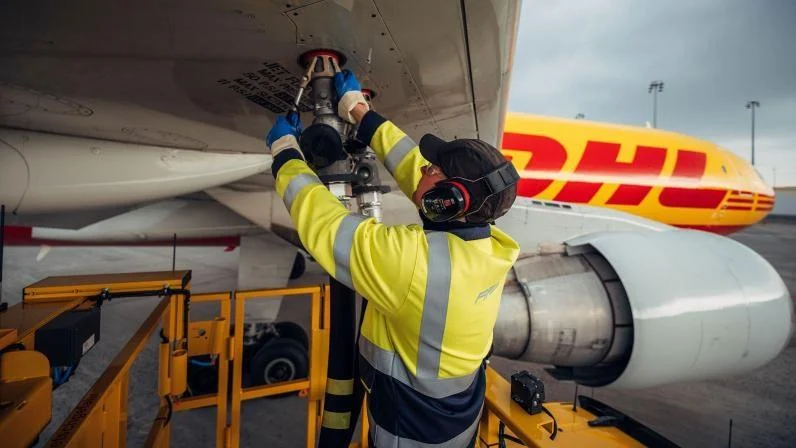
In a major development for the decarbonization of global logistics, international express service provider DHL Express has announced a strategic offtake agreement with Dubai-based sustainable aviation fuel (SAF) producer, SAF One. This landmark deal, spanning a decade, marks a pivotal moment for the Middle Eastern aviation sector, representing the first major SAF offtake agreement of its kind in the region.
The partnership will see the delivery of 250,000 metric tons—equivalent to approximately 327 million liters—of unblended sustainable aviation fuel to DHL. The agreement serves as a cornerstone of DHL’s broader environmental strategy, aiming to bridge the gap between current aviation dependencies and a net-zero future.
The Core Agreement: A Decade of Commitment
Under the terms of the contract, SAF One is slated to supply DHL Express with 25,000 metric tons of unblended SAF annually, with deliveries commencing in 2028. This long-term commitment provides a stable foundation for SAF One to scale its operations while ensuring DHL secures a reliable, high-quality supply of low-carbon fuel to power its air freight operations.
The fuel will be produced at SAF One’s flagship facility in Bahrain. This plant is widely regarded as one of the most technologically advanced in the region, utilizing a sophisticated blend of renewable feedstocks and next-generation refining technologies. By focusing on unblended SAF, the partnership ensures that the carbon reduction benefits are maximized, providing a scalable and certified solution that meets the rigorous standards of international aviation regulations.
Chronology of Sustainability: DHL’s Roadmap to 2050
To understand the weight of this agreement, one must look at the progression of DHL’s sustainability efforts. The company’s trajectory is not a reactionary measure but the result of a meticulously planned strategy launched several years ago.
The 2021 Sustainability Roadmap
In 2021, DHL Group unveiled an ambitious Sustainability Roadmap, pledging to invest €7 billion over the following decade. This capital expenditure was specifically earmarked for three pillars:
- Electrification of the Fleet: Transitioning last-mile delivery vehicles to electric power.
- Climate-Neutral Buildings: Investing in green infrastructure and energy-efficient facilities.
- Alternative Aviation Fuels: The cornerstone of the current SAF deal, aiming to reduce the massive carbon footprint of air cargo.
The 2028 Milestone
While the agreement is signed today, the operational impact begins in 2028. The four-year window between the announcement and the first delivery allows SAF One to complete the scaling of its Bahrain facility and allows DHL to integrate the new fuel supply into its existing supply chain logistics.
The 2030 Interim Targets
By 2030, DHL has set a firm target to increase its usage of sustainable aviation fuels to 30%. This is a significant jump from current global industry averages, and the 25,000 metric tons per year provided by SAF One will be a vital contributor to hitting this threshold.
The 2050 Net-Zero Goal
All these efforts are directed toward the ultimate objective: achieving net-zero emissions across all operations by 2050. This requires a systemic overhaul of the aviation industry, moving away from fossil-based kerosene toward circular, low-carbon alternatives.
Supporting Data: Why SAF is the "Silver Bullet"
Aviation remains one of the hardest sectors to decarbonize due to the high energy density required for long-haul flight. Unlike road transport, which can transition to battery-electric or hydrogen-fuel-cell technology with relative ease, commercial aviation remains tethered to liquid fuels.
- Carbon Reduction Potential: SAF can reduce lifecycle CO2 emissions by up to 80% compared to conventional jet fuel, depending on the feedstock used.
- The "Unblended" Advantage: By sourcing unblended SAF, DHL ensures that it is not merely relying on small percentages of green additives but is participating in the production of pure, high-quality sustainable fuel.
- The GoGreen Plus Model: A critical component of this deal is its integration into DHL’s GoGreen Plus service. This allows DHL’s customers to directly reduce their Scope 3 emissions. Through a "book and claim" model, customers can pay for the environmental benefits of the SAF even if the fuel is not physically utilized on the specific aircraft carrying their parcel. This creates a transparent, verified mechanism for corporate carbon accounting.
Official Responses and Strategic Vision
The partnership has been met with enthusiasm from both the private and public sectors, as it positions Bahrain and the UAE as leaders in the green energy transition.
The Perspective from SAF One
Deepak Munganahalli, Co-Founder & CEO of SAF One, emphasized the strategic importance of the deal for the region:
"We are grateful to DHL Express for entering into this offtake agreement with us. This is not just a commercial contract; it is an important step toward bringing a landmark sustainable aviation fuel facility to the Middle East. By validating the demand for SAF, DHL is helping us create a robust market that will attract further investment into renewable technologies in this part of the world."
The Perspective from DHL Express
Abdulaziz Busbate, CEO of DHL Express MENA, highlighted the regional significance:
"We are proud to see the Middle East playing a central role in the global shift toward emission-reduced aviation. Partnering with SAF One allows us to accelerate regional decarbonization, strengthen local innovation ecosystems, and offer our customers credible and transparent emission-reduced shipping solutions. This agreement symbolizes our long-standing commitment to Bahrain and across the region."
Implications: A New Era for Middle Eastern Logistics
The implications of this agreement extend far beyond the balance sheets of the two companies involved.
1. Regional Economic Diversification
For the Middle East, a region traditionally synonymous with fossil fuel production, this deal signals a pivot toward the "green economy." By fostering a local SAF industry, the region is positioning itself as a hub for sustainable energy exports, leveraging its existing infrastructure and strategic location at the crossroads of global trade.
2. Setting a Benchmark for Scope 3 Reductions
As global corporations face increasing pressure from investors and regulators to disclose and reduce Scope 3 emissions (the emissions in their value chain), DHL’s GoGreen Plus model provides a blueprint. By providing a verified, transparent way to track carbon savings, DHL is offering its corporate clients a way to achieve their own sustainability targets, effectively turning "green logistics" into a competitive advantage.
3. Supply Chain Resilience
Reliance on traditional fossil fuels leaves logistics providers vulnerable to price volatility and future carbon taxes. By securing a long-term, fixed-volume agreement, DHL is effectively hedging against the inevitable increase in the cost of carbon. This move stabilizes their long-term cost structures and protects them from potential regulatory shocks in the European and North American markets, where carbon-related aviation regulations are tightening.
4. Catalyst for Innovation
The requirement for 25,000 metric tons of SAF annually creates a guaranteed market, which is essential for the financing and development of new refining technologies. This deal acts as a catalyst for local research and development, potentially leading to more efficient refining processes and the exploration of diverse, non-food-based feedstocks that can be sourced locally.
Conclusion: A Blueprint for Global Logistics
The 10-year partnership between DHL Express and SAF One is a testament to the fact that decarbonization is no longer a theoretical exercise but an operational reality. By combining the scale of a global logistics giant with the technological ambition of a regional producer, the deal addresses the two biggest hurdles in the transition to sustainable aviation: demand certainty and supply availability.
As the aviation industry faces intensifying scrutiny regarding its environmental impact, collaborations like this will be essential. They prove that with long-term planning, clear interim targets, and a commitment to technological innovation, the aviation sector can transition away from its dependency on fossil fuels. For DHL, the Middle East is no longer just a transit hub—it is becoming a vital node in the global effort to make air cargo a sustainable component of the 21st-century economy.