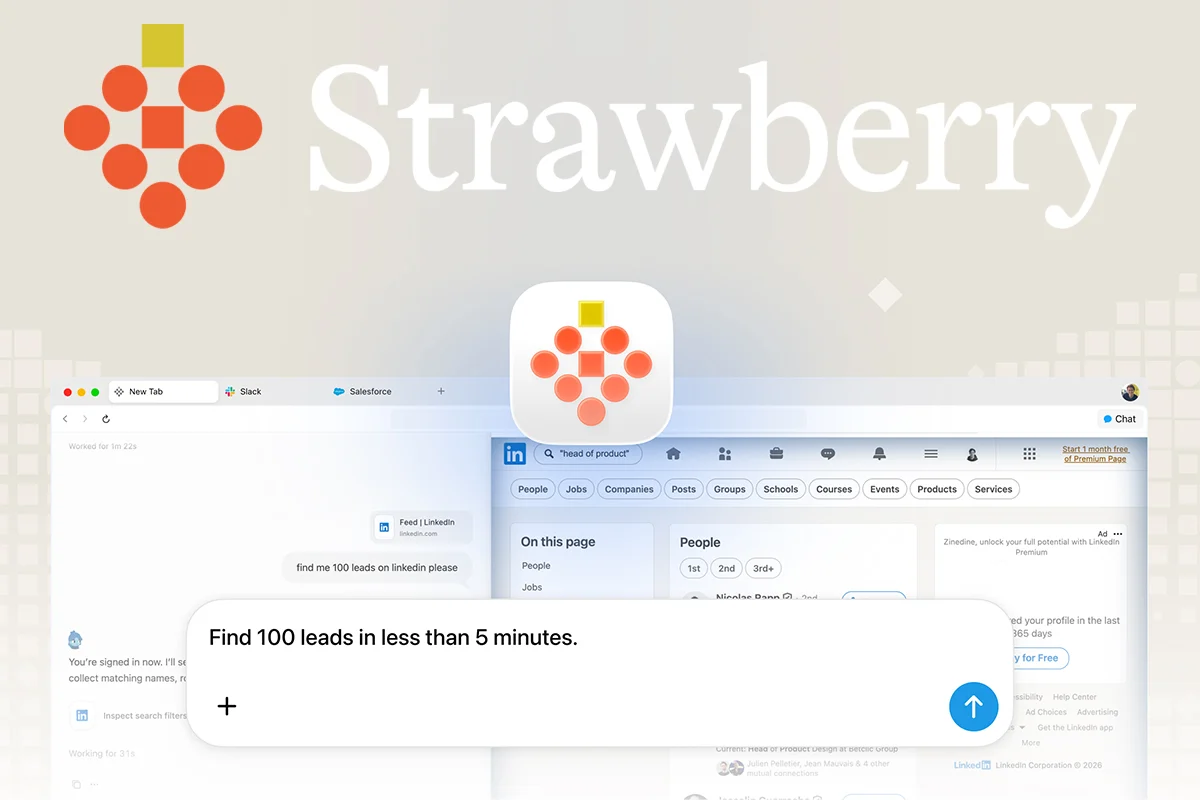
In the rapidly evolving landscape of artificial intelligence, a paradox has emerged: while billions of dollars in capital flow into the development of sophisticated Large Language Models (LLMs), the actual integration of these tools into the daily workflows of small and medium-sized enterprises (SMEs) remains staggeringly low. A new European entrant, Strawberry, launched this morning with a mission to dismantle the barriers of complexity and isolation that have kept AI on the fringes of the modern workplace.
By positioning itself not as a standalone chatbot, but as an integrated, browser-based ecosystem for "AI companions," Strawberry is attempting to shift the narrative from AI as a solo productivity hack to AI as a collaborative, team-based asset.
The Core Concept: From Chatbots to Colleagues
The fundamental difference between Strawberry and established players like OpenAI’s ChatGPT or Anthropic’s Claude lies in the conceptual framework of the user experience. Most current AI interfaces operate on a "prompt-response" model: a user asks a question, the model provides an answer, and the session is often lost to history once the browser tab is closed. This ephemeral nature prevents AI from becoming a persistent part of organizational knowledge.
Strawberry introduces the concept of "AI companions." These are virtual colleagues designed to exist within the browser—the very space where workflows, logins, and operational context already reside. Unlike a chatbot that exists in a vacuum, a Strawberry companion is designed to "remember" how a team operates. It observes workflows, learns the nuances of a business, and improves its output the more it is utilized.
For the average SME owner or employee who may not possess a background in computer science, this is a significant shift. Strawberry is explicitly designed for the non-technical user, aiming to provide the power of AI to those who find current enterprise tools intimidating or overly complex.
Chronology of a Tech Gap: Why Adoption Stalled
The struggle to adopt AI is not a failure of technology, but a failure of integration. To understand why Strawberry’s launch is significant, one must look at the trajectory of AI adoption over the past 24 months.
- 2022–2023: The Discovery Phase. The sudden ubiquity of generative AI tools led to a "gold rush" of experimentation. However, this was largely individualistic. Early adopters within companies used AI to draft emails or summarize notes, but these activities were siloed on personal laptops.
- 2024: The Silo Crisis. As companies matured in their AI usage, a clear problem emerged: "AI silos." One employee might become an expert in "prompt engineering," but that expertise rarely translated to their colleagues. The setup, the context, and the prompts remained trapped in the individual’s browser history.
- 2025: The Security Standoff. Many organizations, particularly in the European Union, hesitated to scale AI usage due to concerns over data residency, compliance, and the "black box" nature of cloud-based AI processing.
- 2026: The Strawberry Solution. With the launch of Strawberry, the market sees a pivot toward "Multiplayer AI"—platforms designed to share intelligence across a team rather than keeping it locked behind individual user accounts.
Supporting Data: The Disconnect Between Investment and Usage
The urgency behind platforms like Strawberry is underscored by a stark disparity in the global AI economy. According to data from the Stanford AI Index (2026) and Gallup (2026), approximately $286 billion was invested in American AI initiatives in the previous year alone. Yet, despite this astronomical figure, only 15% of U.S. employees utilize AI in their daily professional tasks.
This delta suggests that the current tools are either too difficult to use, too disconnected from actual workflows, or perceived as too risky for corporate environments. By focusing on a browser-based, collaborative model, Strawberry is explicitly targeting this 85% "non-user" demographic—the vast majority of the workforce who have yet to find a practical, everyday application for AI.
Official Perspective: The "Multiplayer" Philosophy
Charles Maddock, CEO and co-founder of Strawberry, emphasizes that the company’s architecture is built on the belief that AI should function as a teammate, not a service.
"The technology is already here: agents can now work for weeks in a row," Maddock stated during the launch. "Yet, we see so many companies struggle with adoption. We built a product so delightful that teams adopt it naturally, with companions you bring into your team like colleagues."
Maddock highlights the "Multiplayer AI" aspect as the company’s primary innovation. In most current setups, if a marketing lead discovers an efficient way to automate CRM logging via an AI, that knowledge is essentially invisible to the rest of the company. In Strawberry, the user creates a companion, trains it on a specific task—such as lead qualification or event planning—and then propagates that companion across the organization. The knowledge is democratized instantly.
"Today, the person who is great with Claude keeps all of it on their own laptop," Maddock notes. "In Strawberry, you train a companion once, and everyone on the team gets it, with everything it has learned."
Implications for Data Privacy and Security
For European SMEs, the barrier to AI adoption has historically been a mix of GDPR compliance, data residency, and the fear of sensitive information being ingested by public LLMs. Strawberry has addressed these concerns by decentralizing the processing architecture.
The "On-Device" Advantage
Because Strawberry companions run on the user’s local device and within the browser environment, they provide a level of transparency that cloud-only platforms cannot. Users can monitor the actions their AI companion takes in real-time. If a companion is tasked with an action that involves sensitive data—such as sending a client email or updating a financial record—the system is designed to pause and request human authorization.
Compliance and Infrastructure
Strawberry has prioritized the regulatory environment of the European market, offering:
- EU Data Residency: Ensuring that data handling complies with stringent European standards.
- SOC 2 Compliance: Achieving both Type I and Type II certification to assure enterprises that their security protocols meet rigorous industry benchmarks.
- Encapsulated Logins: By keeping login credentials within the user’s own browser environment rather than sending them to a third-party server, Strawberry minimizes the surface area for potential credential theft or data leakage.
The Future of Work: Collaborative Intelligence
The launch of Strawberry signals a broader shift in the AI industry. We are moving away from the era of "AI as a novelty" and into the era of "AI as infrastructure."
For the average SME, the implications are profound. If a company can successfully transition from using disparate, siloed AI tools to a unified "Multiplayer" companion system, the efficiency gains could be exponential. By lowering the barrier to entry, Strawberry is effectively removing the "IT gatekeeper" from the process. Teams can now build, share, and scale their own AI capabilities without needing a team of data scientists or a massive cloud engineering budget.
However, the success of this model will depend on user trust and the ability of the platform to handle increasingly complex workflows. As AI agents move from simple text generation to executing multi-step tasks across browser applications, the stakes for accuracy and reliability rise.
Strawberry enters a crowded market, but by focusing on the "human-in-the-loop" philosophy and European-grade security, it has carved out a distinct path. It is no longer about how smart the AI is; it is about how well the AI fits into the team. If Strawberry can bridge the gap for that 85% of employees currently sidelined by AI, it may well become the standard-bearer for the next phase of workplace productivity.
As the industry matures, the measure of success will not be the raw power of the underlying models, but the ease with which organizations can transform those models into reliable, collaborative, and secure virtual colleagues. Strawberry is making a bold bet that the future of work is not found in a chatbot—it is found in the team.