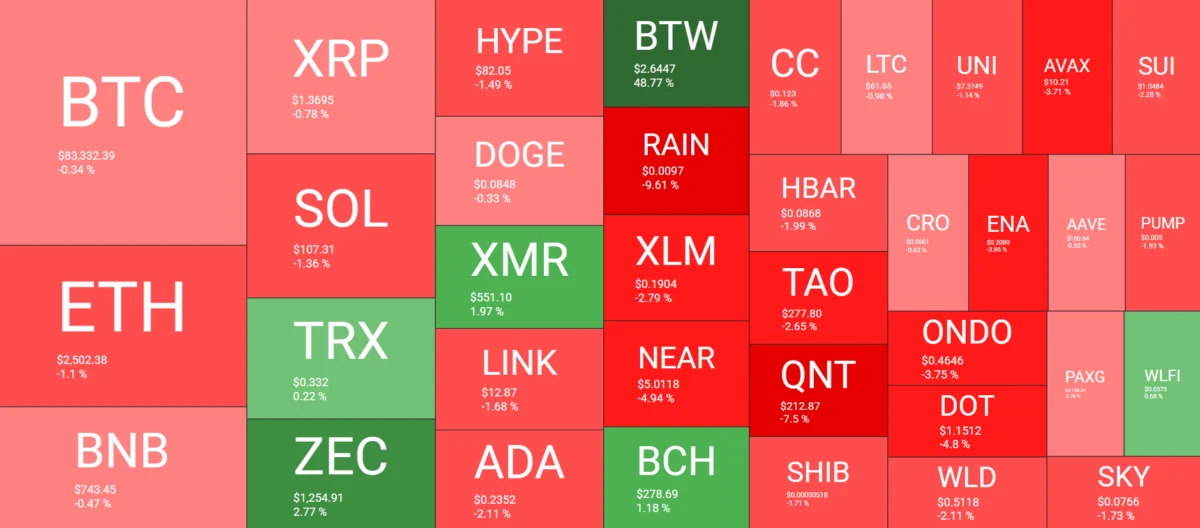
The cryptocurrency market is currently navigating a period of pronounced bifurcation. While Bitcoin (BTC) demonstrates relative resilience, effectively establishing a higher floor despite persistent macroeconomic headwinds, the broader altcoin landscape is struggling to find its footing. Recent market data from CoinMarketCap (CMC) highlights a significant trend: Bitcoin’s market dominance has surged to 60%, signaling a flight to quality among investors who are increasingly wary of the volatility currently plaguing mid-cap assets.
Market Overview: The Current Landscape
As of mid-October, the total cryptocurrency market capitalization has dipped by approximately 0.5%, settling at $2.79 trillion. This decline, while marginal in isolation, masks the deeper instability occurring within the altcoin sector. Major assets are facing significant downward pressure; Ethereum (ETH) has retreated toward the $2,500 support level, while XRP is struggling to maintain momentum, drifting further from the $1.40 threshold. Solana (SOL), a perennial market favorite, has seen its value slide to $107, reflecting a broader malaise affecting decentralized finance (DeFi) and infrastructure tokens.
The divergence is most apparent when comparing the performance of specific assets. While tokens like ZEC, XMR, TRX, and BCH have managed to stay in positive territory, they are outliers. The "losers" list for the past 24 hours is headlined by TIA, M, CRV, and RENDER, each recording double-digit percentage declines, ranging from 8% to 10%. Meanwhile, smaller projects like RAIN have plummeted by nearly 10%, and QNT has shed 7.5% of its value, illustrating that mid-cap volatility remains the dominant theme of the week.
A Chronology of Price Action: The Road to 60% Dominance
To understand the current state of the market, one must look back at the volatile price action of the past week. Bitcoin’s journey toward its current position has been anything but linear.
The Rejection at $87,000
At the start of the previous business week, Bitcoin twice attempted to break through the $87,000 resistance level. Both attempts were met with stiff selling pressure. The second rejection was particularly significant, serving as the catalyst for a more profound correction. By Thursday evening, the market sentiment had shifted decisively, driving the asset down to a multi-week low of $80,400. This three-day period saw Bitcoin lose nearly $7,000 in value, triggering a wave of liquidations that rippled through the leveraged markets.
The Weekend Recovery and Monday Resistance
Following the Thursday slump, the market saw a tentative recovery over the weekend. Bitcoin successfully reclaimed the $83,000 level, holding that position for approximately 36 hours. Monday morning brought renewed optimism as the bulls attempted to push the price toward $84,400. However, the momentum proved unsustainable, and bears regained control during the Tuesday morning session, pushing the price back down toward the $81,000 mark.

The "Higher Low" Phenomenon
Despite the bearish pressure, technical analysts have pointed to a silver lining: the recovery to over $83,000 following Tuesday’s dip established a "higher low." In traditional market analysis, a series of higher lows is often interpreted as a bullish signal, suggesting that despite short-term selling, the asset’s underlying support level is strengthening. Since that recovery, Bitcoin has entered a period of consolidation, trading sideways within the $83,000–$84,000 range, with current prices hovering just above the lower boundary.
Supporting Data: Why Bitcoin Reigns Supreme
The surge in Bitcoin dominance to 60% is not merely a result of Bitcoin’s strength; it is a symptom of the capital flight occurring in the altcoin market. Investors are rotating out of speculative, mid-cap assets—many of which have seen 8% to 10% daily drops—and into the perceived safety of Bitcoin.
While Bitcoin’s total market capitalization has remained relatively flat at $1.67 trillion, the loss of value across the rest of the ecosystem has forced the dominance metric upward. This phenomenon is often observed during periods of macroeconomic uncertainty, where market participants prioritize liquidity and historical reliability over the speculative gains associated with smaller, less liquid altcoins.
Macroeconomic Implications: The CPI Catalyst
The market is currently in a "wait-and-see" holding pattern as traders prepare for the release of the September Consumer Price Index (CPI) numbers. Inflation data remains the primary driver of Federal Reserve interest rate policy, and by extension, the primary catalyst for risk-on asset volatility.
Historical trends suggest that any deviation from analyst expectations regarding inflation can cause rapid, short-term price fluctuations. If the CPI report indicates that inflation is cooling faster than anticipated, it could provide the fuel for a broader market rally. Conversely, higher-than-expected inflation would likely force the Federal Reserve to maintain a "higher-for-longer" interest rate environment, which would further suppress liquidity for risk assets, potentially leading to further consolidation or downward pressure for both Bitcoin and the broader altcoin market.
The Anomaly: The Rise of BTW
Amidst a sea of red, one asset has defied market trends entirely: BTW. The token has surged by an impressive 47% in the last 24 hours, currently trading above $2.60. Such an outlier performance often highlights the idiosyncratic nature of crypto markets, where localized news, protocol updates, or community sentiment can occasionally decouple an asset from the broader market’s downward trend. However, investors are cautioned that such gains are often accompanied by extreme volatility and should be approached with a comprehensive risk management strategy.
Professional Perspective and Investor Caution
The current market structure presents a challenging environment for retail and institutional investors alike. The reliance on Bitcoin as a safe haven has reached levels not seen in months, effectively creating a "Bitcoin-only" market sentiment for the time being.
Industry experts emphasize that the volatility currently seen in tokens like TIA, CRV, and RENDER is a reminder of the inherent risks associated with mid-cap assets. These tokens, which are highly sensitive to market sentiment and liquidity flows, often suffer the most during periods of uncertainty. The current market decline in assets like ADA, HYPE, LINK, XLM, NEAR, TAO, and DOT serves as a cautionary tale for those over-leveraged in the altcoin sector.
A Note on Market Risks
It is essential to state that the information provided here is for educational and informational purposes only. It does not constitute financial advice, investment recommendations, or an endorsement of any specific asset. The cryptocurrency market is notoriously volatile, and the past performance of any token—including those that have surged, like BTW, or those that have declined—is not indicative of future results.
Investors are strongly advised to:
- Conduct Independent Research: Never rely solely on news reports or social media sentiment. Investigate the fundamentals, utility, and tokenomics of any project before committing capital.
- Utilize Risk Management: Use stop-loss orders and position sizing to protect your portfolio against sudden, unexpected market movements.
- Monitor Macro Indicators: Keep a close eye on upcoming economic reports, such as CPI releases and Federal Open Market Committee (FOMC) meetings, as these events frequently trigger major market shifts.
- Beware of Leverage: High-leverage trading during periods of high volatility often leads to significant capital loss, particularly when liquidity is thin.
As we look toward the remainder of the week, the primary focus will remain on whether Bitcoin can maintain its current consolidation pattern or if a break below the $81,000 support level will trigger a new wave of selling. With 60% market dominance, Bitcoin is currently the anchor of the digital asset economy; its trajectory will, in all likelihood, dictate the fate of the wider market in the days to come.