As the fourth quarter of 2026 progresses, the world’s premier cryptocurrency, Bitcoin (BTC), finds itself trapped in a precarious tug-of-war. After a period of relative stability, market sentiment has shifted toward cautious pessimism as a confluence of macroeconomic uncertainty, geopolitical instability, and waning liquidity threatens to drag the asset below the psychological $80,000 threshold.
In its latest weekly market review, Coinbase’s institutional research desk, led by Senior Quantitative Strategist Colin Basco, highlighted the fragility of the current price action. The narrative surrounding Bitcoin has evolved from a mid-year outlook of optimism to a defensive posture as investors grapple with the reality of "sticky" inflation and a Federal Reserve that shows little appetite for aggressive rate cuts.
Main Facts: The $80K Support Level Under Siege
The current market focus is squarely on the $80,000 to $82,000 range—a zone that serves as a critical technical confluence. This level is supported by the 50-day Moving Average (MA) and the average cost basis for many institutional investors who gained exposure through U.S. spot Bitcoin ETFs earlier this year.
However, Basco warns that this defense is thinning. "If this area fails, we view the $73,000–$75,000 zone as the next logical area of support," Basco stated in the report. This potential breakdown is not merely a technical glitch but a reflection of a broader exhaustion in the buying momentum that fueled the asset’s earlier 2026 performance.
The primary drivers of this volatility are twofold:

- Monetary Policy: Markets are currently pricing in an 80% probability of a Federal Reserve rate hike in December, a scenario that would strengthen the U.S. dollar and exert downward pressure on risk assets like Bitcoin.
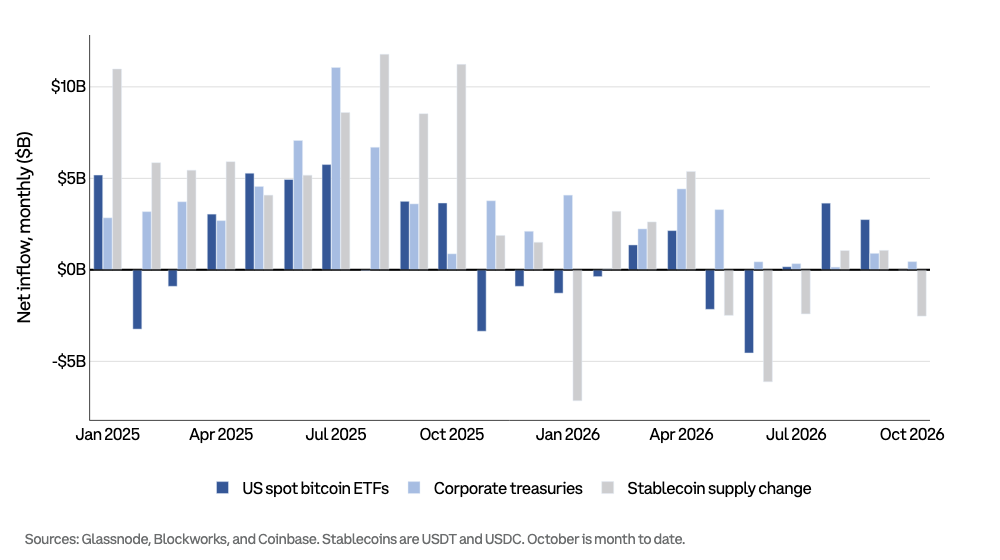
- Capital Flow Shifts: The robust demand for Bitcoin that characterized the first half of 2026 has tapered off. While U.S. spot ETFs remain the primary engines of price movement, they are no longer being supported by the broader treasury accumulation trends observed earlier in the year.
Chronology: A Quarter of Fluctuating Sentiment
To understand the current state of the market, one must look at the progression of events over the last several months.
- May 2026: The crypto market reached a local peak in liquidity, bolstered by a surge in stablecoin supply and a generally risk-on environment.
- H2 2026 (The Shift): As the second half of the year commenced, the enthusiasm that carried BTC into record-breaking territory began to wane. Treasury demand among institutional balance sheets slowed significantly, shifting the entire burden of price maintenance onto the ETF market.
- October 23, 2026: A pivotal moment occurred when the U.S. Bitcoin ETF complex recorded $635 million in net outflows. This represented one of the most significant single-day retreats of the year, signaling that even institutional holders were not immune to the "risk-off" sentiment triggered by renewed geopolitical tensions.
- Late October 2026: With the Coinbase premium remaining in negative territory, the market confirmed that crypto-native liquidity is currently sidelined. Retail investors, outside of those already integrated into the ETF ecosystem, have yet to re-enter the market in force.
Supporting Data: Liquidity and Market Positioning
The quantitative evidence supporting a defensive outlook is substantial. According to data tracked by CryptoQuant and analyzed by the Coinbase team, the broader crypto market liquidity—measured by stablecoin supply changes—has contracted by nearly $13 billion since its May peak. This withdrawal of "dry powder" from the ecosystem is a primary indicator of reduced buying pressure.
The "Apparent Demand" Deficit
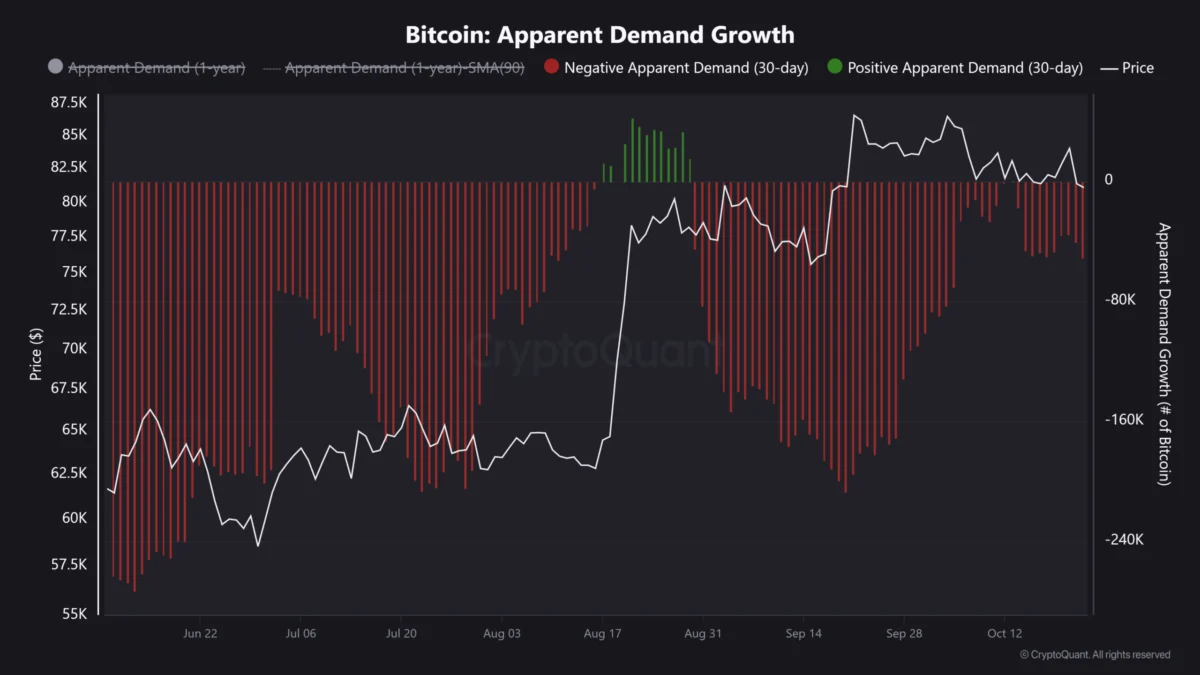
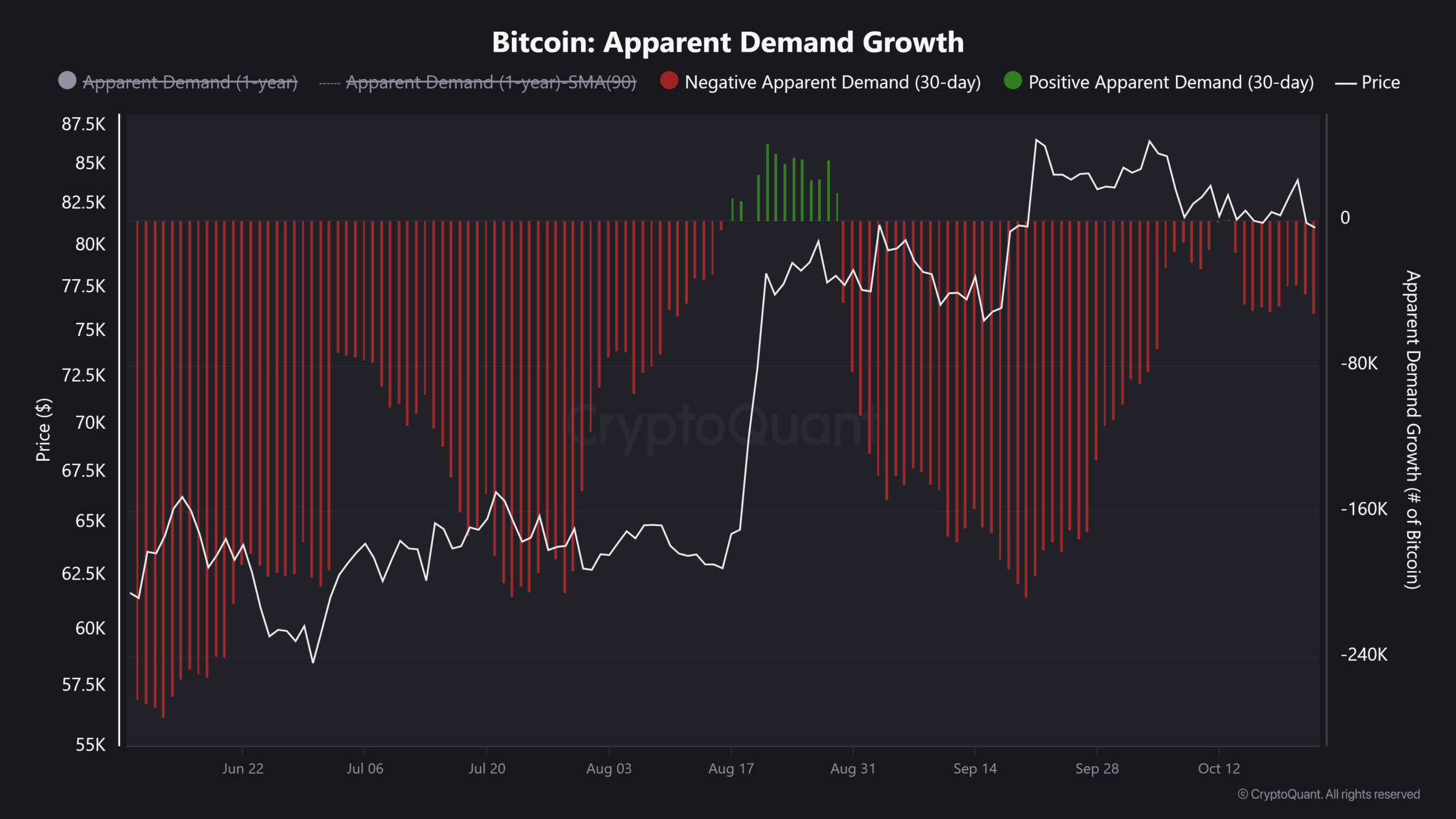
The concept of "apparent demand" for Bitcoin has turned negative. This metric, which subtracts the growth in circulating supply from the net exchange flows, illustrates that there is currently more supply moving toward liquidity providers or exchanges than there is fresh capital entering to absorb that supply.
The Institutional "Roadblock"
Market positioning data suggests that any potential recovery will face significant resistance. Coinbase analysts have identified a massive supply cluster of over 2.1 million BTC held at cost bases between $87,500 and $91,700. For the price to sustain a move upward, it must overcome the "selling pressure" of investors who purchased in this range and are likely looking to break even, turning these previous support levels into formidable resistance.
Official Responses and Institutional Hedging
While the overall tone is one of caution, the institutional response has been nuanced. In the options market, the 25-Delta Skew—a gauge used to measure the cost of put options (downside protection) versus call options (upside bets)—has seen a dramatic shift.
For short-term tenors (1-day and 1-week), the skew surged from 5% to 15%. This spike indicates an urgent demand for hedging against a sharp drop. Professional traders are clearly paying a premium to protect their portfolios against a potential slide toward the $73,000–$75,000 range.
However, there is a silver lining. When looking at the three-month horizon, the 25-Delta Skew has only moved from 6% to 10%. This suggests that while market participants are fearful of immediate shocks—such as next week’s Fed decision or sudden geopolitical escalations—the "long-term" institutional view remains relatively calm. Large players appear to view the current volatility as a transient period of noise rather than a fundamental shift in Bitcoin’s long-term value proposition.
Implications: The Macro and Geopolitical Nexus
The implications for Bitcoin are clear: the asset is currently being treated as a high-beta risk asset rather than the "digital gold" hedge many proponents claim it to be.
Geopolitical Fragility
The ongoing U.S.-Iran tensions have introduced an unpredictable variable into the market. Whenever geopolitical headlines turn toward conflict, Bitcoin tends to experience immediate capital flight as investors retreat to cash and short-term U.S. Treasuries. This correlation to geopolitical risk is currently overriding the narrative of Bitcoin as a hedge against fiat currency devaluation.
The Fed Factor
Next week’s Federal Reserve rate decision will serve as the final piece of the puzzle for Q4. An 80% chance of a hike implies that the market is already bracing for the worst. If the Fed follows through, the immediate impact on Bitcoin will likely be a retest of the $80,000 support. If the Fed manages to surprise the market with a pause or a dovish outlook, the relief rally could be substantial, though it would still face the 2.1-million-BTC supply wall noted earlier.
The Retail Absence
Perhaps the most concerning implication is the lack of retail participation. In previous bull cycles, retail exuberance provided the "parabolic" tailwinds that drove BTC to new all-time highs. Currently, the market is driven almost entirely by institutional ETF flows and derivatives trading. Without the influx of retail capital, Bitcoin is more susceptible to institutional "stop-loss hunting" and programmatic sell-offs.
Conclusion: A Period of Consolidation
Bitcoin is currently in a state of digestion. The rapid price appreciation seen earlier in the year has left the market in a position where it must consolidate, shake out weak hands, and wait for a clearer macroeconomic signal.
The $80,000 level is more than just a price point; it is a sentiment barrier. If it holds, the market may slowly grind toward the $90,000 resistance level. If it breaks, the market will likely undergo a necessary reset to the mid-$70,000s, which could provide a more stable foundation for the next leg of the cycle. For now, institutional investors are playing it safe, hedging their downside, and waiting for the dust to settle on both the Federal Reserve’s policy trajectory and the evolving geopolitical landscape.
As we look toward the end of 2026, the data suggests that patience, rather than aggressive positioning, is the preferred strategy for those navigating the current volatility in the digital asset space.