In an era of intense political polarization, where the American electorate often finds itself fractured along partisan lines, the federal government remains a complex object of public perception. A comprehensive new survey conducted by the Pew Research Center, encompassing 5,062 U.S. adults between September 28 and October 4, 2026, reveals a nuanced landscape of trust, skepticism, and institutional appreciation.
While the data highlights deep-seated partisan divides regarding law enforcement and regulatory bodies, it also underscores a resilient, cross-party appreciation for agencies that provide foundational services—the National Park Service, the National Weather Service, and the U.S. Postal Service.

Main Findings: The Popularity Gap
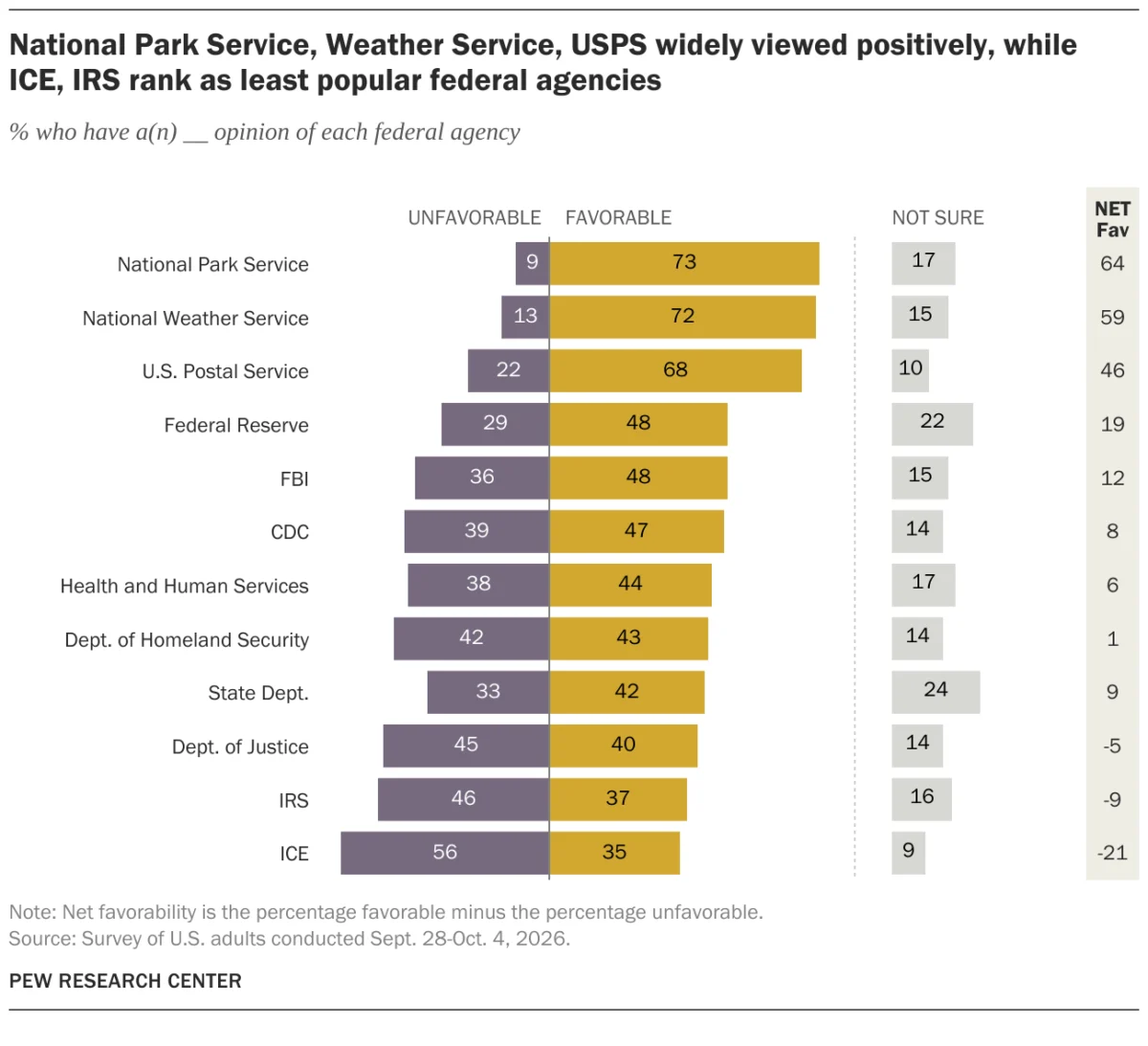
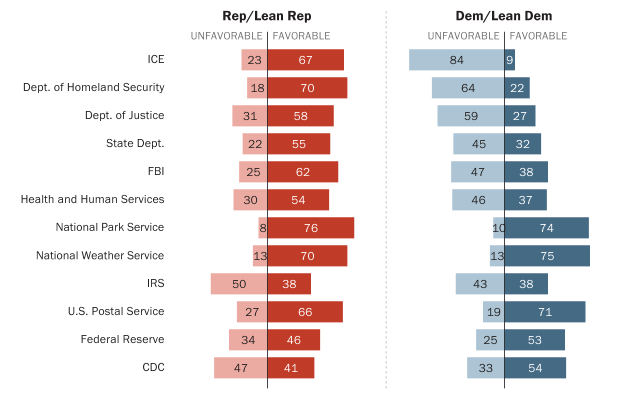
The survey, which measured public sentiment toward 12 major federal agencies, suggests that Americans are far from monolithic in their views of the administrative state. The data reveals a clear "favorability tier." At the top of the hierarchy sit the service-oriented agencies. The National Park Service (73% favorable), the National Weather Service (72% favorable), and the U.S. Postal Service (68% favorable) command broad support that transcends the red-blue divide.
Conversely, agencies tasked with immigration, law enforcement, and taxation face a more uphill battle in the court of public opinion. Immigration and Customs Enforcement (ICE) occupies the lowest rung, with a 56% unfavorable rating and a net favorability of -21. The Internal Revenue Service (IRS) and the Department of Justice (DOJ) also struggle, with net favorability ratings of -9 and -5, respectively. These figures reflect a public that is increasingly sensitive to the perceived missions and political visibility of the institutions tasked with enforcing federal law.

Chronology of Institutional Sentiment
To understand these current attitudes, one must look at the recent trajectory of public opinion. The 2026 findings serve as the latest installment in a multi-year effort by the Pew Research Center to track institutional confidence via the American Trends Panel.
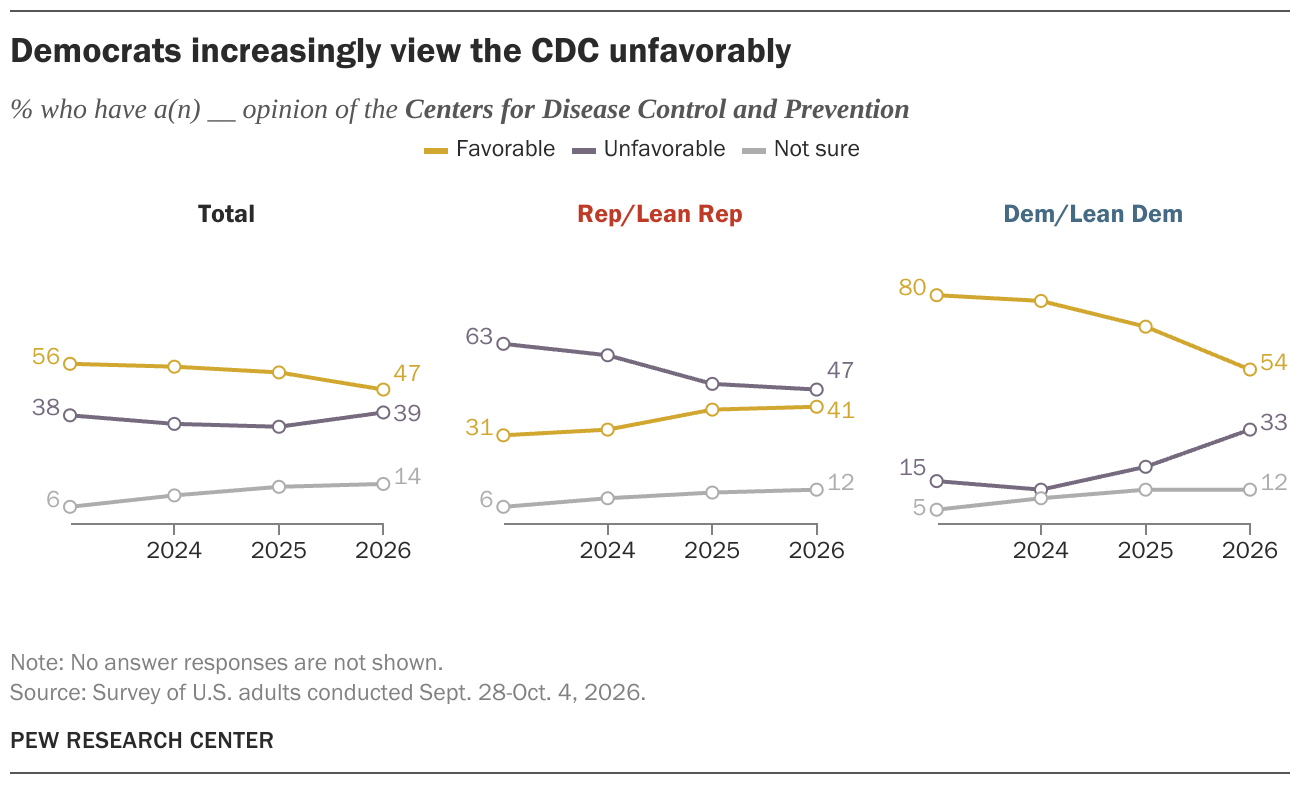
Over the past four years, the landscape has shifted significantly. For instance, the Department of Homeland Security (DHS) saw its net favorability settle at +1 in 2026, a reflection of the intense partisan tug-of-war surrounding national security and border policy. Similarly, the Centers for Disease Control and Prevention (CDC), which enjoyed high visibility and generally favorable ratings during the public health crises of the early 2020s, has seen its support decline. By 2026, the CDC’s net favorability sits at +8, driven largely by a sharp contraction in Democratic approval as the agency’s role in the national consciousness has evolved.
These shifts are not merely static numbers; they represent a "re-sorting" of institutional loyalty. Agencies once viewed through a neutral, administrative lens are now increasingly viewed through the prism of partisan identity, with law enforcement agencies in particular seeing massive swings in support based on whether a respondent identifies as Republican or Democrat.
Supporting Data: The Partisan Chasm
The most striking aspect of the 2026 data is the widening partisan gap. While majorities in both parties can agree on the utility of the National Park Service, the consensus evaporates when discussing the Department of Justice or the FBI.

The Partisan Divide in Law Enforcement
Republicans and those who lean Republican have shown a marked increase in favorability toward the FBI and the DOJ over the last year. In 2025, Republican favorability toward the FBI stood at 54%; by 2026, that figure climbed to 62%. Simultaneously, Democratic sentiment toward the Bureau has curdled, dropping from 45% favorability in 2025 to 38% in 2026. This "partisan flip" is mirrored in the Department of Justice, where Republican favorability surged from 51% to 58%, while Democratic favorability remained stagnant and low at 27%.
The ICE Conundrum
Perhaps the most contentious agency is ICE. The agency faces a brutal partisan reality: 67% of Republicans view it favorably, while a staggering 84% of Democrats view it unfavorably. This chasm has grown over the last year as the public conversation around immigration has intensified, pushing the agency to the forefront of the political debate and making it a lightning rod for ideological disagreement.

Fiscal and Regulatory Perceptions
The IRS and the Federal Reserve present an interesting case study in shifting economic sentiment. Republicans have grown more favorable toward the IRS (38% in 2026, up from 28% in 2025), while Democrats have seen their approval of the tax authority drop from 44% to 38%. This suggests that as tax policies and economic enforcement become central to political messaging, the public’s relationship with the IRS is increasingly defined by the prevailing economic climate and the administration in power.
Implications for Governance and Policy
The findings hold profound implications for the future of federal governance. When a significant portion of the electorate views key institutions—such as the Department of Justice or the CDC—with skepticism or outright hostility, the ability of these agencies to execute their mandates becomes compromised.

The Erosion of "Neutral" Authority
The decline in consensus support for agencies like the CDC and the FBI suggests that the concept of "non-political" expertise is under duress. When public health or law enforcement decisions are interpreted as partisan actions, the institutional legitimacy of these bodies suffers. This complicates the recruitment of non-partisan professionals and makes long-term policy planning susceptible to the volatile swings of the electoral cycle.
The "Service" Buffer
On a more optimistic note, the continued high favorability of the U.S. Postal Service and the National Park Service serves as a crucial reminder. These agencies provide tangible, universal benefits to the public. The "service buffer"—the idea that an agency remains popular as long as it delivers a clear, universally understood service—remains intact. For policymakers, the lesson is clear: agencies that focus on tangible, non-partisan public goods are the most likely to maintain a broad coalition of support in a divided nation.

Navigating the Future
As the U.S. heads into future election cycles, the data suggests that federal agencies will continue to be utilized as proxies for broader ideological battles. The "not sure" responses in the survey—ranging from 9% to 24%—indicate that there is still a segment of the public that remains unengaged or neutral. However, the trajectory of the last four years shows that this "unengaged" middle is shrinking as more citizens form hard opinions on the federal bureaucracy.
Methodological Note: The Shift to Digital
It is essential to contextualize these findings within the methodology of the study. The transition from telephone surveys to the online American Trends Panel is not merely a change in logistics; it is a change in the psychological environment of the survey. The inclusion of an explicit "not sure" option online, contrasted with the necessity of volunteering that response in phone surveys, accounts for some of the variance in the data. Furthermore, the "mode effect"—the phenomenon where individuals answer questions differently on a screen than they do when speaking to a live interviewer—must be acknowledged.
Despite these shifts, the trends captured by the Pew Research Center provide a vital window into the American psyche. Whether through the lens of national identity, economic security, or political affiliation, the public’s perception of federal agencies remains a barometer for the health of the republic. As these agencies continue to navigate a turbulent political landscape, their challenge will be to maintain the trust of a public that is increasingly skeptical of authority, yet deeply reliant on the services these institutions provide.