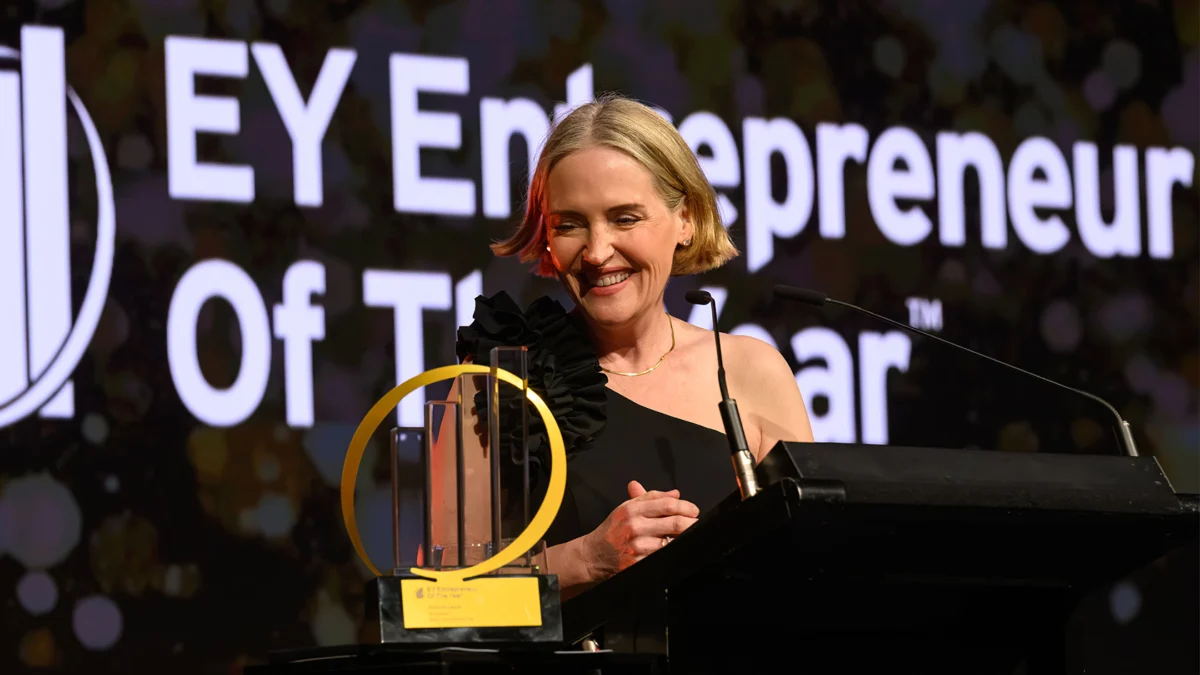
For over a quarter of a century, the EY Entrepreneur Of The Year™ awards have served as the definitive barometer for Australia’s business landscape. More than just a gala event, the program identifies, connects, and champions the individuals who are fundamentally rewriting the rules of industry, technology, and social progress. On October 22, at the historic Regent Theatre in Melbourne, the curtains rose on the 2025 cohort, honoring 27 national finalists whose collective ambition is propelling the nation into a new era of economic and social prosperity.
The Pinnacle of Innovation: Katrina Leslie Takes the Top Honour
The evening’s most anticipated moment saw Katrina Leslie, founder and chair of the AI-driven recruitment platform Swipejobs, crowned as the 2025 EY Entrepreneur Of The Year.
Founded in 2013, Swipejobs has emerged as a disruptive force in the global labor market. By leveraging sophisticated artificial intelligence to match jobseekers with employers based on granular skill sets and personal preferences, Leslie has effectively digitized the recruitment process, stripping away the friction of traditional hiring. The company’s growth trajectory has been nothing short of meteoric; now firmly established in the US and UK markets, Swipejobs generated an impressive $1.3 billion in revenue in 2025 alone.
For the judging panel, led by Naomi Simson OAM, selecting a winner from such a competitive field was a challenge, yet Leslie’s impact was undeniable. "As founder and chair of Swipejobs, Katrina stood out for her forward-thinking approach and her rare ability to turn bold, abstract ideas into a globally scalable, high-performing business," Simson noted. "She has fundamentally challenged the status quo of recruitment, creating a model that is not only reshaping the industry but setting a new standard for operational efficiency. We need more role models like Katrina in the Australian entrepreneurial community."
A Career Defined by Evolution: The Chronology of an Entrepreneur
To understand the magnitude of Katrina Leslie’s achievement, one must look at the arc of her career—a journey that began far from the boardrooms of Sydney or Melbourne. Raised as a Queensland cattle farmer’s daughter, Leslie’s professional path is a testament to the power of adaptation.
With more than 30 years of experience, she has witnessed firsthand the digital transformation of the labor market. Her early career saw the industry operating through manual, analog methods—’help-wanted’ signs in shop windows and dense newspaper classifieds. She cut her teeth in recruitment at industry titans such as Westpac, Microsoft, and BHP, gaining deep institutional knowledge of how talent acquisition functioned at scale.
In 1997, Leslie transitioned from employee to architect, launching her first venture, the assessment and career services company IPS. This marked the beginning of a serial entrepreneurial career characterized by technical foresight:
- 1997: Launch of IPS, establishing her presence in the HR services market.
- 2005: Establishment of ePredix, a pioneer in applicant screening and ranking.
- 2005: Launch of HRX, a sophisticated applicant tracking and sourcing platform.
- 2013: Founding of Swipejobs, integrating AI into the heart of recruitment.
Despite this extensive history, Leslie remains resolutely focused on the future. "If you want to get out of bed and drive a car at 100 kilometres an hour, you can’t be looking in the rearview mirror at the same time," she remarked during her acceptance speech. This forward-looking mindset is not merely a philosophy; it is a business strategy, as she now prepares to represent Australia on the global stage at the EY World Entrepreneur Of The Year™ 2027 in Monaco.
Supporting Data: The Economic Weight of Entrepreneurship
The EY Entrepreneur Of The Year program is more than a trophy presentation; it is an economic indicator. The cumulative impact of the program’s alumni is staggering. Previous winners have collectively supported approximately 135,000 jobs across the country and have contributed a combined $21.4 billion to Australia’s GDP.
These figures underscore a vital truth about the Australian economy: it is the agility and risk-taking of founders like Leslie and her fellow finalists that provide the structural foundation for long-term growth. When businesses scale, they create specialized job roles, stimulate regional economies, and force larger, legacy corporations to innovate or risk obsolescence.
Excellence Across the Ecosystem: The 2025 Category Winners
While Leslie took home the top prize, the 2025 awards showcased a diverse range of industries, proving that Australian innovation is as robust in travel and fashion as it is in technology and infrastructure.
The Consumer Sector: Lou Tandy, The APT Travel Group
The travel industry has undergone a massive transformation in the post-pandemic era, and Lou Tandy of The APT Travel Group has been at the forefront of that shift. With nearly a century of heritage, the company now facilitates premium travel for 60,000 guests annually across six continents. Tandy’s recognition highlights the importance of balancing a storied brand legacy with the rapid, tech-driven expectations of modern, luxury-seeking travelers.
The Emerging Category: Zane and Omar Sabré, MAISON de SABRÉ
In a category defined by rapid growth, the Sabré brothers triumphed by flipping the luxury script. With no prior experience in the fashion industry, the founders of the accessories brand MAISON de SABRÉ used their status as outsiders to challenge stagnant design norms. "Rather than asking how luxury products had always been designed or sold, we asked what customers actually valued and where the category had stopped evolving," noted Zane Sabré. Their success serves as a masterclass in how fresh perspectives can disrupt entrenched, traditional markets.
Industry Powerhouse: Dave Riches, GenusPlus Group Ltd
Infrastructure is the backbone of any nation, and Dave Riches has been instrumental in building the backbone of Australia’s future. Since founding GenusPlus in 2009, Riches has transformed a local Western Australian powerline business into a billion-dollar national infrastructure entity. His work spans critical sectors including electricity transmission, renewable energy integration, and telecommunications—all essential components for a sustainable Australian economy.
Services and Leadership: Daniel Tucker AM, Carey Group Holdings
The Services category winner, Daniel Tucker AM, represents a significant milestone in Australian business history. Since 1995, he has built Carey Group Holdings into the nation’s largest 100% First Nations-owned commercial enterprise, specializing in mining, civil works, and professional training. Tucker’s leadership style emphasizes a commitment to outcomes that transcend the balance sheet. "The key is delivering consistently on safety, quality and outcomes, while staying true to why the business exists," Tucker said, highlighting the role of values-based leadership in scaling a business over three decades.
Social Impact: David Elliott OAM, Australian Age of Dinosaurs Ltd
Perhaps the most unique success story of the year belongs to David Elliott OAM. What started as a chance discovery of a dinosaur fossil while mustering sheep in 1999 has evolved into a world-class scientific institution. By creating the Australian Age of Dinosaurs museum, Elliott has revitalized the Winton region. His initiative has doubled local tourism in just over a decade, contributing to a 10% population growth in the area—a powerful example of how entrepreneurial spirit can anchor regional development and cultural preservation.
Implications: The Road Ahead for Australian Business
The 2025 EY Entrepreneur Of The Year awards arrive at a critical juncture for the Australian startup and business ecosystem. As the nation grapples with global economic headwinds, the success of these 27 finalists offers a roadmap for resilience.
The common threads among this year’s winners—the adoption of AI, the prioritization of sustainable growth, and the integration of social responsibility into the core business model—suggest a maturing entrepreneurial environment. We are moving away from an era of "growth at all costs" toward an era of "impact-driven scale."
For the wider Australian startup ecosystem, the message from the Regent Theatre is clear: the most successful founders are those who treat their businesses as dynamic, living entities capable of solving real-world problems. Whether it is revolutionizing the way we find work, how we travel, or how we power our homes, these entrepreneurs are demonstrating that Australia has the talent, the infrastructure, and the vision to compete on the world stage.
As Katrina Leslie prepares for Monaco in 2027, the eyes of the global investment and innovation community will be on Australia. If the 2025 finalists are any indication, the nation’s contribution to global commerce is only just beginning. Through continued support, mentorship, and a commitment to celebrating these pioneers, Australia will undoubtedly continue to produce the business leaders who will define the next 26 years of the global economy.