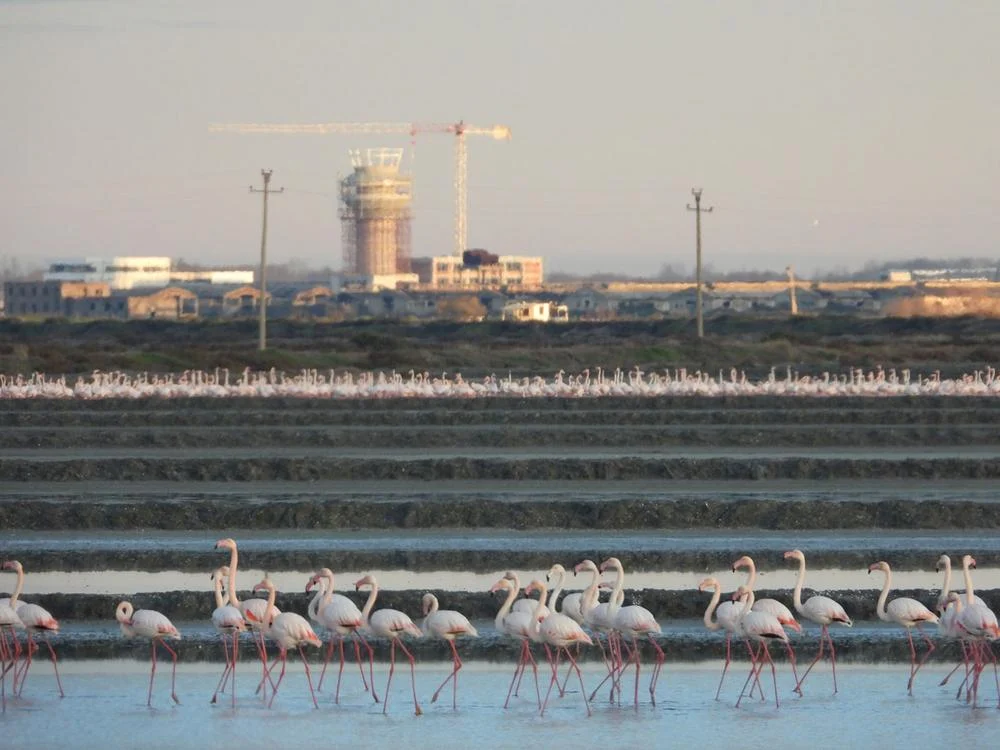
Tirana, Albania – The picturesque lagoon of Narta, a vital sanctuary for flamingos, stands juxtaposed against the relentless march of construction for the Vlora International Airport. This striking imagery encapsulates a deeper, more complex struggle unfolding in Albania: the perennial tension between ambitious development projects and the preservation of natural heritage, all set against a backdrop of political maneuvering and public trust. The Sazan-Zvernec development project, initially conceived as a high-end tourist resort, has rapidly transformed into a potent symbol of Albania’s governance challenges, revealing a multi-faceted conflict involving powerful capital, a fatigued government, a vigilant opposition, international civil society, and a citizenry increasingly disillusioned with decision-making processes that appear to bypass their interests.
At its core, the debate transcends a simple question of whether to build a resort. It delves into the fundamental question of what kind of Albania will emerge from these competing forces, and who ultimately bears the consequences when the scales tip precariously. The article posits that understanding Albania’s current political landscape requires a "reverse engineering" approach – not analyzing slogans, but dissecting the underlying incentives. It’s about identifying who stands to gain, who stands to lose, and who ultimately pays the price when situations spiral out of control.
The Nexus of Power and Place: Sazan and Zvernec as Focal Points
The islands of Sazan and Zvernec, along with the Narta Lagoon, are no longer merely geographical locations or environmental protest sites. They represent a critical intersection where numerous systems converge simultaneously:
- Vast Capital: Significant financial interests are at play, driving the demand for large-scale development.
- Government Fatigue: A government in power for an extended period may exhibit signs of weariness, impacting its capacity for decisive and transparent action.
- Opposition Ambition: An opposition seeking to carve out space and challenge the status quo often leverages such contentious issues.
- International Civil Society Networks: Global organizations play a crucial role in monitoring, advocating, and applying international pressure.
- Regional Interests: Geopolitical considerations and regional economic dynamics invariably influence such projects.
- European Integration Aspirations: Albania’s commitment to EU accession often brings scrutiny to its environmental and governance standards.
- Media Influence: The media acts as a conduit for information, shaping public perception and framing the narrative.
- Diaspora Engagement: The Albanian diaspora often participates in national debates, bringing external perspectives and resources.
- Citizen Disillusionment: A growing segment of the population harbors deep-seated distrust, questioning whether decisions are truly made in their name.
This intricate web of stakeholders underscores why the Sazan-Zvernec situation is far more than a local environmental dispute; it is a microcosm of Albania’s broader developmental trajectory and its ongoing struggle for effective governance.
Scenario Analysis: Who Wins, Who Loses, and Who Pays?
The article outlines several potential scenarios, each with distinct winners and losers, offering a pragmatic framework for understanding the underlying dynamics.
Scenario 1: Project Proceeds Without Full Transparency
Winners:
- The Investor: Beyond the immediate prospect of building hotel rooms, the investor secures a strategic position. Establishing a long-term presence on a strategically vital Adriatic island confers not just business but geopolitical and relational influence. Such a foothold becomes politically and legally costly to dislodge later.
- The Government (Short-Term): The government can capitalize on a narrative of development, showcasing "big capital," "luxury tourism," and "international image." This can bolster its standing domestically and regionally.
Losers:
- Nature: If environmental regulations are weak or poorly enforced, the natural ecosystem of the Narta Lagoon faces significant degradation.
- Local Residents: Without clear provisions for property rights, access, and fair compensation, local communities can be marginalized.
- The Citizenry: The public may perceive that public assets are being negotiated away without their genuine consent, eroding their sense of ownership and control.
- The Idea of Development Itself: A project marred by suspicion can cast a long shadow, making future investments appear as potential land grabs rather than opportunities for shared prosperity.
Implications: This scenario highlights a short-term gain for powerful entities at the expense of long-term public good, environmental sustainability, and democratic trust. The loss of public faith, particularly in a developing nation, represents a capital far more valuable and harder to replenish than any financial investment.
Scenario 2: Project Halted Without Due Process
Winners:
- Environmental Activists: The immediate halt can be seen as a moral victory, validating their advocacy efforts.
- The Opposition: Politically, this provides a tangible success, allowing them to claim credit for halting a controversial project.
- International Networks: Advocacy groups that championed the cause gain international visibility and reinforce their role as global watchdogs.
Losers:
- Albania’s Development Potential (Perceived): While stopping a potentially harmful project, the lack of a clear, institutional process can leave the country with a reputation for instability and unpredictable investment climates.
- Institutional Strength: The absence of robust mechanisms for assessment, negotiation, and resolution means the underlying issues remain unaddressed.
- Nature (Potentially): Protected areas may remain designated on paper but lack effective state management, control, and meaningful conservation efforts. The land is neither developed nor truly protected, falling into a state of neglect.
- Future Investments: A precedent where major projects are decided by confrontation rather than procedure can deter future legitimate investment.
Implications: While morally and politically satisfying for some, an abrupt halt without a structured resolution perpetuates a cycle of weak institutions. It risks leaving protected areas vulnerable and creating a disincentive for any large-scale project, regardless of its potential benefits, if the process is perceived as too volatile. True environmental protection requires a functional state capable of measurement, control, management, and accountability.
The Nature of Luxury and Value in the 21st Century
The article challenges the simplistic dichotomy of "development versus nature." It argues that luxury in the 21st century is not solely about concrete and steel; it is about rarity: pristine waters, tranquility, biodiversity, stunning landscapes, and authenticity. Flamingos and the Narta Lagoon are not obstacles to value; they are value. An investor who destroys the lagoon fundamentally misunderstands the product they are acquiring, or is driven by interests beyond sustainable development. The true question for Albania is not if it can attract private capital, but if it possesses a state strong enough to transform private capital into public value, rather than allowing it to exert private control.
Scenario 3: The Stalemate – Crisis Unresolved
This is painted as the most dangerous scenario, where the conflict stagnates, leading to a prolonged period of uncertainty.
Winners:
- The Investor: Retains strategic positioning with ambiguous obligations, gaining leverage in future negotiations.
- The Government: Buys time, deflecting criticism by framing the debate as a motive-driven political dispute rather than a substantive governance issue.
- The Opposition: Capitalizes on public discontent without bearing the responsibility of governing or offering concrete solutions.
- International Networks: Gain ongoing relevance and operational leverage by monitoring a protracted crisis.
- Media: Benefits from sustained conflict and controversy.
- Regional Actors: Exploit Albania’s weakness and internal divisions to advance their own interests.
Losers:
- The Ordinary Citizen: Lives in a constant state of uncertainty, impacting daily life, economic stability, and future planning.
- The Ecosystem: Remains in limbo, vulnerable to neglect or ad-hoc exploitation.
- Legitimate Business: Normal business operations are hampered by an unstable and unpredictable environment.
- Local Property Owners: Face perpetual ambiguity regarding their rights and potential compensation.
- Public Trust: Further eroded by the government’s inability to resolve critical issues.
- The Notion of Albania as a Negotiating State: The country is perceived as a territory to be exploited rather than a sovereign entity defending its interests.
Implications: This scenario breeds political paralysis. Uncertainty becomes a political product, allowing various actors to derive benefit from the lack of resolution. The absence of decisive institutional action allows incentives to align in a way that perpetuates the crisis, benefiting those who thrive in ambiguity.
Scenario 4: The Political Reckoning – A Call for Change
A crucial element of the ongoing debate is the widespread sentiment of democratic fatigue, leading to calls for a change in leadership.
The Question of Succession: While the demand for leadership rotation is acknowledged as a normal and healthy aspect of a republic, the critical question becomes: who replaces the current leadership? If the underlying systemic issues – permits, land access, media control, oligarchic influence, procurement practices, clientelism, and opaque financing – remain unaddressed, a change at the top may merely lead to a "re-wiring" of the system rather than a fundamental reform. Oligarchs can shift allegiances, media outlets find new sponsors, and the bureaucracy adapts to new political flags. Corruption, the article emphasizes, has methods, not ideologies.
The Need for Institutional Demands: Protests, while morally justified, must evolve beyond mere opposition. They need to articulate clear, institutional demands. This includes:
- Elections or Technical Government: A clear pathway for political transition.
- Independent Investigations: Mechanisms for accountability.
- Moratoriums: Pausing development pending review.
- Reform of Protected Areas: Ensuring their effective management.
- Guarantees for Property and Public Access: Protecting citizens’ rights.
Without these, citizen energy risks being co-opted by more organized actors, becoming mere fuel for political theatre.
Scenario 5: Escalation – The Unacceptable Risk
This scenario, warned against with the utmost urgency, involves the uncontrolled escalation of conflict.
Historical Parallels and Modern Dangers: The article draws a parallel to Albania’s tumultuous past, noting that communist regimes did not gain ground solely through violence but by channeling legitimate desires for justice and change into fatal projects. Similarly, the 1997 economic collapse, fueled by understandable anger over lost savings, led to institutional vacuum, anarchy, and enduring trauma.
Today, while the context differs, the logic of escalation remains potent. It manifests as:
- Entrenched Camps: Society divides into rigid, polarized factions.
- Non-Arbitrating Institutions: Governmental and judicial bodies fail to mediate disputes.
- Amplifying Media: News outlets exacerbate divisions by focusing on extreme viewpoints.
- Patient Actors: External and internal forces wait for emotional tides to shift public opinion and create opportunities.
Who Pays the Ultimate Price? In a scenario of escalation, the heavy burden falls not on the powerful investors with their legal teams and escape routes, nor on the politicians who negotiate, nor on international networks that move on, nor on oligarchs who adapt. It is the ordinary citizen who pays: the family living on a single wage, the small business owner, the child facing an uncertain educational future, the patient awaiting treatment, the emigrant contemplating return, the youth seeking reasons to stay.
The Path Forward: Transparency, Accountability, and Citizen Empowerment
The solution, the article argues, lies not in choosing sides prematurely but in breaking the cycle of uncertainty. This requires:
- Radical Transparency: The publication of key documents, maps, timelines, beneficial owners, public access rights, environmental obligations, and clear mechanisms for sanctions and accountability if the project causes harm. Transparency strengthens agreements; its absence is a response in itself.
- Institutional Demands from Protests: Protests must transition from mere outbursts to articulated institutional demands. Change without architecture is mere shock, and in a small nation, shock translates into cost, fear, emigration, and silence.
- Empowering the Citizen: The fundamental shift occurs when citizens refuse to be instruments. They must temper emotion with facts, prevent their passions from being used against them, and ask not just "against whom am I protesting?" but "what happens next?"
Ultimately, the Sazan-Zvernec case is a symptom of a larger ailment. The question is not just who profits from a specific development, but who profits from each potential scenario. In nearly every negative outcome, the Albanian citizen is left to foot the bill. Only when the citizen refuses to be a pawn, when they demand facts over fervor, and when they understand the long-term consequences of immediate reactions, can Albania transition from a territory for others to test their power, to a state that genuinely defends its own interests. The integrity of its natural heritage, the fairness of its development, and the trust of its people hang in the balance.