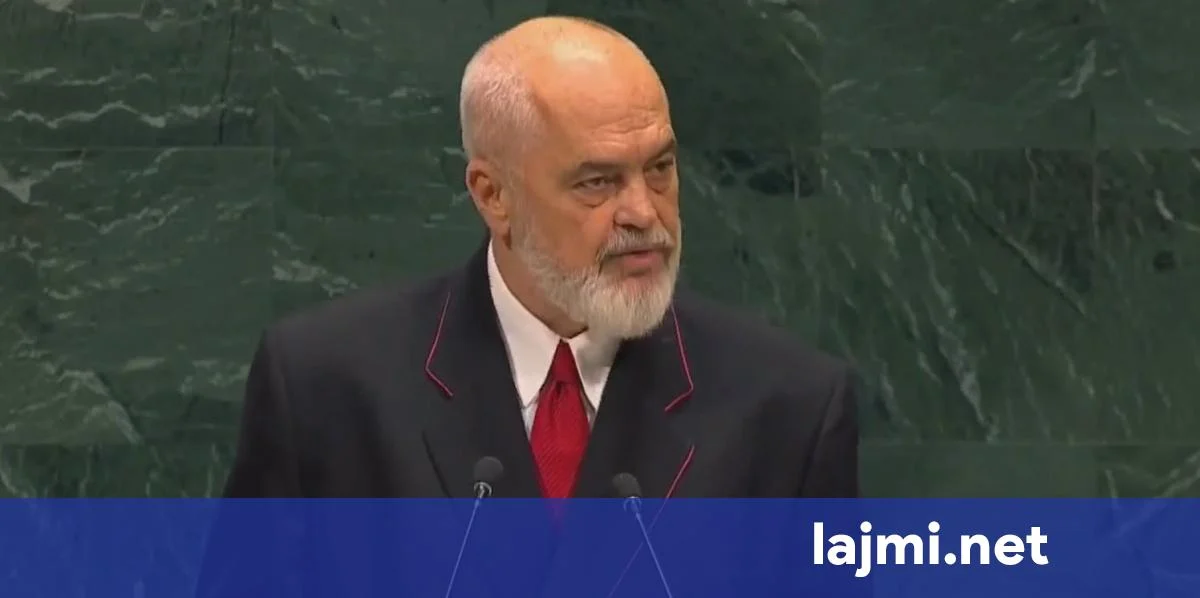
Tirana, Albania – In a highly symbolic gesture aimed at de-escalating weeks of political tension and persistent public demonstrations, Albanian Prime Minister Edi Rama has once again extended an invitation for dialogue to protesters. On a recent morning, invitations were conspicuously placed on the concrete seats located in front of the Prime Ministry in Tirana, a silent yet potent appeal for constructive engagement. This move comes as the government grapples with ongoing dissent, characterized by both peaceful gatherings and instances of violent confrontation.
Prime Minister Rama underscored his unwavering commitment to open discussion, stating his readiness to engage with "anyone who believes in dialogue and the possibility of making Albania better through the exchange of views, regardless of differences." However, his call for reconciliation was juxtaposed with a stern warning to those responsible for recent acts of violence and disruption, asserting that their actions would be met with legal and criminal repercussions. The Prime Minister firmly reiterated that Albania’s strategic path towards European integration remains immutable, dismissing the notion that current unrest could derail the nation’s aspirations.
Main Facts
The core of Prime Minister Edi Rama’s recent public address and accompanying gesture is a renewed, direct appeal for dialogue with the various groups involved in ongoing protests across Albania. This invitation was materialized through the symbolic placement of physical invitations on the concrete seating areas situated directly outside the Prime Ministry building in the heart of Tirana. Rama’s central message was one of inclusivity, emphasizing his willingness to meet with any individual or group that genuinely believes in the power of dialogue to foster a better future for Albania, regardless of their differing viewpoints. He articulated a vision of national progress achieved through "humanity, exchange, and confrontation of views," advocating for a civil and democratic approach to resolving societal challenges.
However, the Prime Minister’s conciliatory tone was sharply contrasted by a forceful condemnation of violent protest tactics. He explicitly warned those who have engaged in acts of "violent opposition," accusing them of "holding the capital hostage" and employing "the language of stone and fire." Rama asserted that such disruptive and unlawful behavior, which he described as "exporting Antifa’s terror" and "playing the game of others," would not be tolerated and would result in severe legal and criminal accountability. This dual message—an olive branch for peaceful engagement coupled with a firm stance against lawlessness—underscores the government’s current strategy in managing the volatile political climate. Crucially, Prime Minister Rama reaffirmed Albania’s steadfast commitment to its pro-European trajectory, stating unequivocally that the nation’s path towards European Union integration "does not change" and will not be obstructed by internal unrest or "great mischief."
Chronology of Escalating Tensions and Dialogue Attempts
The current political landscape in Albania, characterized by persistent protests and the government’s renewed call for dialogue, is the culmination of a complex series of events and grievances that have simmered for an extended period. While specific triggers often ignite larger movements, the underlying discontent has roots in various socio-economic and governance issues.
Late 2023 – Early 2024: Initial Spark and Student Mobilization
The most recent wave of significant protests gained momentum in late 2023, initially driven by student grievances. Students took to the streets to protest perceived corruption within the higher education system, inadequate infrastructure, and high tuition fees. Their demands soon broadened to include calls for greater government accountability, improved public services, and measures to combat the rising cost of living. These initial protests were largely peaceful, characterized by marches and sit-ins, and quickly garnered public sympathy.
February 2024: Opposition Joins, Demands Broaden
As the student movement continued, opposition political parties, primarily led by the Democratic Party, began to align themselves with the protesters, albeit with their own distinct agendas. The opposition’s demands often centered on broader political issues, including calls for early elections, accusations of government corruption at higher levels, and concerns over the erosion of democratic institutions. This alliance broadened the demographic of the protests, bringing in a more diverse cross-section of society, from civil society activists to disgruntled citizens.
March 2024: Escalation to Confrontation
By March, the nature of some protests began to shift. While many demonstrations remained peaceful, isolated incidents of violence started to occur. Clashes between protesters and police, often involving the throwing of objects like stones and Molotov cocktails by a fringe element, and the use of tear gas and water cannons by law enforcement, became more frequent. These incidents often took place outside key government buildings, including the Prime Ministry and the Parliament. The government, through the Ministry of Interior, condemned these acts of violence, attributing them to "radicalized groups" and "provocateurs" seeking to destabilize the country.
April 2024: Government’s Initial Responses and Failed Dialogue Attempts
In response to the escalating situation, Prime Minister Rama made initial attempts to open channels for communication. These early overtures often involved public statements urging dialogue and inviting protest leaders to the negotiating table. However, these attempts largely failed. Many protest organizers and opposition figures rejected the invitations, citing a lack of trust in the government’s sincerity, demanding preconditions (such as Rama’s resignation or the fulfillment of specific demands) before any talks could begin. The government, in turn, criticized the protesters for refusing dialogue, accusing them of being unwilling to engage constructively.
Late April 2024: Continued Disruption and Economic Impact
The protests continued intermittently through late April, causing significant disruption in central Tirana. Major thoroughfares were often blocked, impacting daily life, commerce, and tourism. The economic strain on small businesses, particularly those in the affected areas, became a growing concern. Law enforcement agencies increased their presence, often erecting barricades around government buildings, further heightening the sense of tension and siege in the capital.
May 2024: Rama’s Symbolic Gesture and Renewed Warning
The latest development, unfolding in early May, saw Prime Minister Rama undertake his most direct and symbolic appeal for dialogue yet. The act of placing physical invitations on the concrete seats outside the Prime Ministry was a highly visual and widely publicized gesture. This was accompanied by his latest comprehensive statement, which, while reiterating the call for dialogue, also delivered a stringent warning about the legal consequences for those who resort to violence. The Prime Minister’s reference to "Antifa’s terror" and "covered faces" specifically targeted elements he perceives as orchestrating or participating in destructive acts, aiming to distinguish legitimate protest from unlawful behavior. This move marks a critical juncture, as it simultaneously offers an olive branch while drawing a firm line against further escalation of violence. The immediate reaction from protest groups and opposition figures to this latest overture remains varied, with some dismissing it as a public relations stunt and others pondering its potential for genuine engagement.
Supporting Data and Context
Understanding the protests and the government’s response requires examining the broader socio-economic and political context in Albania. The demonstrations are not merely isolated incidents but reflect deeper societal currents.
Protest Demographics and Core Grievances: The protesters represent a diverse coalition. Initially sparked by students demanding reforms in education and a crackdown on corruption, the movement has expanded to include a significant number of opposition supporters, civil society activists, and ordinary citizens frustrated with the cost of living. Key grievances include:
- Economic hardship: Albania, despite recent economic growth, faces challenges such as high youth unemployment, persistent poverty, and a significant wealth gap. Rising inflation, particularly in essential goods and energy, has fueled widespread discontent.
- Corruption: Perceptions of widespread corruption within government institutions remain a potent driver of public anger. International watchdog organizations often highlight Albania’s struggles with graft, which undermines public trust and economic development.
- Governance and Rule of Law: Concerns about the independence of the judiciary, selective enforcement of laws, and the concentration of power within the ruling party have been voiced by critics and opposition groups.
- Specific Policies: While not always the primary focus, certain government policies, such as urban development projects, privatization efforts, or environmental regulations, have also drawn localized protests and contributed to the broader sense of dissatisfaction.
Scale and Impact of Protests: The demonstrations have varied in scale, ranging from several hundred to several thousand participants, depending on the specific call to action. While not always massive in terms of raw numbers compared to the total population, their sustained nature and the strategic choice of locations (e.g., in front of the Prime Ministry, Parliament, and key ministries) have ensured maximum visibility and disruption. The economic impact has been notable, particularly in Tirana, where blocked roads and closed businesses have affected daily commerce and the city’s overall rhythm. The psychological impact of prolonged unrest also contributes to a sense of instability and uncertainty among citizens and potential investors.
Public Opinion: Public sentiment regarding the protests is complex and often divided. While many Albanians sympathize with the underlying grievances (e.g., against corruption, for better living standards), there is also a segment of the population that disapproves of the disruptive tactics and violence. Support for the government often remains robust among its core constituency, who may view the protests as politically motivated attempts to destabilize the country. The constant back-and-forth between the government and protesters, often characterized by strong rhetoric, can lead to political fatigue among the general populace, who simply desire stability and resolution.
International Observation: Albania’s political stability and adherence to democratic principles are closely watched by international partners, particularly the European Union and the United States. As a candidate country for EU membership, Albania is under scrutiny for its progress in rule of law, democratic governance, and fundamental rights. Prolonged political crises, especially those involving violence, can negatively impact its EU accession prospects. International organizations like the OSCE and Council of Europe often monitor electoral processes, judicial reforms, and human rights situations, and their reports frequently highlight areas for improvement, which can indirectly fuel public and opposition discontent.
Legal Framework and Enforcement: Albania has laws governing public assembly, freedom of speech, and the use of force. While the right to peaceful protest is constitutionally guaranteed, acts of violence, damage to public property, or obstruction of public order are subject to legal penalties. The government’s warning of "legal and criminal responsibility" for those engaged in violence underscores its intent to enforce these laws. The judicial system’s independence and efficiency in handling such cases are crucial for upholding the rule of law and ensuring that justice is administered fairly, without political interference.
Official Responses and Government Stance
Prime Minister Edi Rama’s latest pronouncements represent a comprehensive articulation of the government’s current stance, balancing an offer of engagement with a firm commitment to law and order. His message was not merely a repetition of previous calls for dialogue but an amplified and detailed exposition of the government’s position.
Prime Minister Rama’s Elaborated Stance:
Rama’s statement, "Again, and again and again, the invitation for dialogue and the readiness to be with anyone who seeks and believes in dialogue, is here," conveyed a sense of persistent openness despite previous rejections. He elaborated on his vision for productive engagement, stating, "I am ready anywhere, at any place and at any hour with those who believe that Albania must be made better and that Albania is made better with humanity, with exchange and confrontation of views, however opposing." This underscores a desire for a broad, inclusive discussion based on mutual respect and a shared national interest, rather than partisan divides.
Crucially, Rama drew a stark line between legitimate dissent and violent acts: "Violent opposition, with force, which goes against the thread of reason, cannot impose itself on the necessity for dialogue, for confrontation of views, however opposing, and for democratic coexistence, in a country where the past has no chance of returning." This phrase serves multiple purposes: it delegitimizes violent tactics, frames them as irrational, and links them to a past Albania is striving to leave behind—a subtle reference to authoritarian or chaotic periods. His explicit mention of "Antifa’s terror" and "covered faces" suggests an attempt to characterize the violent elements as external or extremist, rather than representative of the broader protest movement or student body.
Warnings of Legal Consequences:
The Prime Minister’s warning was unequivocal: "And whoever held the capital hostage, exporting Antifa’s terror and playing the game of others here in the name of students, putting themselves at the forefront of students with covered faces, must know that they will be held legally, criminally responsible, according to the degree of violation committed, according to the violation of the great misunderstanding." This is a clear signal that the government intends to pursue legal action against individuals identified as participating in or instigating violent acts. The phrase "great misunderstanding" frames the belief that violence can achieve political change as a fundamental error in judgment, one that will carry serious repercussions. He emphasized this point by stating, "A very great misunderstanding that will turn into a very important lesson for anyone who believed that through this misunderstanding they would change Albania’s path."
Government Spokespersons and Ministerial Support:
Following Rama’s statement, other government officials have typically echoed his sentiments. Ministers of the Interior and Justice often issue statements reinforcing the importance of maintaining public order and upholding the rule of law. The Ministry of Interior, through its police force, usually emphasizes its commitment to facilitating peaceful protests while ensuring public safety and property protection. Police spokespersons would likely provide updates on investigations into protest-related violence, detailing arrests and charges. These officials often reiterate that dialogue is the preferred path, but that violent acts will be met with the full force of the law.
Parliamentary Majority and Ruling Party:
The Socialist Party, holding a comfortable majority in Parliament, typically rallies behind the Prime Minister’s position. Statements from party leaders and members of parliament usually express full support for Rama’s call for dialogue, while simultaneously condemning any form of violence or attempts to destabilize the country. They often frame the opposition’s actions as obstructionist and politically opportunistic, aimed at undermining the government’s reform agenda and the nation’s European trajectory. This unified front within the ruling party serves to strengthen the government’s resolve and present a cohesive message to both domestic and international audiences.
Reaffirmation of National Trajectory:
A critical component of Rama’s message, consistently emphasized by the government, is the unwavering commitment to Albania’s European future. "Albania’s path does not change. Albania will continue straight and will carry the dreamed flag of Ismail Qemali and Skënderbeu to the top, and Albania will be part of that European Union, which the forces involved in this great mischief cannot prevent," Rama asserted. This statement serves to reassure citizens and international partners that, despite internal challenges, the country’s strategic foreign policy goals remain intact. It also implicitly links the "great mischief" of violent protests to forces attempting to hinder Albania’s European integration, a powerful rhetorical tool in a country with strong pro-EU aspirations.
Implications and Future Outlook
The current political standoff in Albania, characterized by the government’s renewed call for dialogue and its firm stance against violence, carries significant implications for the nation’s political stability, democratic development, and European integration prospects.
For Dialogue and Reconciliation:
The success of Prime Minister Rama’s latest overture for dialogue hinges on several factors. Firstly, the willingness of protest leaders and opposition figures to engage constructively. Previous attempts have faltered due to a lack of trust and preconditions. The symbolic nature of placing invitations might be seen by some as a genuine effort to bridge divides, while others might dismiss it as a mere public relations maneuver. A true dialogue would require a neutral mediator, a clear agenda, and a commitment from both sides to find common ground. Without these elements, the current impasse is likely to persist, further entrenching divisions.
For Political Stability:
Continued political unrest, especially if marked by further violence, poses a substantial threat to Albania’s domestic stability. Prolonged disruptions can erode public confidence in democratic institutions, discourage investment, and foster a climate of uncertainty. The government’s firm line on prosecuting violent offenders, while aiming to restore order, could also risk further antagonizing some segments of the protesting population if perceived as heavy-handed or politically motivated. Balancing the need for order with the right to protest peacefully is a delicate act that will define the government’s approach in the coming weeks.
For EU Integration:
Albania’s path toward European Union membership is a cornerstone of its foreign policy and a long-held national aspiration. The EU places significant emphasis on political stability, democratic governance, rule of law, and respect for fundamental rights as prerequisites for accession. Sustained political crises, especially those involving violence or challenges to democratic norms, could negatively impact Albania’s progress in the accession process. International partners, including the European Commission, regularly monitor the political situation and may issue recommendations or express concerns if the situation deteriorates. Rama’s strong reaffirmation of Albania’s EU path is a direct message to both domestic and international audiences that this strategic goal will not be compromised.
For Rule of Law and Democratic Coexistence:
The government’s pledge to hold those responsible for violence "legally, criminally responsible" underscores its commitment to the rule of law. The effective and impartial application of justice in these cases will be critical. It will send a message that violent acts have consequences, but it also necessitates transparent judicial processes that are free from political interference. The ability of Albanian society to uphold democratic coexistence, allowing for diverse viewpoints and peaceful opposition, even amidst deep disagreements, is fundamental to its democratic maturity. The challenge lies in fostering an environment where legitimate grievances can be expressed and addressed without resorting to destructive means.
Future of Protests and Opposition Strategy:
The Prime Minister’s dual message might prompt a reassessment of strategies among protest groups and the opposition. Some might choose to distance themselves from violent elements to gain broader public and international legitimacy, potentially engaging with the offered dialogue. Others might view the government’s warnings as an attempt to suppress dissent, leading to further defiance or a change in tactics. The opposition faces the challenge of maintaining pressure on the government while avoiding actions that could discredit their cause or lead to legal repercussions for their supporters. The long-term impact on their public image and political viability will depend on their response to Rama’s latest move.
International Perception:
The ongoing situation in Albania is closely watched by international media, diplomatic missions, and human rights organizations. How the government manages the crisis, particularly its adherence to democratic principles, human rights, and the rule of law, will shape Albania’s international reputation. A peaceful resolution through dialogue would enhance its standing, while prolonged instability or excessive force could draw criticism and potentially affect its relationships with key partners.
In conclusion, Prime Minister Edi Rama’s latest move is a high-stakes maneuver. It attempts to reframe the narrative around the protests, offering an olive branch while firmly asserting the boundaries of acceptable dissent. The coming weeks will reveal whether this strategy can break the cycle of confrontation and pave the way for a more constructive political discourse, or if the deep-seated mistrust and grievances will continue to fuel unrest in Albania.