Tirana, Albania – October 21, 2026 – A wave of increasingly intense protests is sweeping across Albania, fueled by widespread discontent with the current government’s policies and perceived corruption. What began as isolated demonstrations has evolved into a significant national movement, with students emerging as a powerful driving force. The escalating unrest has prompted strong reactions from Prime Minister Edi Rama, who has decried the protests as an orchestrated effort to destabilize the nation and derail its European Union integration process.
The demonstrations, which have seen clashes between protestors and riot police, are rooted in a complex interplay of economic hardship, concerns over the quality of education, and a deep-seated frustration with the political establishment. While the government attempts to frame the dissent as external manipulation, participants articulate a clear demand for systemic change and a more responsive, accountable governance.
Escalating Tensions and Government Response
Prime Minister Edi Rama, in a meeting with educational institution leaders on Tuesday, characterized the ongoing student protests, initially born from civic dissatisfaction, as an organized attempt to destabilize the country and impede its path toward European Union membership. He further warned of a forthcoming response involving a new package of criminal and administrative sanctions.
Following this meeting, Rama took to Facebook to share a video depicting him placing a sign reading "Dialogue" and 12 red chairs at the entrance of the Prime Ministry, an apparent invitation for talks. However, this gesture was met with skepticism by protest participants. Jesmina Sengla, a student actively involved in the protests, responded with a curt "Build it!", implying that Rama’s offer lacked sincerity.
Sengla articulated the prevailing sentiment among many protestors: "His invitation is not sincere. He is responding to the pressure from the international community to engage in dialogue with the protestors and to present himself as ready for change." This suggests a belief that the government’s outreach is a performative act rather than a genuine commitment to addressing the protestors’ grievances.
The protests themselves are characterized by their decentralized nature, with no single leadership or designated spokespersons. This has often led to their messages being overlooked or misrepresented. BIRN (Balkan Investigative Reporting Network) has engaged with several participants to understand the root causes of their mobilization and their specific demands.
Core Demands and Underlying Grievances
At the heart of the protestors’ demands is a fervent call for the protection of democracy and the assurance that citizens can express themselves without fear. Beyond this fundamental right, they are advocating for a new political system, one that would exclude both Prime Minister Edi Rama and the opposition leader, Sali Berisha, from any future political role. This indicates a profound disillusionment with the entire political spectrum.
Economic factors are also significant drivers of the current unrest. The rising cost of living and the challenging conditions within universities are frequently cited as reasons for students taking to the streets. Jesmina Sengla elaborated on this, expressing her profound dismay at the continuous emigration of Albanians, particularly young university-age individuals, attributing it to "terrible living conditions and high costs."
"Today, students, in a way, are forced to work because they cannot afford the cost of living in Tirana," Sengla told BIRN, highlighting the precarious economic situation faced by many.
Escalation of Police Violence
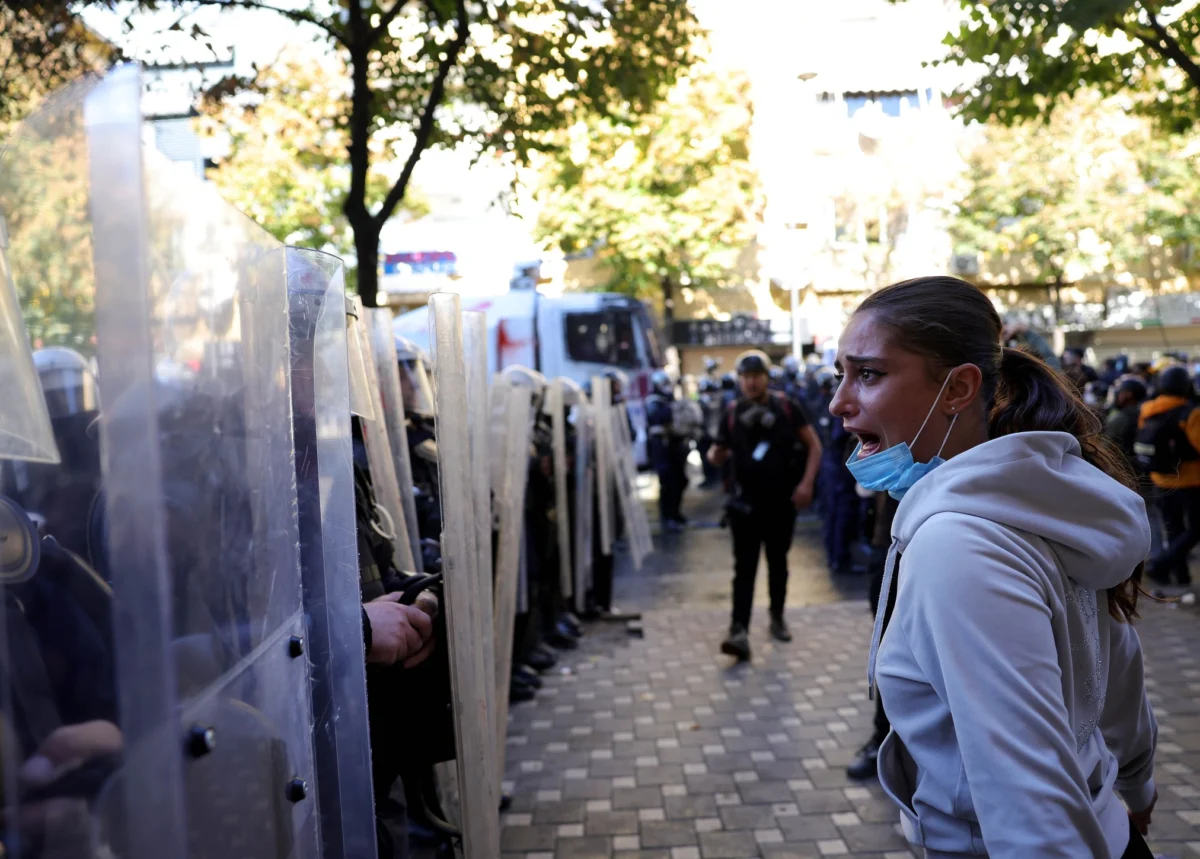
The intensification of the protests has been accompanied by a disturbing increase in injuries and arrests, as well as damage to public and private property. The clashes have been marked by the police’s use of tear gas, water cannons, and rubber bullets, met by protestors hurling stones and pyrotechnics.
However, for many interviewed by BIRN, the manner in which the police are treating protestors, especially minors, has become a primary catalyst for their opposition to the government.
Megi Ibrahimi, a 20-year-old electrical engineering student at the Polytechnic University of Tirana, recounted her experience, stating she had participated in protests since their early stages. She described how students gathered in front of the Ministry of Education, throwing stones to express their opposition to the ministry’s policies. "And then the police started hitting us with water, gas, and even physical violence," she said.
Ibrahimi emphasized the stark power imbalance between the police and the protestors. While protestors rely on their "bodies and some stones," she noted, the police possess "all kinds of military equipment to attack us."
Despite the physical confrontations, Ibrahimi identified "corruption" as the "most insidious and brutal form of violence." She elaborated, "Corruption in Albania does not stop at the high levels of power. It is found in every position of power, in every office, and every service where the government exercises its authority. Therefore, life here is impossible."
Adding to the volatile atmosphere, on the evening of the report, Rama, during a meeting with the State Police, alleged that the young protestors had ties to extremism and foreign intelligence services. He also announced a bonus of 2,500 euros for police officers.
The Prime Minister also warned of financial and administrative repercussions for protestors, stating that the families of minors would be held responsible for damages incurred during protests, and that students would forfeit scholarships, financial support, and the right to free education.
"He is threatening us," Ibrahimi responded. "But his threats are not that frightening. He threatens us with not giving us scholarships, but his scholarships are ridiculous. With that scholarship, we cannot even cover the expenses of one week."
Some educators have publicly voiced their support for the student cause. Doriana Musai, a lecturer in urban planning at the private Polis University, told BIRN that "violence against youth is violence against democracy and risks destabilizing the country." She added, "Students have rights. They have shown courage and determination by demanding new policies that would orient the country towards the European Union."
Chronology of the Evolving Movement
The protests against Rama’s government initially erupted in late May, sparked by the construction of a resort in the protected coastal area of Zvërnec. This project is reportedly linked to Jared Kushner, the son-in-law of former U.S. President Donald Trump.
Over time, the protests broadened into a wider movement against corruption, the capture of state institutions, and the entanglement of politics with business interests. However, after more than four months of largely peaceful gatherings, the protests were losing momentum, and the government had consistently refused to meet the protestors’ primary demand: the resignation of Prime Minister Edi Rama.
A significant turning point occurred on October 13th, when thousands of university students and high school pupils joined the movement, following a call for national mobilization issued three days prior. Dissatisfied with the state of education, the costs of study, and the lack of future employment prospects, students converged in front of the Ministry of Education in Tirana, injecting new impetus into the anti-government movement.
This student mobilization transformed a flagging civic movement into a potent revolt. The subsequent clashes with police, mass arrests, and reports of excessive force deepened the political crisis and societal tensions.
Among the protestors on the evening of the report was Celeste Fejzo, who still possessed an invitation from Edi Rama in 2013, when she was a high-achieving high school student. Rama had invited her to participate in an activity for the "Albania of the European Generation" initiative, which promised a better future for the youth.
Thirteen years later, Fejzo found herself on the streets, demanding Rama’s removal from power. For her, the contrast between past hopes and present reality was stark. "The Albania that is being offered to us has nothing to do with what we expected," she told BIRN.
"At this point, we as protestors demand only one political act," stated protesting student Jesmina Senga, referring to the resignation of Rama. "His resignation."
Supporting Data and Context
The underlying issues driving these protests are complex and deeply entrenched. For years, Albania has grappled with significant challenges related to governance, economic development, and the rule of law. International reports, including those from the European Commission, have consistently highlighted concerns about corruption, organized crime, and the need for judicial reform.
The high rate of emigration, particularly among young and educated Albanians, is a direct consequence of these systemic issues. The lack of economic opportunities, coupled with a perceived lack of meritocracy and rampant corruption, pushes many to seek better prospects abroad. This brain drain further exacerbates the country’s development challenges.
The education sector, a key focus of the student protests, has also faced criticism for its quality and accessibility. Rising tuition fees, inadequate resources, and a curriculum that is perceived as disconnected from the job market contribute to student frustration. The promise of a European future, often touted by the government, appears increasingly distant to a generation facing significant domestic hurdles.
Official Responses and International Scrutiny
Prime Minister Rama’s strong condemnation of the protests, framing them as a threat to national stability and EU integration, reflects a common tactic employed by governments facing widespread dissent. His accusations of foreign influence and extremism aim to delegitimize the movement and rally a segment of the population against it.
The offer of dialogue, while seemingly conciliatory, has been met with deep skepticism by the protestors, who view it as a superficial response to mounting pressure. The proposed sanctions, on the other hand, signal a hardening stance from the government, potentially escalating the conflict.
The involvement of international actors, such as Jared Kushner in the Zvërnec resort project, has also drawn attention and contributed to the narrative of unchecked development and potential conflicts of interest that fuels public anger. International bodies, including the EU and various human rights organizations, are closely monitoring the situation in Albania, particularly concerning the government’s response to protests and the protection of fundamental freedoms.
Implications for Albania’s Future
The current wave of protests in Albania carries significant implications for the country’s political and social landscape. The growing disillusionment with the established political order, encompassing both the ruling party and the opposition, suggests a deep-seated desire for fundamental change. The demand for a new political system, free from the influence of figures like Rama and Berisha, underscores the extent of this dissatisfaction.
The increased intensity of clashes and the government’s punitive rhetoric risk further polarizing Albanian society. The impact on the country’s aspirations for EU membership also remains a critical concern. Continued political instability and a failure to address the root causes of public discontent could hinder Albania’s accession process.
The emergence of students as a powerful force in this movement signals a new dynamic in Albanian activism. Their willingness to confront the authorities and their articulate articulation of grievances suggest a generation that is determined to shape its own future, even in the face of significant challenges. The coming weeks and months will be crucial in determining whether dialogue can prevail over confrontation and whether Albania can navigate this period of intense social and political upheaval towards a more stable and democratic future.