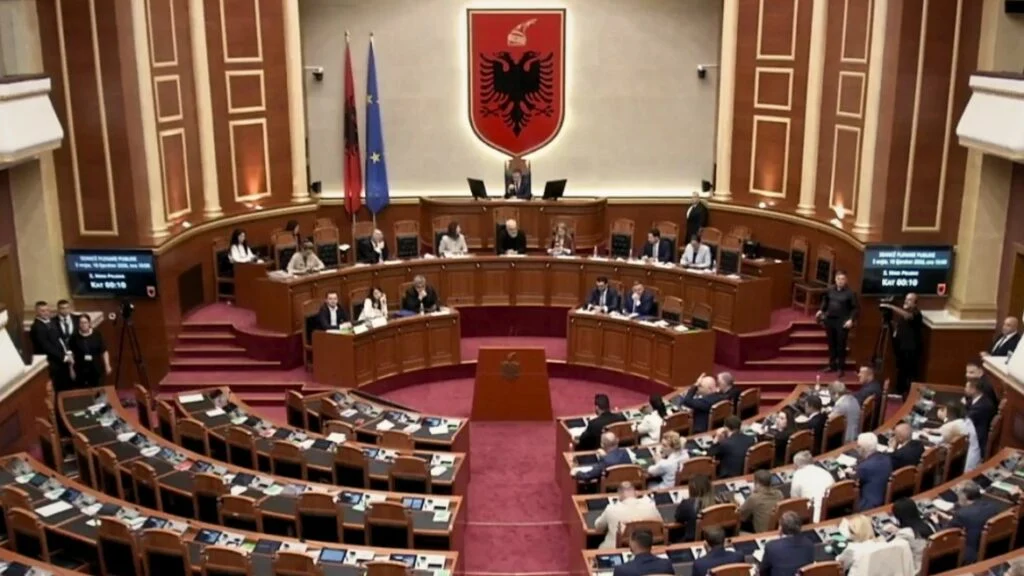
TIRANA, Albania – October 8, 2026 – In a move poised to fundamentally reshape local governance across Albania, the nation’s Parliament today officially approved a new administrative map, drastically consolidating the country’s municipalities from 61 to just 46. The reform, championed by the ruling Socialist Party (PS) majority, marks a significant overhaul of the territorial-administrative structure, aiming to enhance public services and align local government operations with European Union standards. However, the decision comes amidst vehement opposition from the Democratic Party (PD) and considerable public debate, raising profound questions about electoral fairness, local representation, and the future of Albania’s democratic decentralization.
The vote, largely a foregone conclusion given the Socialist Party’s parliamentary majority, saw the new draft adopted despite lingering internal concerns within the ruling party and fierce external criticism. Arbjan Mazniku, Co-Chair of the Special Commission for Territorial Reform, unequivocally stated that the new division would be enacted, underscoring the majority’s commitment to the reform’s objectives. Speaking on the "Real Story" program, Mazniku emphasized that these changes are primarily designed to deliver better services to citizens and ensure that local administrations function more effectively, in line with the legislative frameworks prevalent across the European Union.
This sweeping reform is presented by the government as a critical step towards modernizing the state and improving efficiency. Conversely, the opposition decries it as a cynical political maneuver intended to consolidate the ruling party’s power, undermine local democracy, and potentially exacerbate the depopulation of rural areas. The implications of this decision are far-reaching, setting the stage for a new era of local governance in Albania, fraught with both potential and peril.
Main Facts: A New Era for Albanian Local Governance
The core of the newly approved administrative reform lies in the significant reduction of local government units. From the current 61 municipalities established in the 2014 reform, Albania will now operate with just 46. This consolidation is not merely a numerical change; it represents a philosophical shift in how local services are envisioned, how resources are managed, and how citizens interact with their local authorities.
The Socialist Party-led government argues that this leaner structure will foster greater administrative efficiency, allowing for economies of scale and more robust strategic planning. The proponents of the reform highlight the imperative for Albania to develop local governance structures that are capable of attracting and effectively managing European Union funds – a critical component of the country’s EU accession aspirations. They contend that many of the smaller, existing municipalities lacked the administrative capacity, qualified staff, and financial strength to undertake complex development projects or absorb substantial international aid.
Conversely, the Democratic Party and other opposition groups have consistently characterized the reform as a thinly veiled attempt at political gerrymandering. They argue that the redrawing of municipal boundaries has been strategically orchestrated to favor the ruling party in future local elections, effectively diluting the opposition’s strongholds and creating larger, more unwieldy electoral districts that are harder for non-incumbents to campaign across. Furthermore, the opposition expresses deep concern that centralizing services and decision-making in larger municipal centers will inevitably lead to the further neglect and depopulation of smaller towns and rural communities, eroding local identity and exacerbating socio-economic disparities.
The approval of this reform marks a pivotal moment in Albania’s post-communist history, reflecting a continued, albeit often contentious, effort to modernize its state apparatus. The debate surrounding it has touched upon fundamental questions of democratic representation, decentralization, economic development, and the nation’s European future.
Chronology of a Contentious Reform
The journey towards the 2026 administrative map has been a protracted and often acrimonious process, building upon previous efforts to modernize Albania’s local governance landscape.
2014: The Precedent-Setting Reform: The current reform is not Albania’s first foray into territorial restructuring. A landmark reform in 2014, also driven by the Socialist Party, drastically reduced the number of municipalities from 373 to 61. That reform, too, was met with significant opposition, but it fundamentally reshaped the administrative map, creating larger units with the stated goal of improving efficiency and service delivery. The lessons, both positive and negative, from the 2014 experience undoubtedly informed the current debate. While some improvements in service provision were noted, challenges related to integrating disparate administrations, managing vast territories, and maintaining local representation also emerged.
Post-2019 Local Elections: Seeds of New Reform: Following the highly contested local elections of 2019, which saw the opposition largely boycott the process, the ruling majority began to signal the need for further administrative adjustments. Discussions intensified, often framed around the evolving demographic realities, the persistent challenges of fiscal decentralization, and the ongoing push for EU integration. The argument gained traction that even the 61 municipalities were, in many cases, still too small or financially weak to function optimally in a modern European context.
2023-2024: Formation of the Special Commission and Initial Proposals: By late 2023, a Special Commission for Territorial Reform was established within the Parliament, tasked with analyzing the existing administrative division and proposing potential changes. Co-chaired by Arbjan Mazniku, the commission brought together experts and political representatives to draft the new framework. Early proposals began circulating, suggesting a further reduction in the number of municipalities. These initial drafts immediately ignited a fresh wave of public and political debate.
2025: Drafting, Consultations, and Mounting Opposition: Throughout 2025, the Special Commission worked on refining the draft, reportedly conducting a series of consultations. However, these consultations were widely criticized by the opposition and civil society organizations as being superficial, lacking genuine inclusiveness, and failing to incorporate diverse perspectives from local communities and independent experts. The Democratic Party, alongside other smaller opposition entities, launched a concerted campaign against the proposed changes, organizing protests and issuing strong condemnations, branding the reform as undemocratic and politically motivated.
Early 2026: Parliamentary Debates Intensify: As the draft administrative map progressed to parliamentary debate in early 2026, the political rhetoric escalated. Heated exchanges characterized sessions, with the majority emphasizing efficiency, EU alignment, and improved services, while the opposition underscored concerns about electoral manipulation, depopulation, and the erosion of local autonomy. Despite the intense scrutiny and calls for more transparent and inclusive processes, the ruling majority remained steadfast in its determination to pass the reform.

October 8, 2026: The Final Vote: The culmination of years of discussion and months of intense debate arrived on October 8, 2026, when the Parliament, by a majority vote, formally adopted the new administrative map. The passage of the law initiates a new phase, transitioning from legislative approval to practical implementation, which is expected to be a complex and multi-faceted undertaking.
Supporting Data and Rationale for the Reform
The arguments for and against the new administrative division are rooted in contrasting interpretations of Albania’s socio-economic realities and its path toward European integration.
The Majority’s Vision: Efficiency, Fiscal Strength, and European Alignment
The ruling Socialist Party frames the territorial reform as an indispensable step towards building a more efficient, responsive, and fiscally sound local government system, mirroring models found in many developed European nations.
-
Enhanced Service Delivery and Economies of Scale: A primary argument is that larger municipalities possess greater capacity to provide a wider range and higher quality of public services. Instead of numerous small, underfunded units struggling to deliver basic utilities, waste management, urban planning, or social services, consolidated entities can pool resources, invest in modern infrastructure, and employ specialized personnel. This consolidation is expected to lead to economies of scale, reducing administrative overheads per capita and allowing for more strategic and integrated development planning across broader geographical areas. For instance, a larger municipality could more effectively manage a regional waste disposal system or coordinate public transport, which smaller units would struggle to do independently.
-
Fiscal Autonomy and Capacity to Absorb EU Funds: This is perhaps the most critical economic argument put forth by the majority. Many of Albania’s smaller municipalities reportedly struggle with limited revenue bases, high dependency on central government transfers, and a severe lack of expertise in project development and financial management. This deficiency has historically hindered their ability to access and effectively utilize significant funds available through European Union pre-accession instruments (IPA funds) or other international development programs. Larger municipalities, with potentially more robust tax bases, greater human resource capacity, and more sophisticated financial departments, are envisioned as being better equipped to design, implement, and co-finance complex projects, thereby accelerating local economic development and improving infrastructure. This directly supports Albania’s EU integration agenda, as efficient local governance is a key requirement.
-
Administrative Capacity and Professionalization: The reform aims to address the issue of insufficient qualified staff at the local level. Small municipalities often lack the resources to hire and retain experts in fields such as urban planning, environmental protection, economic development, or legal affairs. Merging these units allows for the creation of more professional administrative structures, attracting higher-caliber talent, and fostering specialized departments that can operate more effectively and in compliance with national and EU regulations. This professionalization is seen as vital for good governance and transparent public administration.
-
Adapting to Demographic Shifts: Albania, like many countries in the region, has experienced significant internal migration, with a steady flow of population from rural areas to larger urban centers. This has resulted in depopulated villages and growing pressures on cities. The reform acknowledges these demographic shifts, aiming to create administrative units that better reflect the current distribution of population and economic activity, ensuring that resources are allocated where they are most needed and that services are accessible to the majority of the population.
The Opposition’s Critique: Electoral Manipulation, Depopulation, and Erosion of Local Democracy
The Democratic Party and its allies vehemently reject the government’s narrative, arguing that the reform is fundamentally flawed, driven by partisan interests, and detrimental to the principles of local democracy and equitable development.
-
Allegations of Electoral Gerrymandering: The most vocal criticism centers on the accusation that the redrawing of municipal boundaries is a calculated political strategy to enhance the Socialist Party’s electoral advantage. The opposition alleges that the new map systematically merges traditionally opposition-leaning areas with larger, ruling party-dominated regions, effectively diluting the opposition vote and making it exceedingly difficult for their candidates to win in the expanded electoral units. This, they argue, undermines the fairness of future local elections and distorts the democratic process.
-
Concerns for Depopulation and Rural Neglect: A significant fear articulated by the opposition is that centralizing administrative functions and services in fewer, larger municipal centers will further marginalize remote and rural communities. They contend that this will lead to reduced local representation, longer travel distances for citizens to access essential services (e.g., permits, social assistance), and a decreased focus on the specific needs of smaller villages. This, in turn, could accelerate the ongoing depopulation of rural areas, as residents migrate to larger towns or cities in search of better services and opportunities, exacerbating regional disparities.
-
Erosion of Local Identity and Citizen Engagement: Critics argue that merging distinct communities with unique historical, cultural, and socio-economic characteristics into larger, more heterogeneous units will lead to a loss of local identity and a weakening of community bonds. They also express concern that larger administrative units will create a greater distance between citizens and their elected representatives, diminishing opportunities for direct engagement, civic participation, and accountability, thereby undermining the very essence of local democracy.
-
Lack of Genuine Consultation and Transparency: The opposition strongly criticizes the reform process itself, asserting that it lacked transparency, inclusiveness, and genuine public consultation. They argue that the process was top-down, with decisions largely made by the ruling party without sufficient input from local communities, independent experts, or opposition parties. This perceived lack of democratic legitimacy further fuels their objections to the reform.
Official Responses and Political Stances
The administrative reform has become a focal point of Albania’s political discourse, with key figures from both sides articulating firm and often contradictory positions.
Arbjan Mazniku and the Socialist Party’s Unwavering Stance:
As Co-Chair of the Special Commission for Territorial Reform, Arbjan Mazniku has been a prominent voice in advocating for the new map. His statements consistently emphasize the inevitability and necessity of the reform, painting it as a crucial step towards modernizing Albania’s governance in line with European best practices. Mazniku has publicly acknowledged "concerns expressed within the Socialist Party," but he has framed these not as fundamental opposition to the reform itself, but rather as constructive internal discussions aimed at refining details and ensuring the most effective implementation. He underscores the party’s collective belief that the benefits of consolidation – better services, fiscal sustainability, and stronger administrative capacity – far outweigh any perceived drawbacks. For Mazniku and the PS leadership, the reform is not merely a political choice but a strategic imperative for Albania’s development and its European future. The party’s messaging consistently highlights that the current structure, with many small municipalities, has proven inefficient and incapable of fully harnessing development opportunities, particularly concerning EU funds.
The Democratic Party’s Resolute Opposition:
The Democratic Party has adopted an uncompromising stance against the reform, characterizing it as an assault on local democracy and a blatant act of political opportunism. Led by its leadership, the PD has consistently articulated that the primary motive behind the reform is electoral manipulation, designed to cement the Socialist Party’s power at the local level. They argue that the redrawing of boundaries is engineered to dilute opposition votes and make it virtually impossible for non-incumbents to challenge the ruling party effectively.
Beyond the electoral allegations, the Democratic Party has voiced profound concerns about the potential negative socio-economic impacts. They contend that the consolidation will lead to the further marginalization of rural areas, increase the distance between citizens and their local administration, and erode local identity and representation. The PD has called for a reversal of the decision, advocating for a genuinely inclusive and transparent reform process that involves broad public consultation and consensus-building across the political spectrum. They have also hinted at exploring all available legal avenues to challenge the new administrative map.
Civil Society and Expert Commentary:
Reactions from civil society organizations and independent experts have been varied, reflecting the complexity of the issue. While some experts acknowledge the theoretical benefits of consolidation, particularly concerning administrative efficiency and fiscal capacity, many have echoed the opposition’s concerns regarding the process’s transparency and the potential for political abuse. Local government associations have expressed apprehension about the integration challenges, the potential loss of local specificities, and the need for robust mechanisms to ensure continued citizen participation in the larger entities. International organizations, such as the Council of Europe, typically encourage administrative reforms that enhance good governance and decentralization but simultaneously emphasize the importance of democratic legitimacy, inclusiveness, and adherence to the principles of local self-government. Any reform that appears to undermine these principles would likely draw scrutiny.
Implications of the New Administrative Map
The approval of Albania’s new administrative map carries profound implications across the political, socio-economic, and administrative landscapes of the country. Its success or failure will largely depend on the implementation phase and the ability of the government to address the significant challenges and criticisms that have emerged.
Political Landscape:
- Increased Polarization: The reform has significantly deepened the political divide in Albania. The opposition’s firm rejection and allegations of gerrymandering are likely to fuel further political tensions, particularly as the country approaches the next local elections. This heightened polarization could make consensus-building on other critical reforms more challenging.
- Impact on Future Local Elections: The most immediate political consequence will be felt during the next cycle of local elections. The expanded municipal territories will necessitate new campaign strategies, potentially favoring parties with stronger organizational structures and financial resources capable of reaching larger electorates. The opposition fears this will create an uneven playing field, making it harder to challenge incumbents.
- Potential for Legal Challenges: The Democratic Party has indicated that it may challenge the new law in the Constitutional Court, arguing that it violates principles of local self-governance or constitutional rights. The outcome of such a challenge, if pursued, would have significant ramifications for the legitimacy and implementation of the reform.
Socio-Economic Ramifications:
- Urban Centers vs. Rural Areas: While larger urban centers may benefit from increased resources and consolidated administrative capacity, potentially leading to more ambitious development projects and improved infrastructure, there are significant concerns for rural and remote areas. Critics fear that these areas could become even more marginalized, with reduced access to municipal services, less direct representation, and a further decline in local economic activity, accelerating the trend of internal migration.
- Service Delivery Transformation: The government’s stated goal of improving services is ambitious. Successful implementation could indeed lead to more standardized, efficient, and higher-quality services in areas like waste management, water supply, urban planning, and social welfare, particularly in regions that previously struggled due to small budgets and limited expertise. However, the immediate transition period could see disruptions and challenges in integrating disparate service delivery systems and ensuring equitable access across the expanded territories.
- Local Economies: The reform could stimulate regional economic development by creating larger markets and enabling more strategic planning for tourism, agriculture, and small businesses. Conversely, the centralization of administrative functions could negatively impact smaller local economies that previously thrived around the presence of municipal offices and staff.
Administrative and Governance Challenges:
- Transition Management: The logistical and administrative challenges of merging 61 municipalities into 46 are immense. This involves integrating thousands of municipal employees, harmonizing diverse administrative procedures, consolidating budgets, managing vast arrays of assets and debts, and unifying IT systems. This process will require substantial planning, resources, and a clear legal framework to avoid chaos and ensure continuity of services.
- Capacity Building: The success of the reform hinges on the ability of the newly formed, larger municipalities to effectively manage their expanded mandates. This will necessitate significant investment in capacity building, including training for administrative staff in areas such as project management, EU fund absorption, and advanced public administration techniques.
- Citizen Engagement and Representation: A critical challenge will be to ensure that citizens in the larger municipalities do not feel further removed from their local government. Mechanisms for effective citizen participation, such as local councils, digital platforms, and transparent decision-making processes, will be crucial to maintain democratic accountability and responsiveness in the new structure.
Path to EU Integration:
While the principle of administrative reform for efficiency and good governance generally aligns with EU accession requirements, the European Union will closely scrutinize the implementation of this specific reform. Key factors for Brussels will include:
- Transparency and Inclusiveness: Was the reform process sufficiently transparent and did it involve broad consultation?
- Rule of Law: Does the reform adhere to democratic principles and the rule of law, including potential challenges in the Constitutional Court?
- Effective Decentralization: Does the new structure genuinely empower local governments and improve services, or does it lead to over-centralization and reduced local autonomy?
A positive assessment from the EU will depend not just on the passage of the law, but on its demonstrable positive impact on governance, democracy, and citizens’ lives.
Conclusion
The Albanian Parliament’s approval of the new administrative map marks a watershed moment in the nation’s ongoing efforts to modernize its state and align with European standards. Proponents herald it as a necessary reform to foster efficiency, strengthen local government finances, and improve public services, particularly in the context of absorbing crucial EU development funds. Arbjan Mazniku’s assurances reflect the ruling majority’s firm belief in the reform’s transformative potential.
However, the vehement opposition, led by the Democratic Party, casts a long shadow over these aspirations, raising serious allegations of electoral manipulation, concerns about the depopulation of rural areas, and the erosion of local democratic principles. The debate underscores a fundamental tension between the pursuit of administrative efficiency and the preservation of local representation and identity.
As Albania embarks on the complex journey of implementing this far-reaching reform, the true measure of its success will not be found in the parliamentary vote alone, but in its tangible impact on the daily lives of its citizens. The coming years will reveal whether the new 46 municipalities truly deliver on the promise of better governance and services, or if they exacerbate existing challenges, deepening the political divide and further alienating communities from their decision-makers. The stakes are undeniably high for Albania’s democratic development and its European future.