For years, Indian enterprises operating in the digital space have faced a persistent, frustrating ultimatum: prioritize structural document parsing or sacrifice accuracy for the sake of native language support. Whether it was a finance team automating high-volume invoices, an insurance provider processing handwritten claims across diverse linguistic states, or an archive digitizing century-old regional records, the trade-off was absolute. You could have a model that understood the layout of a document, or a model that could read the script—but rarely both.
With the release of Sarvam Vision 2.1, that era of compromise may finally be drawing to a close. This new model represents a significant milestone in optical character recognition (OCR) and document intelligence, effectively shattering the glass ceiling that has kept Indian languages in the "second-class citizen" tier of AI development.
The Core Innovation: Ending the Trade-Off
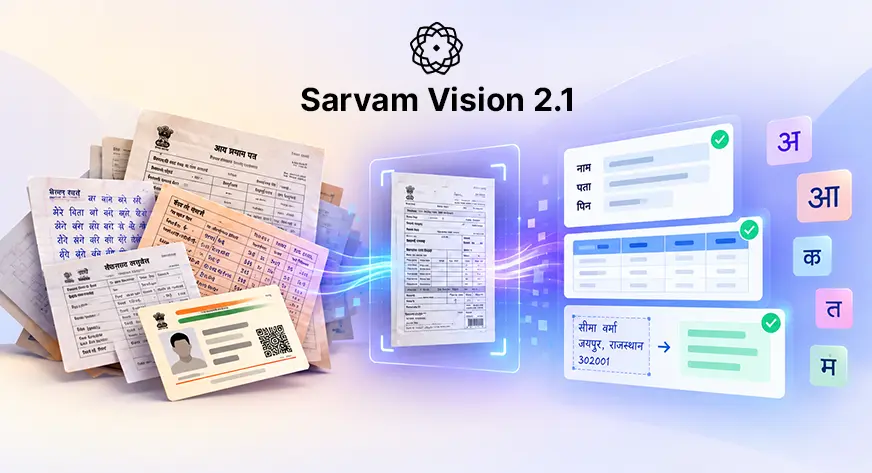
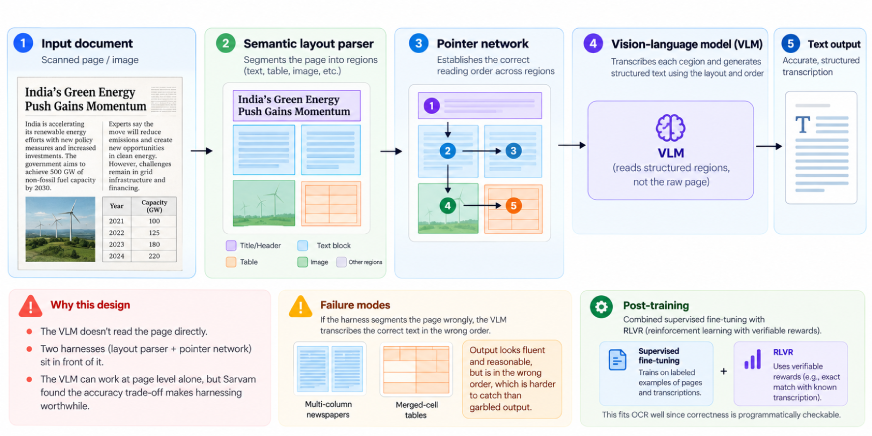
The breakthrough behind Sarvam Vision 2.1 lies in its architectural ability to handle complex layout comprehension alongside multi-script fluidity. Historically, developers relied on disparate systems: one to recognize the characters (OCR) and another to map the relationships between those characters on a page (layout parsing).
Sarvam Vision 2.1 integrates these processes, enabling it to perform high-level tasks that were previously impossible for a single model:
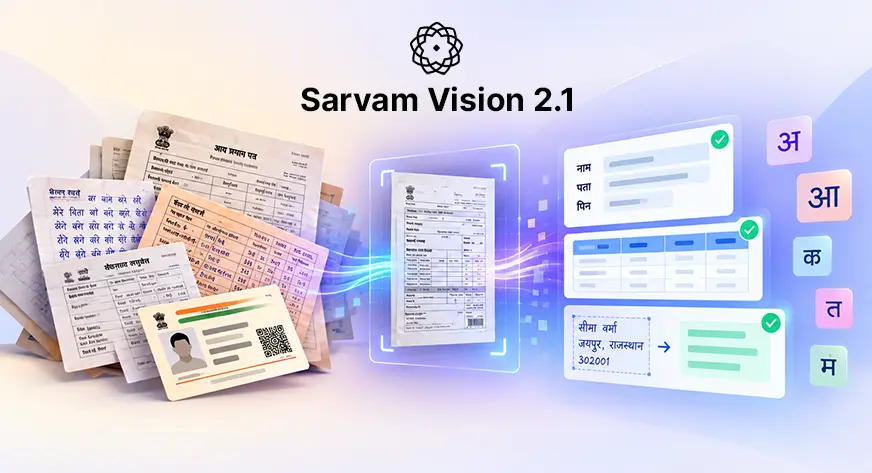
- Intelligent Field Extraction: Instead of simply transcribing a grid, the model extracts named fields directly from tables. This is vital for financial ledgers or bank statements where the value of a digit is entirely dependent on its relationship to row and column headers.
- Contextual Form Parsing: The model recognizes that in a form, a label and its corresponding value often reside in physically separate boxes. By inferring the logical pairing based on layout rather than linear reading order, the model achieves a level of human-like understanding.
- Advanced Indic Handwriting Extraction: Perhaps its most daunting challenge, the model has been trained on diverse video sources to capture the nuances of real-world Indian handwriting. This moves the needle from "block transcription" to "structured extraction," even for messy, handwritten scripts.
A Chronology of the Development
The path to Sarvam Vision 2.1 is not an overnight success story. It is the culmination of years of iterative development in the Indian AI ecosystem.
Phase 1: The Era of Specialization (2020–2023)
During this period, global models like Google Cloud Vision established dominance in Indic script recognition but struggled significantly with document architecture. Meanwhile, specialized layout models gained traction in the West for English-language parsing but remained blind to the morphological complexities of scripts like Devanagari, Bengali, or Tamil.
Phase 2: The Rise of Multimodal LLMs (2023–2025)
As Large Multimodal Models (LMMs) entered the scene, there was a brief hope that general-purpose intelligence would solve the OCR problem. While these models showed promise, they were computationally expensive and prone to "hallucinating" structure in tables. They were not designed for the rigid, high-accuracy requirements of corporate document processing.
Phase 3: The Sarvam Vision Milestone (2026)
With the launch of 2.1, Sarvam AI has shifted the focus from raw text generation to "Document Intelligence." By publishing their benchmarks openly on Hugging Face, they have signaled a transition toward transparency, challenging the "black-box" nature of proprietary OCR vendors.
Supporting Data: What the Benchmarks Reveal
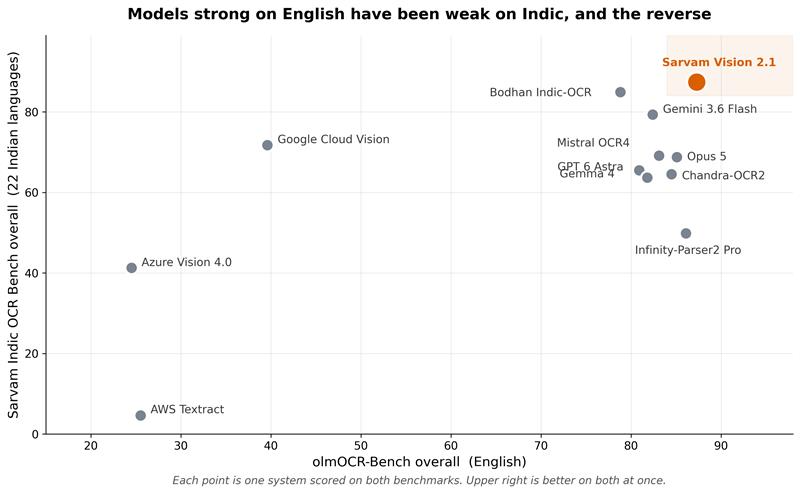
To understand where Sarvam Vision 2.1 sits in the competitive landscape, one must look at the performance data across multiple axes. In a market where most models excel at one task but fail at another, Sarvam’s position in the "upper-right" quadrant of performance—high accuracy on both English structure and Indic scripts—is unique.
The Indic Benchmark
Sarvam introduced a new benchmark comprising 6,909 samples spanning all 22 official Indian languages, plus English. The dataset is a time-capsule of sorts, featuring everything from contemporary brochures and newspapers to historical texts dating back to 1800.
Global Performance Metrics (olmOCR-Bench)
On the standard olmOCR-Bench (which measures facts across categories like math, tables, and multi-column layouts), the results are telling:
| Model | Math | Tables | Old Scan | Multi-Col | Overall |
|---|---|---|---|---|---|
| Sarvam Vision 2.1 | 90.5 | 91.9 | 55.3 | 82.1 | 87.3 |
| Infinity-Parser2 Pro | 87.4 | 88.9 | 58.0 | 83.3 | 86.1 |
| Opus 5 | 90.0 | 89.5 | 54.0 | 85.8 | 85.1 |
| GPT 6 Astra | 82.6 | 90.9 | 47.0 | 77.8 | 81.8 |
While Sarvam leads in overall score, the data reveals specific niches. For instance, Infinity-Parser2 Pro still holds a slight edge in handling "Old Scans," a notoriously difficult category for AI models. This highlights that while Sarvam is the new benchmark leader, the field remains highly competitive.
OmniDocBench v1.6: The Fidelity Test
When measuring structural fidelity—how well a model maintains the integrity of a document’s layout—the battle becomes even tighter. PaddleOCR-VL 1.6 maintains a narrow lead in table structure (0.931 vs. 0.890), but Sarvam dominates in text edit distance and formula recognition. This trade-off suggests that for users with hyper-complex tabular data, hybrid approaches may still be necessary, though the gap is closing rapidly.
Official Stance and Industry Implications
Sarvam AI’s decision to release its benchmarks to the public is a strategic move designed to build trust. By allowing third-party auditors and developers to run their own tests, they are inviting scrutiny that many of their competitors avoid.
For the industry, the implications are profound:
- Cost Optimization: Organizations can now consolidate their pipelines. Instead of paying for a specialized English parser and a separate Indic OCR engine, they can move to a single, unified workflow.
- Scalability: With the ability to process handwritten forms at scale, government and private sector bodies can digitize legacy paper records without the massive manual intervention previously required.
- Language Inclusion: By improving support for 22 Indian languages, the digital divide is narrowing. Tools that once ignored non-English speakers are now becoming accessible to the broader Indian populace.
Limitations and Future Outlook
Despite the fanfare, it is critical to address where the model struggles. Sarvam 2.1 is not a panacea.
- The Language Gap: The performance on Santhali (53.91%) and Kashmiri (54.82%) indicates that these languages remain "low-resource" for current AI models. While they outperform older systems, they are still far from the accuracy levels seen in Hindi or English.
- Historical Degradation: The 55.3 score on old scans is a reminder that the degradation of physical paper—fading ink, yellowing, and water damage—still poses a significant hurdle for modern neural networks.
How to Test the Model
For those looking to evaluate Sarvam Vision 2.1, the barrier to entry is low. The company has provided a "Document Intelligence" playground via their dashboard, which requires no coding knowledge.
For engineers building production pipelines, the API is split into two distinct, optimized endpoints:
/digitise: Designed for full-page conversion where the goal is to maintain the layout of the original document. This is ideal for archiving textbooks or long-form records./extract: A surgical tool for pulling key-value pairs and table data. This is the recommended route for processing invoices, tax filings, and insurance claims.
Conclusion
Sarvam Vision 2.1 is a watershed moment for Indian document intelligence. It successfully addresses the "bilingual" requirement of the modern Indian enterprise, proving that high-performance AI does not have to be tethered to English-only dominance. While specific regional languages and severely degraded historical documents remain areas for future growth, the model provides a robust, predictable, and highly accurate foundation for the next generation of digital infrastructure.
For organizations that have long awaited a tool that treats Indic scripts with the same structural intelligence as English, the wait is over. The challenge now shifts from whether these documents can be digitized, to how these organizations will leverage this new, structured data to drive their next chapter of growth.